

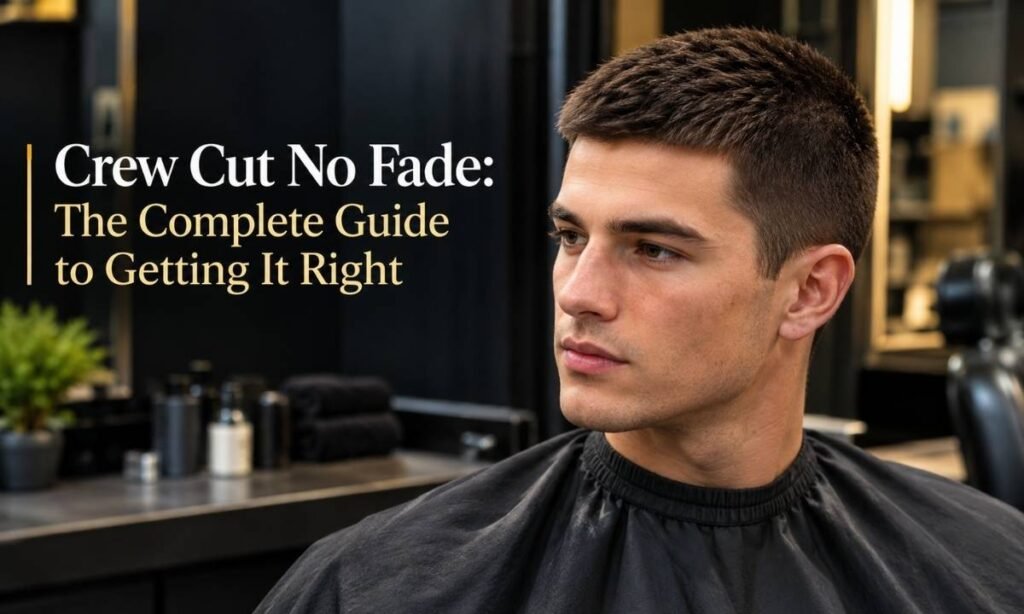
The crew cut no fade is one of the few haircuts that has never really gone out of style. It started as a military standard, moved into college locker rooms, and eventually settled into everyday life as the haircut men choose when they want something short, sharp, and easy to maintain without asking a barber to blend anything.
What sets it apart from most short men’s haircuts today is the word “no fade.” Everywhere you look, barbershops are pushing skin fades, tapers, and drop fades. The crew cut no fade goes the other direction. The sides are cut to a single clipper length, the top is left slightly longer, and there’s no gradual blend connecting the two. That single difference changes how the haircut looks, how often you need to get it touched up, and who it actually suits.
This guide covers what the cut is, how it differs from a faded crew cut, which guard lengths and face shapes work best, how to ask for it correctly, and how to keep it looking sharp between visits.
What Is a Crew Cut No Fade?
A crew cut no fade is a short haircut where the top is cut to a uniform length, usually somewhere between half an inch and an inch and a half, while the sides and back are clipped shorter using a single guard size with no blending between the two lengths.
Instead of the sides tapering smoothly into the top the way they do in a fade, there’s a visible but clean line where the shorter length ends and the longer top begins. Barbers sometimes call this a “one-length” or “block” cut on the sides, since the guard doesn’t change as it moves around the head.
The result is a haircut that reads as neat and structured rather than sculpted. It doesn’t chase a dramatic contrast between skin and hair. It just keeps everything short, even, and controlled.
Where the Style Comes From
The crew cut traces back to American college rowing teams in the late 1800s, who wore it short to keep hair out of their eyes on the water. The U.S. military adopted a version of it for practicality, and that association is part of why the cut still reads as disciplined and low-fuss today. The “no fade” version is closer to that original look than the more stylized crew cut variations barbershops offer now.
Crew Cut No Fade vs. Crew Cut With a Fade
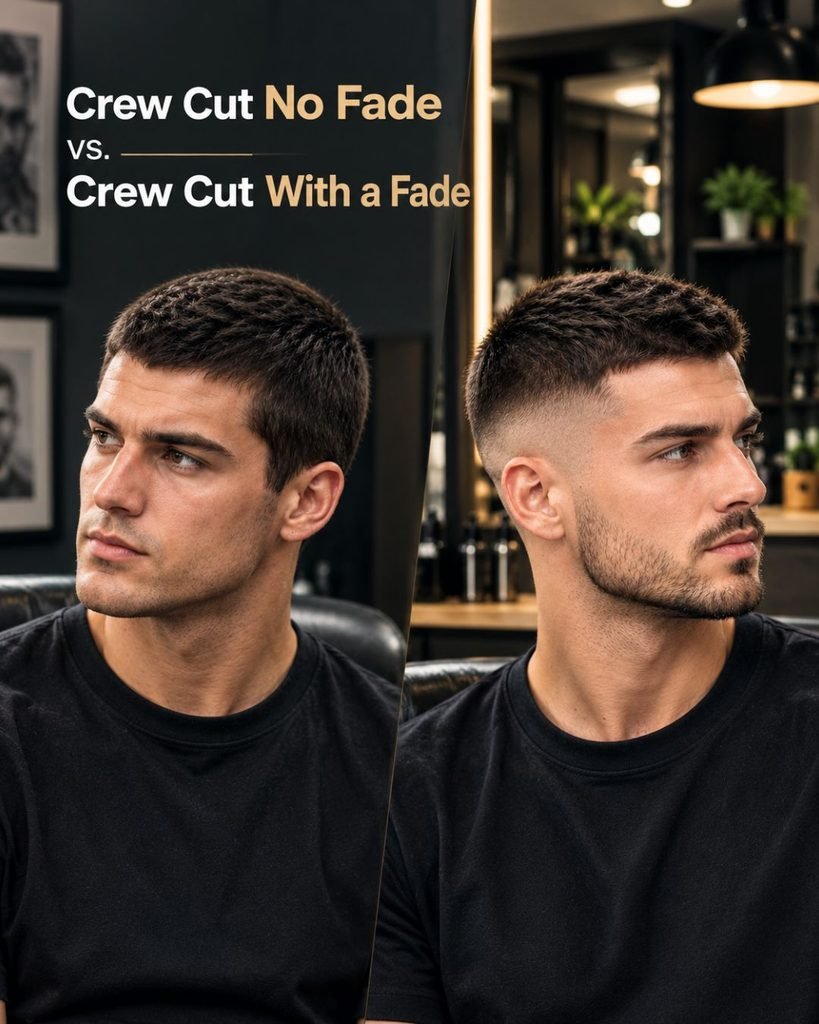
This is where most of the confusion happens, because “crew cut” only describes the top. It says nothing about what happens on the sides. A barber hears “crew cut” and still needs a second instruction for the sides, and that’s the part people usually get wrong when they book an appointment.
| Feature | Crew Cut No Fade | Crew Cut With Fade |
|---|---|---|
| Side finish | Single clipper length, no blend | Gradual blend from short to skin or near-skin |
| Visual contrast | Low, even all around | High, with a defined light-to-dark transition |
| Maintenance frequency | Every 4–6 weeks | Every 2–3 weeks to keep the fade line clean |
| Skill required to cut | Lower, easier for home cuts | Higher, best left to an experienced barber |
| Grow-out appearance | Even, doesn’t look patchy | Fade line grows out and needs a touch-up sooner |
| Best suited for | Low-maintenance, classic, professional settings | Fashion-forward, sharper aesthetic |
If you like the idea of a fade but don’t want to be back in the chair every two weeks, the no-fade version is worth trying first. It holds its shape for longer because there’s no delicate blend line to grow out unevenly.
Clipper Guard Lengths for a Crew Cut No Fade
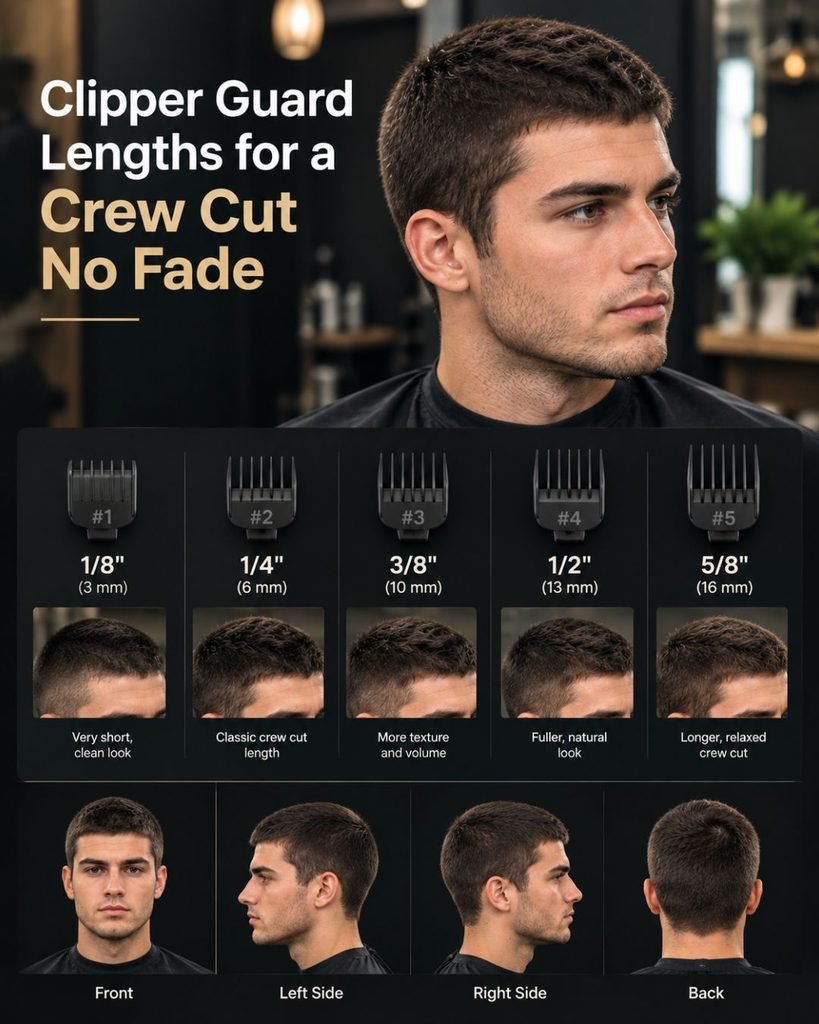
Guard numbers determine how much length stays on your head, and getting this part right before you sit in the chair makes the conversation with your barber much shorter.
- Top: A #4 to #7 guard is typical, leaving roughly ½ inch to ⅞ inch of hair. A #4 keeps things tighter and more military in feel. A #6 or #7 gives enough length to comb forward or add light texture with product.
- Sides and back: A #2 or #3 guard is the standard choice, leaving ¼ inch to ⅜ inch of hair. This keeps the sides noticeably shorter than the top without shaving down toward skin.
- No blending pass: Unlike a fade, the barber doesn’t run a middle guard or use the clipper’s taper lever to soften the line between the two lengths. The transition stays as a clean, visible step.
A common combination worth bringing up by name is “4 on top, 2 on the sides.” That single sentence tells a barber almost everything they need to know, and it removes the guesswork that leads to a haircut you didn’t ask for.
If your hair is thick or curly, going up to a #6 or #7 on top gives the length enough room to show texture instead of sitting flat. Fine or thin hair usually looks fuller with a slightly shorter top, since less length means less flattening under its own weight.
Who the Crew Cut No Fade Works Best For
Face Shape
A crew cut no fade doesn’t hide much, since there’s no length on the sides to soften the jawline or add width near the temples. That makes face shape more relevant here than it would be with a longer style.
- Oval faces can wear almost any top length and guard combination without issue, since the proportions are already balanced.
- Square faces tend to look best with slightly more length on top, which softens the strong jawline instead of matching its sharp angles.
- Round faces benefit from keeping the sides tight and the top a bit higher rather than flat, which adds visual height and avoids widening the face further.
- Long or rectangular faces usually do better with a slightly longer top left with a bit of volume, since a very short, flat cut can emphasize length.
Hair Type
Straight hair holds the crew cut no fade cleanly, since it lies flat and shows the line between lengths clearly. Wavy and curly hair can also wear it well, though the top will read as more textured and less uniform than on straight hair, which some men prefer for a slightly less rigid look. Very thin hair benefits from a shorter top length, since long thin hair can look sparse rather than styled.
Lifestyle
This cut suits people who want a haircut that survives a gym session, a swim, or a full workday without needing a comb-through. It’s a strong choice for:
- Students and academics who want something neat without looking overly styled
- Office workers in conservative or business-casual environments
- Athletes who need hair that doesn’t interfere with helmets, caps, or sweat
- Anyone who wants to cut their barbershop visits down to once a month or so
How to Ask Your Barber for a Crew Cut No Fade
Walking in and saying “crew cut” leaves too much room for interpretation. Barbers default to what’s trending, and right now that’s usually a fade. Be specific about both parts of the cut.
- Name the guard length for the top (for example, “a 6 on top”).
- Name the guard length for the sides and back separately (for example, “a 2 on the sides and back”).
- Say clearly that you don’t want the sides blended or faded — ask for “one length on the sides, no taper, no fade.”
- Bring a photo if you have one. It removes any ambiguity about how much contrast you want between the top and sides.
- Ask about the neckline. A squared-off neckline reads more classic; a rounded one looks slightly softer.
Being this specific isn’t overkill. Many barbers are trained to soften transitions by habit, so without a clear instruction, you may end up with a light taper instead of the clean line you actually wanted.
Maintaining a Crew Cut No Fade
One of the main reasons people choose this cut over a fade is how well it grows out. Because there’s no delicate blend to maintain, you get more time between visits before the haircut starts looking unkempt.
- Trim frequency: Every 4 to 6 weeks is standard. Men with faster-growing hair may prefer closer to the 4-week mark to keep the line between top and sides sharp.
- Washing: Wash 2 to 4 times a week with a mild shampoo. Short hair doesn’t need daily washing, and over-washing can dry out the scalp.
- Styling: A small amount of matte clay, paste, or pomade worked through damp hair gives the top texture without looking greasy. For a more polished, military-style look, skip product entirely and let the natural short length hold its shape.
- At-home touch-ups: Because the guard lengths are simple and there’s no blending required, this is one of the easier cuts to maintain yourself between barber visits with a basic clipper set. Focus on the sides and back, and leave the top length to your barber unless you’re confident with scissors.
- Neckline and sideburns: These grow out fastest and are the first sign a cut needs a refresh. A quick trimmer touch-up around the neckline and sideburns can stretch the time between full cuts by a week or two.
Common Mistakes to Avoid
- Not specifying the side length separately from the top. “Crew cut” alone tells a barber almost nothing about the sides.
- Letting the sides grow out too long between trims. Once the side length starts closing the gap with the top, the defined line that makes this cut look sharp disappears.
- Using too much product on short hair. A little goes further than most people expect; too much on a short top looks wet and heavy rather than textured.
- Assuming it looks the same on every hair type. What looks clean and structured on straight hair can look flatter or bulkier on thick or curly hair, so it’s worth discussing your specific hair type with your barber before committing to a guard length.
Crew Cut No Fade vs. Buzz Cut
These two get confused often enough that it’s worth a direct comparison. A buzz cut uses one guard length across the entire head, including the top, so there’s no length difference anywhere. A crew cut no fade keeps that same evenness on the sides but leaves the top noticeably longer, giving you something to style. If you want zero maintenance and don’t care about styling options, a buzz cut is simpler. If you want a bit of length on top to comb or add texture to, the crew cut no fade is the better fit.
Frequently Asked Questions
What guard number is a crew cut no fade?
A common combination is a #4 to #7 guard on top and a #2 or #3 guard on the sides and back, with no blending between the two.
Is a crew cut no fade high maintenance?
No. It typically only needs a trim every 4 to 6 weeks, since there’s no fade line to maintain as it grows out.
Can I style a crew cut no fade?
Yes. A small amount of matte clay or paste worked into the top while damp adds texture without looking greasy.
Does a crew cut no fade suit round faces?
It can, especially if the top is kept slightly longer with some height rather than cut flat, which helps avoid widening the face further.
What’s the difference between a crew cut and a crew cut no fade?
“Crew cut” only describes the top length. “No fade” specifies that the sides are cut to a single length with no gradual blend, as opposed to tapering or fading down toward the skin.
Can I cut a crew cut no fade myself at home?
The sides are simple enough for most people to manage with a single clipper guard. The top is easier to get wrong with scissors, so many men still have a barber handle that part while doing side touch-ups themselves.
Final Thoughts
The crew cut no fade earns its staying power by doing less, not more. There’s no blend to get wrong, no fade line to maintain, and no risk of it looking outdated in a year because it was never chasing a trend to begin with. If your priority is a haircut that looks intentional every single day with minimal upkeep, this is one of the more reliable choices you can walk into a barbershop and ask for — as long as you’re specific about what “no fade” actually means when you say it.
