

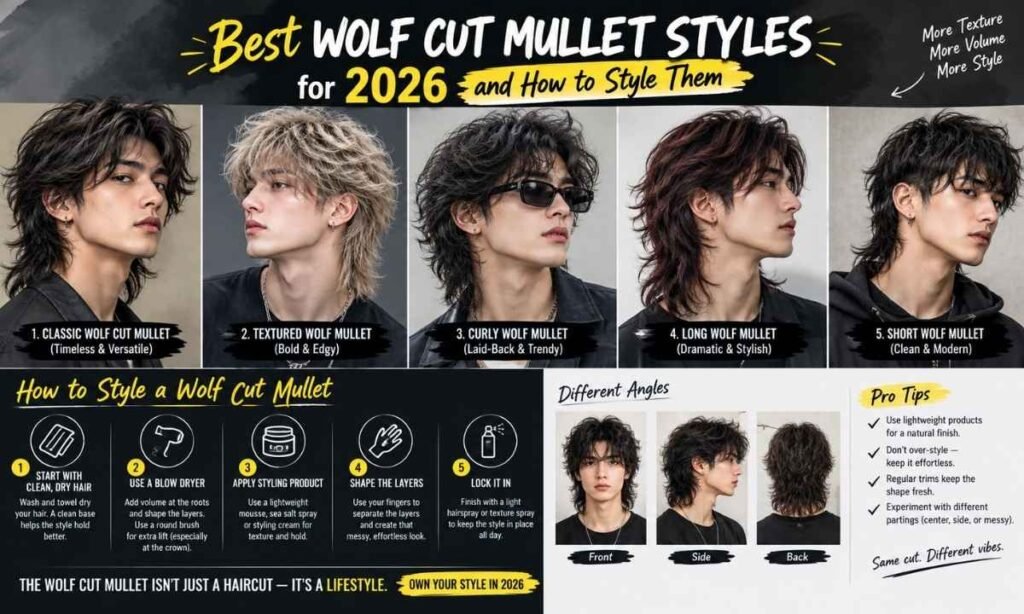
A wolf cut mullet is a heavily layered haircut with short, textured layers on top and around the face, and a longer, feathered tail at the back. It blends the volume of a shag with the shape of a mullet, so it looks messy on purpose.
This guide covers the main versions: textured, curly, straight, layered and Korean. You will also find advice on matching a version to your hair type, what to tell your stylist, and a simple styling routine you can repeat at home.
What Is a Wolf Cut Mullet?
The wolf cut grew out of two older styles, the 1970s shag and the mullet. Layers are cut short at the crown to build volume, then blend into longer, wispy lengths through the back. The wolf cut mullet keeps that structure but pushes the nape longer, so the mullet shape is easier to spot.
A classic mullet is defined by contrast, with short sides and a much longer back. A wolf cut is defined by layering and texture all over. The wolf cut mullet sits between them, with the shaggy top of a wolf cut and a visible tail at the back.
| Cut | Main feature | Overall feel |
|---|---|---|
| Classic mullet | Short front and sides, long back | Retro, high contrast |
| Wolf cut | Heavy layers, shag-like shape | Soft, tousled |
| Wolf cut mullet | Wolf layers with a longer, defined nape | Edgy, textured, modern |
| Shag | Layers throughout, less length contrast | Relaxed, 1970s |
These names overlap online, and stylists do not all use them the same way. One salon may call a soft, shoulder-length layered cut a wolf cut, while another calls it a shaggy mullet. Bring photos instead of relying on the label. A picture shows exactly how short the crown and how long the tail should be.
Is the Wolf Cut Mullet Still in Style in 2026?
Yes, though it has changed. Recent 2026 guides from salons and hair publications still feature it heavily, but the mood has moved from very choppy, high-contrast versions toward softer, blended ones. Trend claims like this are editorial observations, not measured data, so treat them as a general direction.
The cut also has some history behind it. The wolf cut gained mainstream attention around 2021 and 2022, helped by social media and celebrities such as Billie Eilish, and the mullet itself returned around 2020. Several years of steady salon interest suggests it is more than one viral moment.
Textured Wolf Mullet
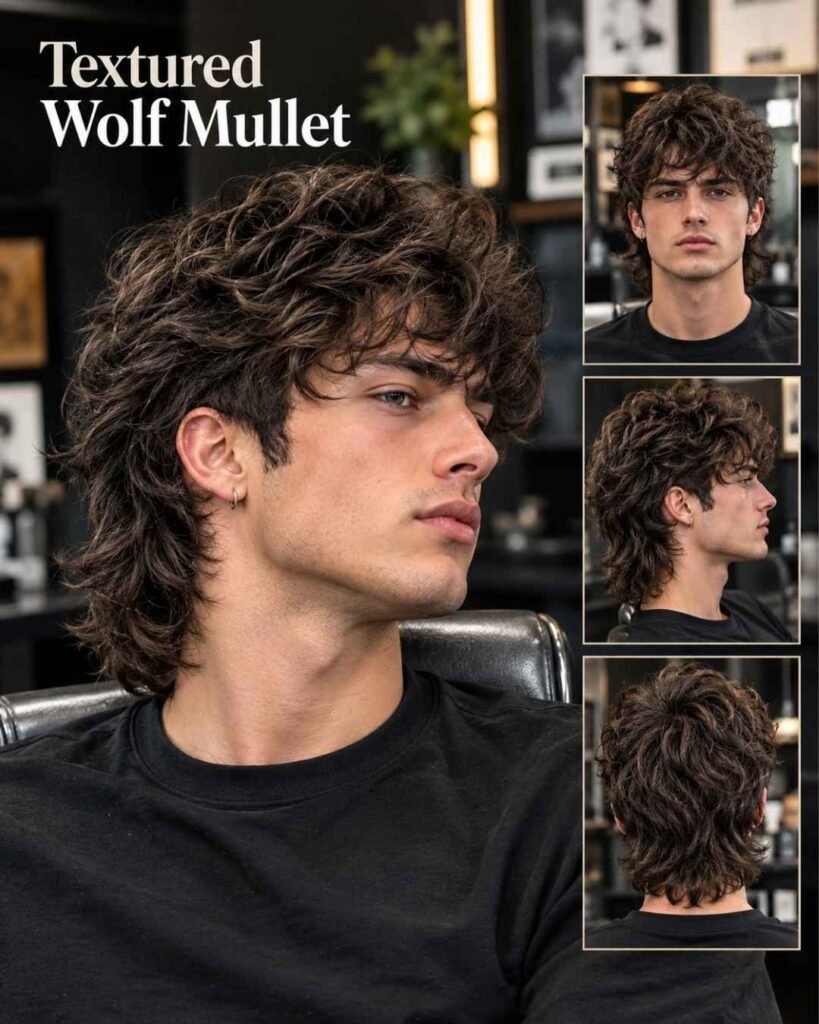
The textured wolf mullet is the version closest to the original look. Layers are disconnected on purpose, so the crown sits noticeably shorter than the length beneath it. Stylists often use point cutting or a razor to leave the ends broken and uneven instead of clean.
It works best on wavy hair, where natural bend gives the layers something to grab. On fine hair, ask for soft blended layers, since very short crown pieces can make hair look thinner. On thick hair, ask the stylist to remove weight inside the cut so it does not puff outward.
To style it, apply sea salt spray or a lightweight mousse to damp hair, then rough dry with your fingers. Finish with a small amount of matte paste or clay on the ends only. Keep product away from the roots if the crown starts to look flat.
Ask your stylist for:
- Choppy, point-cut ends
- A crown that is visibly shorter than the mid-lengths
- Weight removed inside the cut if your hair is thick
- A tail that ends unevenly, not blunt
Curly Wolf Mullet
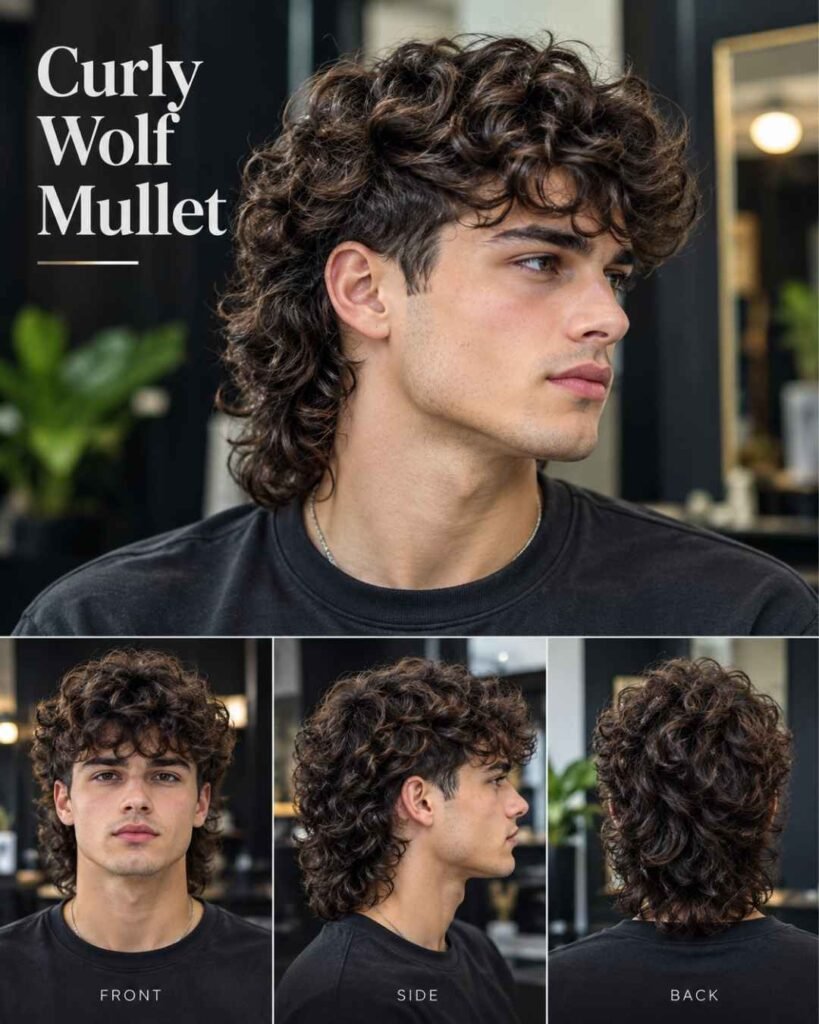
Curly hair and the wolf cut share a goal, which is volume with movement. The layers stack on natural curls, so the crown lifts without much effort. The catch is shrinkage. Curls spring up as they dry, so a cut that looks right when wet can end up much shorter.
Many curl-focused stylists cut dry for this reason. One stylist described starting with the back length, adding slightly disconnected crown layers next, shaping the face after that, and saving the fringe for last. If your stylist prefers wet cutting, ask how they plan to account for shrinkage.
For styling, apply curl cream or leave-in to soaking wet hair, working from the roots through the back tail. Scrunch upward, then diffuse on low heat or air-dry. Avoid touching the curls until they are fully dry, then loosen them gently with your fingers.
Some stylists say the cut is trickier on coarse, dense or very tightly coiled hair. That is a reason to choose a stylist who regularly cuts your texture, not a reason to skip the style. On day two, a water-based refresh spray and a satin pillowcase help protect the shape.
Straight Wolf Mullet
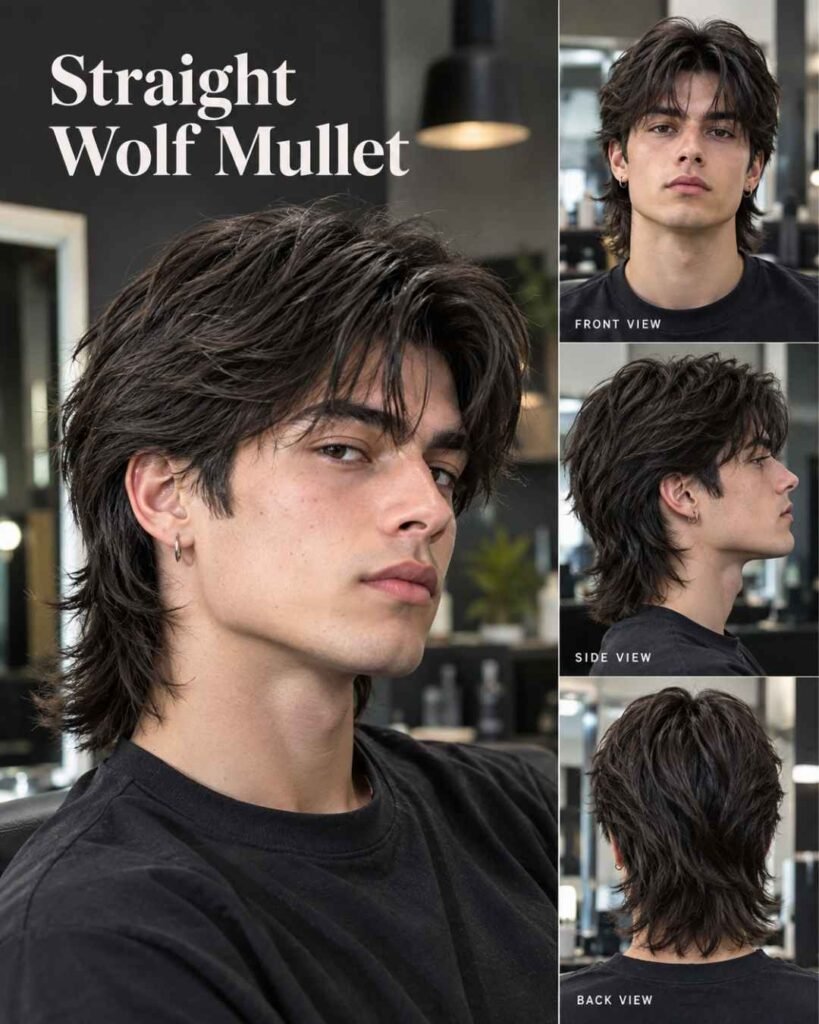
Straight hair can wear a wolf mullet, but it asks for a little more effort. Layers show clearly on straight strands, which some people love, yet the cut can fall flat without texture. Some stylists warn that very straight hair often needs a heat tool to add bend.
Thick straight hair is the easiest case, since the density holds choppy edges well. Fine straight hair is trickier, so ask for fewer, longer layers and only a modest crown. Either way, plan to use a texturizing spray or a loose curl with an iron.
Ways to style straight hair:
- Leave it sleek and rub a little texture cream through the ends
- Curl random sections loosely, alternating direction for a natural look
- Air-dry with sea salt spray to encourage some bend
- Blow-dry the crown upward with a round brush for lift
Layered Wolf Mullet
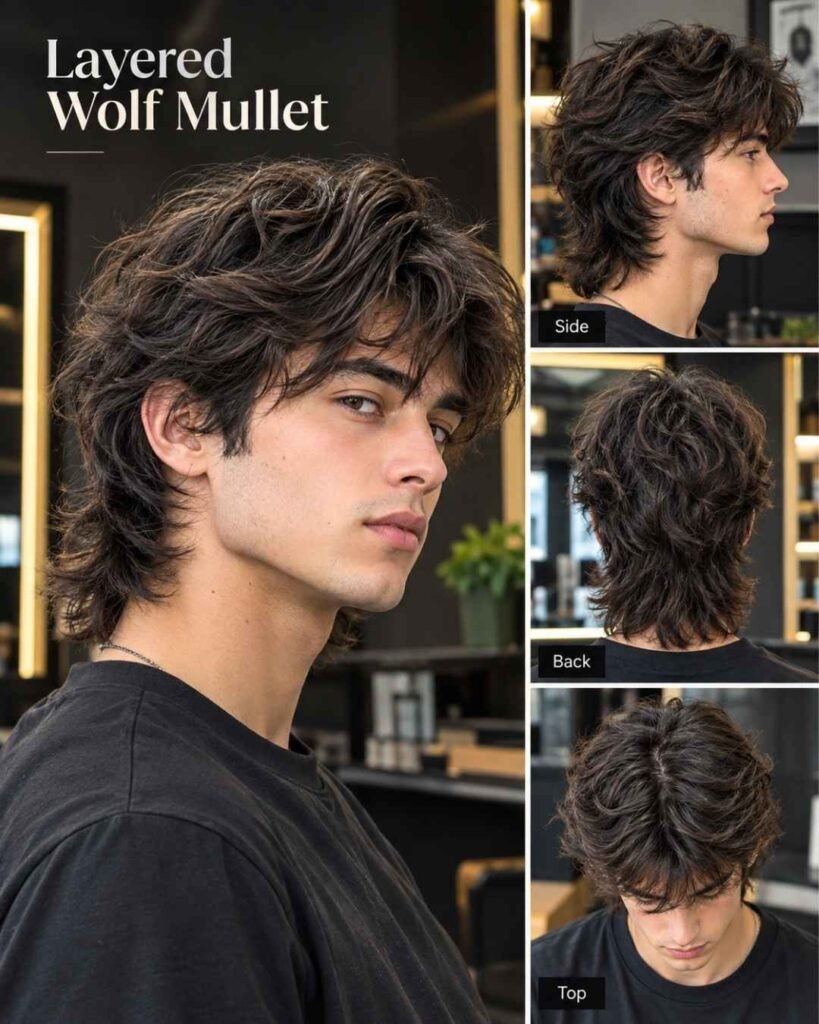
A layered wolf mullet keeps the shape but blends the steps between short and long. Instead of a sharp jump at the crown, the layers descend gradually, so the cut reads as a shag with a longer back. It is a good starting point if a full wolf mullet feels like too much.
Length matters here. Medium hair gives the layers room to show, while very short hair leaves little to blend. Long hair allows the most dramatic version, though the tail can look heavy unless the stylist removes bulk. Ask where the shortest layer will land, because that one detail changes the whole silhouette.
| Hair length | What to expect | Watch for |
|---|---|---|
| Chin to shoulder | Tight, playful crown, shorter tail | Little room to blend |
| Shoulder to collarbone | Clearest layers, easiest to style | Needs regular trims |
| Below the shoulders | Strongest contrast with the tail | Can look heavy |
Korean Wolf Mullet
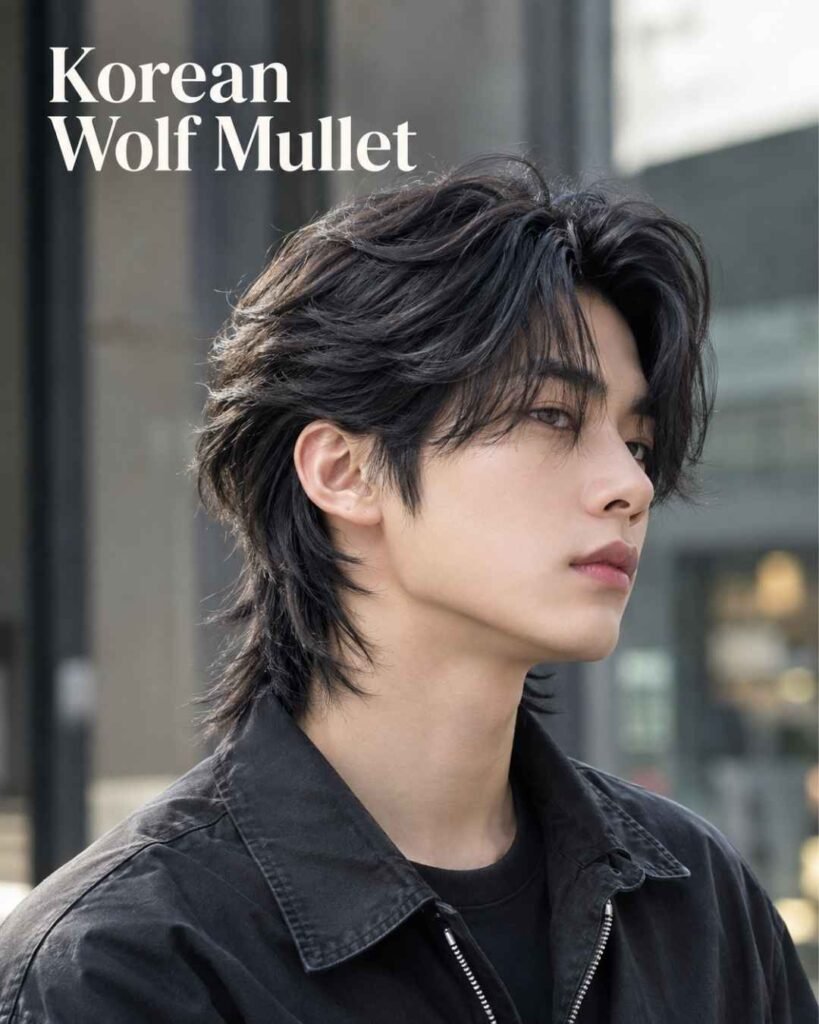
The Korean wolf cut is a softer, more controlled cousin. Stylists describe it as having cleaner ends, a shorter tail than a traditional mullet, and longer, wispy fringe that parts in the center and sweeps past the cheekbones. The layers are placed to flatter the face instead of looking raw.
It suits straight to slightly wavy hair, which helps explain its link to K-pop and K-drama styling. Much of the technique involves razor texturing and slide cutting to remove bulk. Because the crown is less dramatic, salon guides often call it a more office-friendly option.
Descriptions vary by salon, so treat “Korean wolf cut” as a style direction, not a strict technical category. If you want it, show photos and ask for a soft crown and see-through bangs. Style it with a medium-hold wax or cream on dry hair and a quick round-brush blow-dry.
Which Wolf Cut Mullet Fits Your Hair Type?
Hair texture usually decides the outcome more than face shape does. Use this table as a starting point for your consultation, not a strict rule.
| Hair type | Best fit | Key request |
|---|---|---|
| Fine, straight | Layered or Korean | Soft blended layers, modest crown |
| Fine, wavy | Light textured | Longer layers, no very short crown |
| Thick, straight | Textured or Korean | Weight removed inside the cut |
| Wavy | Textured or layered | Mid-length layers, minimal styling |
| Curly or coily | Curly wolf | Dry cut, extra length for shrinkage |
Does Face Shape Matter?
Face shape is a starting point, and the fringe changes the balance more than anything else. Stylists say the cut can be adjusted to suit different faces. The suggestions below are general styling logic, not tested rules, so let your stylist adapt them.
| Face shape | Fringe idea | Layer note |
|---|---|---|
| Oval | Almost any fringe | Most versions work |
| Round | Side-swept or curtain | Keep width at the sides modest |
| Long | Fuller fringe | Add side volume, not extra height |
| Square | Soft, wispy fringe | Blend layers around the jaw |
How to Ask Your Stylist for a Wolf Cut Mullet
A good consultation prevents most regrets. Bring two or three photos of hair with a texture similar to yours, because a photo on different hair can mislead. Say what you dislike as well as what you want, since that often clarifies more than the photos.
Settle these points before the scissors come out:
- How short the crown layers will be.
- How long the nape will be, and how sharp the change in length is.
- Whether a fringe is included, and which kind.
- Whether the cut will be done wet or dry, especially for curls.
- How the cut will look after a month and how it will grow.
- Which products the stylist would use on your hair.
Also ask how the cut behaves when tied up. Shorter layers can make ponytails and buns difficult, so headbands, clips and hats often become useful. Knowing this before the cut avoids surprises later.
How to Style a Wolf Cut Mullet Easily
The cut does much of the work, so the routine can stay short. The main goal is to build volume at the crown and keep the tail from going flat. Heavy conditioner near the roots is a common reason layers collapse.
Step-by-step routine:
- Wash smart. Use a volumizing shampoo and apply conditioner from mid-length to ends only. Roots stay light so the crown can lift.
- Towel dry gently. Remove excess water until hair is damp, not dripping. Curly hair is the exception and works best when it is still very wet.
- Add product. Use a texturizing spray for fine hair, mousse or cream for thicker hair, and curl cream for curls. Scrunch it through.
- Dry for shape. Air-dry, diffuse, or rough dry. For extra lift, flip your head upside down and dry the roots on medium heat.
- Style the fringe last. Use a round brush to shape it, then pinch small pieces with a tiny amount of cream so they separate.
- Finish the ends. A little matte paste or light oil on the tail adds definition. Add light hairspray at the crown only if it needs help.
| Hair type | On damp hair | To finish |
|---|---|---|
| Fine | Sea salt or texturizing spray | Light texture spray at the crown |
| Thick | Light cream | Matte paste on the ends |
| Wavy | Mousse or salt spray | Small amount of serum on the tail |
| Curly | Curl cream, then gel | Light oil on the tail ends |
Wolf Cut Mullet for Men
Men’s versions follow the same idea, with more variety at the sides. Some keep shaggy sides, while others add a fade or undercut for contrast with the long back. Crown layers and a clear nape length remain the signature.
Wavy and curly hair suits it well, and the same dry-cutting advice applies to curls. Matte clay or sea salt spray gives texture, and a light serum on the tail keeps a contrast between top and back. Korean barbershops often use a shorter back and tighter layers for a subtler result.
Maintenance, Trims and Growing It Out
Most stylists and hair brands recommend trimming every 6 to 8 weeks to keep the layers looking intentional. Curly cuts may stretch longer between shape-ups, but the right timing depends on how fast your hair grows. Ask your stylist for a personal schedule.
Growing it out is the honest downside. Because layers are cut at different lengths, they do not even out neatly. One celebrity stylist told Fox News the fix is often a long pixie or a shortened back that grows into a bob. Another stylist recommends keeping up with face-framing trims.
Cost varies by city, salon and stylist level, and curl specialists may charge more. Ask for a price before you book, and check whether a fringe trim is included. Any price range you see published online is a rough estimate, so treat it that way.
Common Mistakes to Avoid
- Cutting the crown too short on fine hair, which can make it look sparse
- Skipping photos and relying on a label like “wolf cut” alone
- Putting heavy conditioner or oil near the roots
- Cutting curls wet without planning for shrinkage
- Trying the cut at home, since uneven layers are hard to fix
Frequently Asked Questions
What is a wolf cut mullet?
It is a layered haircut that combines a shag’s volume with a mullet’s longer back. Short, choppy layers sit on top, and a longer tail runs down the nape.
Is a wolf cut the same as a mullet?
No. A mullet has short sides and a long back, while a wolf cut uses heavy layers all over. The wolf cut mullet blends both.
Does a wolf cut mullet work on fine hair?
Yes, with softer, blended layers. Avoid very short crown layers, which can make fine hair look thinner.
Can I get a wolf cut mullet with straight hair?
Yes. Expect to add texture with spray or a loose curl, because straight hair can look flat without it.
Should curly hair be cut dry for a wolf cut?
Many curl specialists prefer it, because dry cutting shows the true curl pattern and accounts for shrinkage.
How often should I trim a wolf cut mullet?
Every 6 to 8 weeks is a common recommendation. Your stylist can adjust that for your texture and growth rate.
Can I tie my hair up with a wolf cut mullet?
Only partly. Shorter layers slip out of ponytails and buns, so clips and headbands often work better.
Is a wolf cut mullet hard to grow out?
It can be. The layers grow unevenly, so many people trim toward a bob or a longer layered shape.
What is the difference between a Korean wolf cut and a regular wolf cut?
The Korean version is usually softer, with cleaner ends, see-through bangs and a less dramatic tail.
Conclusion
The wolf cut mullet works best when the version matches your hair. Textured suits wavy hair, curly needs a dry cut, straight needs some added bend, layered gives a gentler shape, and the Korean style is the most polished option.
Bring photos, ask about crown height and nape length, and plan on regular trims. With a good cut, daily styling usually takes only a few minutes.
