

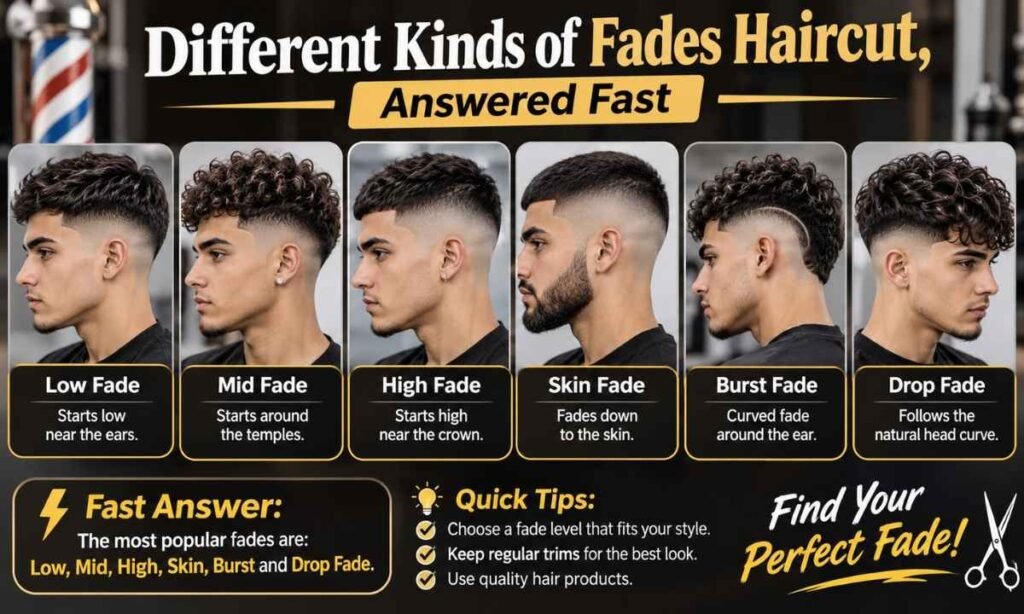
A fade is a haircut in which the hair on the sides and back gets steadily shorter as it moves down the head, finishing at fine stubble or bare skin. Change where the blend starts or how short it finishes and you get a different name.
Here are the main kinds of fade haircuts for men, in one list:
- Low fade: the blend starts just above the ear.
- Mid fade: the blend starts around the temple.
- High fade: the blend starts high on the sides of the head.
- Skin (bald) fade: the hair finishes at bare skin.
- Taper fade: the hair finishes short but visible, mostly near the ears and neck.
- Drop fade: the fade line arcs down behind the ear.
- Burst fade: the blend curves in a half circle around the ear.
- Temple (Brooklyn) fade: the fade is concentrated at the temples and sideburns.
- Razor fade: a razor finishes the bottom for the smoothest move into skin.
- Hi-top fade: short faded sides under a tall, flat top.
Most bad fades are not a skill problem. They happen because “fade” means different things to different people. The sections below explain what each name tells your barber, how each one grows out, and the exact sentence to say in the chair.
Fade vs taper, the distinction behind most bad haircuts
A taper keeps hair visible at its shortest point. A fade keeps going until the hair disappears into skin, or very close to it. That one difference explains most of the confusion at the chair.
A taper shortens the hair gradually and mostly at the edges: around the ears, the sideburns and the back of the neck. The sides stay fairly full, and the change in length is gentle. A fade covers more ground. The hair gets noticeably shorter across a larger area, and the contrast with the top is sharper.
In practice the two differ in four ways:
- Shortest length: a taper usually stops at short but visible hair, often around a #1 or #2 guard. A fade often reaches skin.
- Area covered: a taper hugs the hairline. A fade runs up the sides and around the back.
- Contrast: a taper is subtle. A fade is a clear visual step.
- Upkeep: a fade shows regrowth sooner, so it needs more visits.
The technique differs too. A taper is usually built with clippers or scissors over a comb, working slowly through lengths so the hair stays soft. A fade steps through very short lengths with guards or an adjustable blade, then blends the steps until no line shows. Blending is the whole skill. A fade with visible steps, often called tracks, is the most common complaint, and it is a blending problem, not a flaw in the design you picked.
The trouble starts with the phrase “taper fade.” Some barbers hear a taper. Others hear a fade with a softer finish. Neither is wrong, and that is exactly why the same request gives different results in different shops.
A good barber will ask you one clarifying question. Answer it before you sit down: do you want to see skin at the bottom, or not? Your answer sorts you into one camp or the other, and most of the vocabulary below builds on it.
Every fade name is built from five variables
Fade names look like a long menu, but each one is a combination of five settings. Learn the settings and you can decode any name, including ones you have never heard.
| Variable | Options | What it changes |
|---|---|---|
| Start height | Low, mid, high | How much of the side stays short |
| Shortest length | Skin, shadow, short stubble | How bare the bottom looks |
| Line shape | Straight, dropped, curved | How the fade sits around the ear |
| Area covered | Full sides, temples only, back included | Where the blend appears |
| Finishing tool | Clippers, foil shaver, razor | How crisp the bottom edge is |
Take “low skin drop fade.” Low is the start height. Skin is the shortest length. Drop is the line shape. The area and finishing tool were not named, so the barber chooses them or asks you.
This is also where requests go wrong. Saying “a fade” names none of the five variables, so the barber fills in all of them from habit. Naming even two, say start height and shortest length, removes most of the guesswork.
One more point worth knowing: the five variables are independent. You can pair a high start with a shadow finish, or a low start with a razor-smooth skin bottom. The names below are just popular combinations.
Low fade
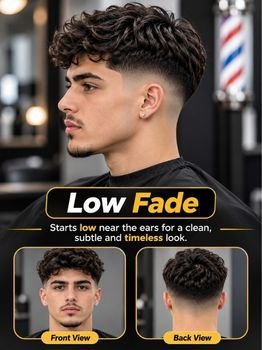
A low fade starts just above the ear and follows the natural hairline around to the nape. Only a small band of the side is faded, so most of the length stays where it was.
This is the gentlest fade, and the usual first one for anyone who has never had one. It looks tidy in an office, it suits a conservative workplace, and it keeps the sides looking like hair rather than a statement.
- Best with: crew cuts, side parts, textured crops, and longer tops you are growing out.
- Face shapes: round and oval faces tend to like it, because it does not add height or width.
- Skin or shadow: both work. A low skin fade is sharper, a low shadow fade is softer.
- Upkeep: roughly every three to four weeks. The fade line is short, so a little regrowth does not show much.
One limit to know: a low fade is a small change. If you want your head to look cleaner and more defined from the front, the effect may be too quiet for you. In that case look at the mid fade next.
Mid fade
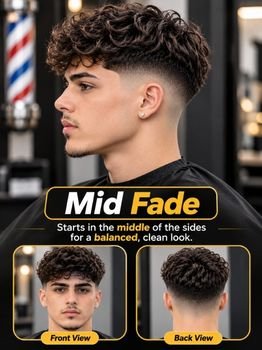
A mid fade starts around the temple, roughly halfway between the ear and the top of the head. It is the most requested fade for a reason: it shows clearly without looking severe.
Because the blend begins higher than a low fade, more of the side is short. That gives you a visible shape, and it gives the top more room to look intentional. A quiff, a pompadour, a slick-back or a messy textured top all sit well on it.
- Best with: medium-length tops that need some contrast underneath.
- Face shapes: most of them. It is the safest pick if you cannot decide between low and high.
- Skin or shadow: your choice. Mid skin fades are popular, but a mid shadow fade is easier for sensitive skin.
- Upkeep: every two to three weeks if you want the line crisp.
If you are unsure, ask for a mid fade and say how short you want it to finish. That second detail matters more than the height. A mid fade that ends at skin and a mid fade that ends at a #1 guard look like two different haircuts.
High fade
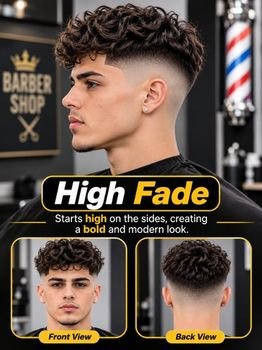
A high fade starts well above the temple, close to where the head begins to curve toward the crown. Most of the side is short, and the longer hair on top sits like a separate block.
The effect is height and contrast. A high fade makes the top look taller and the sides look cleaner, which is why it works so well with a tall textured top, a pompadour, twists or an afro. Barbers also like it for designs and part lines, since it leaves a lot of faded surface to work with.
- Best with: thick or voluminous tops that need a strong outline.
- Face shapes: round and square faces handle it well. On a long face, it can stretch the look further, so keep the top shorter.
- Comfort: it is a cool cut in summer, because very little hair sits over the ears.
- Upkeep: every one to two weeks. The line is high and obvious, and regrowth shows fast.
A high fade is a commitment. If you wear it with a hat often, or you dislike a stark change between sides and top, a mid fade is the more forgiving version.
Skin fade, bald fade, and shadow
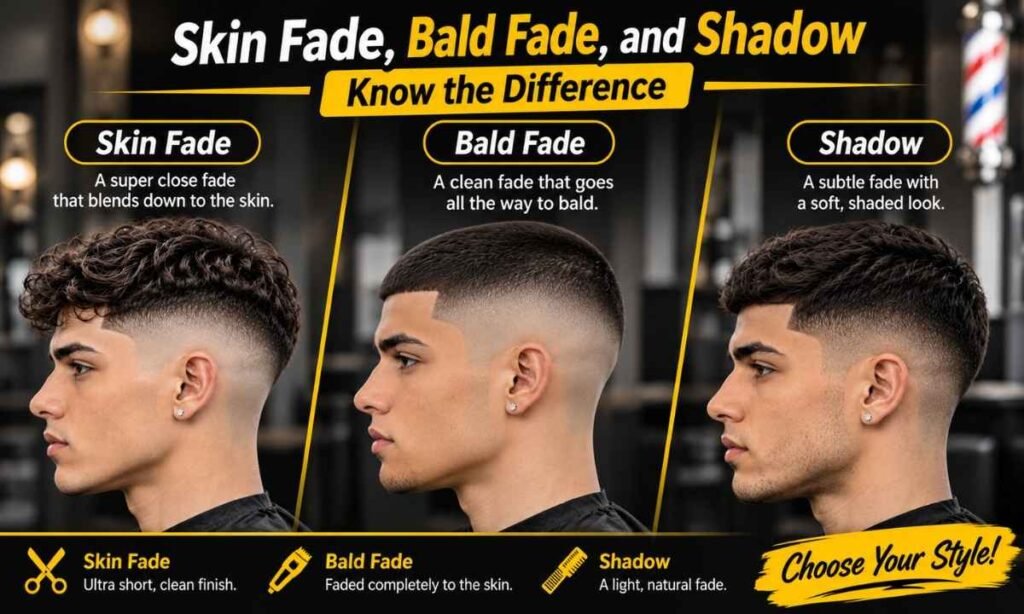
A skin fade, also called a bald fade, takes the hair at the bottom down to bare skin. A shadow fade stops just short of that and leaves a faint haze of stubble. Both can start low, mid or high, so “skin” and “shadow” describe the finish, not the height.
The skin version is the sharpest. The barber works the clippers with the blade lever open, then often finishes with a foil shaver or razor so the bottom edge reads as clean skin. The result is high contrast and a very polished outline.
The shadow version is softer. It reads as a darker tone rather than a visible line, which makes it friendlier to beards, because the stubble can match the cheek hair. It also forgives a missed week better than skin does.
Things to weigh before choosing skin:
- Bare scalp at the sides takes sun. Use sunscreen on it in summer.
- Regrowth appears within days, so the edge softens fast.
- Skin that reacts to close shaving may get red or bumpy. A shadow finish is the lower-risk option.
If you cannot decide, ask for the shadow finish first. You can always take it shorter next visit, and you cannot add length back.
Taper fade
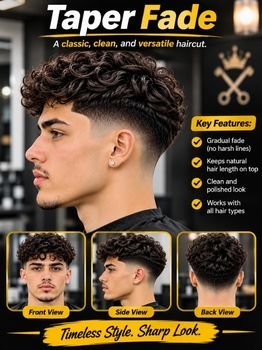
“Taper fade” is the most debated name in barbering, so start with what you will most likely get. Ask for a taper fade and many barbers will give you short, visible hair at the sideburns and neckline that blends upward into the sides. The shortest point is a close clipper length rather than bare skin.
Others treat the term as a fade with a soft finish. A few use it for a taper that happens to be a bit more cleaned up. This inconsistency is the reason to attach height and finish to it. “Low taper fade, ending at a #1” is a clear request. “Taper fade” alone is a guess.
- Where it sits: mostly sideburns, around the ear and the nape, with the sides left fuller than in a true fade.
- Best with: classic styles, side parts, business settings, and hair that is growing out and needs a neat edge.
- Hair types: works with straight, wavy and curly hair. On very curly hair, a taper keeps the shape softer than a hard skin fade.
- Upkeep: three to four weeks is usually enough. A taper tolerates delay better than almost any other cut here.
The low taper fade is the quiet workhorse of this family. It cleans the perimeter without making a visible statement, which is why it is so common among people who want to look tidy and not think about it.
Drop fade
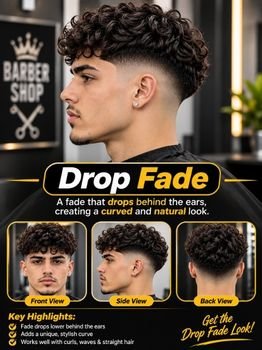
A drop fade changes the shape of the fade line. Instead of running straight across the back of the head, the line arcs behind the ear and dips lower toward the nape. The name comes from that drop.
What this does is follow the skull. A straight fade line cuts across the head like a belt. A drop fade follows the curve of the bone behind the ear, which gives the back of the head a rounder, more sculpted look. It is more noticeable from the side and the back than from the front.
The height is separate. A drop fade can be low, mid or high, and it can end in skin, shadow or short hair.
- Best with: curls, waves, textured tops and longer hair left to grow at the back.
- Good to know: it needs a steadier hand than a straight fade, since the curve must stay even on both sides.
- Upkeep: two to three weeks. The arc softens quickly, and an uneven grow-out is more visible than on a straight line.
Drop and burst fades are often confused. A quick test is to look behind the ear. A drop fade dips lower and looks more angular, while a burst curves around the ear in a rounder shape.
Burst fade
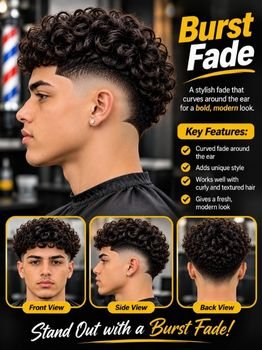
A burst fade curves in a half circle around the ear and into the neckline. Think of the ear as the center of a small circle: the hair is shortest nearest the ear and gets longer as it fans outward and down.
The unusual part is what happens behind the circle. Because the fade is concentrated around the ear, the hair at the back of the head can stay long. That is why burst fades show up so often on mullets, mohawks and faux hawks, with the fade framing the sides and the length kept at the back or on top.
A burst fade is not just a mullet. A mullet is a length pattern. A burst fade is a way of treating the sides. You can have one without the other.
- Best with: curls, coily hair and textured styles that carry volume.
- Height: it can be low or mid. High versions exist but are less common.
- Upkeep: two to three weeks. The circle loses its edge quickly, and a grown-out burst looks rounded rather than sharp.
Bring a photo for this one. Burst fade is a clear name, but how big the circle should be and how far it should reach down the neck are matters of taste.
Temple fade, Brooklyn fade, and blowout
A temple fade concentrates the blend at the temples and sideburns instead of running it around the whole head. The Brooklyn fade is the same cut under another name. Most barbers use the two terms interchangeably.
What sets it apart is the geometry. The faded area is small and sharply defined, so the corners of the hairline look crisp and deliberate. A clean line-up at the forehead usually goes with it. Even a loose, messy top looks put together when the temples are this precise.
The cost is regrowth. A small, high-contrast zone shows every millimeter of new hair, so a temple fade looks its best for a short window.
The blowout is a different thing that often travels with it. A blowout is a voluminous, rounded top of curly or textured hair, left to stand up and out, usually paired with a temple fade or another close finish on the sides. It is a style on top, not a fade technique. The name gets used loosely, so show a photo to confirm the shape you want.
- Best with: curls, coils, waves and anything with volume that needs a clean frame.
- Upkeep: every one to two weeks.
- Watch for: a line-up that cuts too far back, especially if your temples are already thinning.
Razor fade and hi-top fade
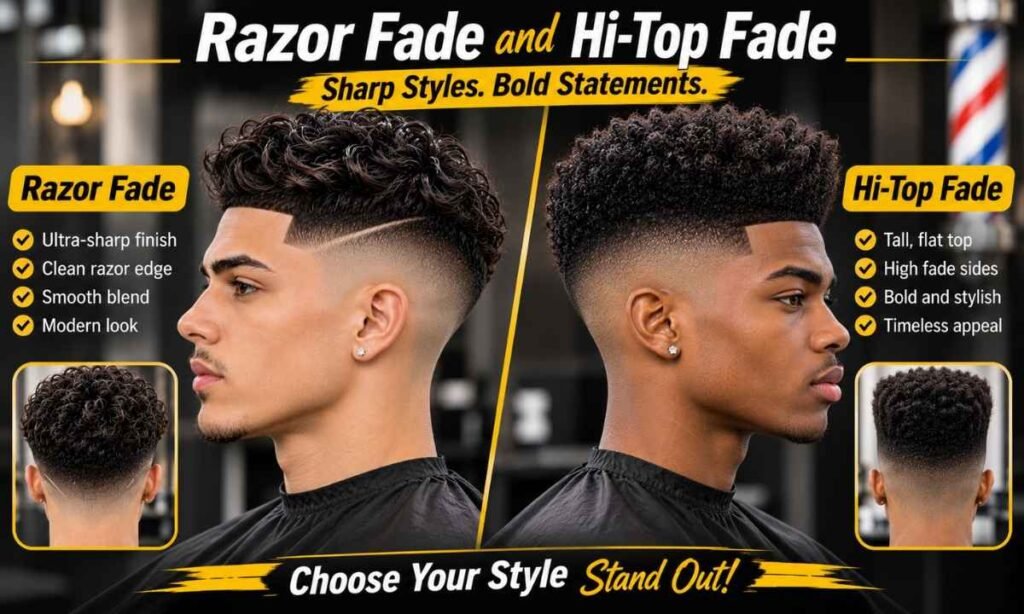
A razor fade is a fade whose bottom edge is finished with a razor, so the move into bare skin is as smooth as it can be. The clippers do the blending. The razor, or often a foil shaver, takes the last stubble off and leaves the line crisp. Barbers use it for skin fades and for detailing the outline.
It looks excellent and it asks a lot of the skin. Close shaving can cause razor bumps and irritation, especially on curly or coarse hair, and the finish fades visibly within a few days. If your skin is sensitive, ask for a clipper-only shadow finish instead.
A hi-top fade is a throwback. It pairs short faded sides with a tall, flat or boxy top, a silhouette tied to the late 1980s and early 1990s. The top is cut or shaped to stand straight up, and the sides are kept tight so the height reads clearly.
The style has returned in modern forms, often with twists, coils or a sharper line-up. It needs hair with enough texture and density to hold the vertical shape.
- Razor fade upkeep: every one to two weeks.
- Hi-top upkeep: every two to three weeks, plus regular shaping of the top.
- Commitment: both look deliberate, so they suit people who like a defined, groomed outline.
Fade comparison table
Use this as a quick reference. Heights are approximate, since barbers set them by eye on your head, not by a measurement.
| Fade | Starts | Ends at | Best for |
|---|---|---|---|
| Low | Just above ear | Skin or stubble | Office, first fade |
| Mid | Temple level | Skin or stubble | Most people |
| High | Above temple | Skin or stubble | Tall, thick tops |
| Skin / bald | Any height | Bare skin | Sharp contrast |
| Shadow | Any height | Faint stubble | Beards, sensitive skin |
| Taper fade | Sideburns, nape | Short hair | Classic, formal |
| Drop | Arcs behind ear | Any | Curls, round skulls |
| Burst | Around the ear | Any | Mullets, mohawks |
| Temple / Brooklyn | Temples, sideburns | Any | Curls, sharp lines |
| Razor | Any height | Smooth skin | Crisp edges |
| Hi-top | Any height | Any | Tall, flat tops |
The first column names the cut. The other three show the settings behind it. If a fade you hear about is missing here, it is almost certainly one of these with a different start height, finish or line shape.
Which fade suits your hair, face, and hairline
Start with your hair texture, then your face shape, then your hairline. Texture decides what is practical. Face shape decides what looks balanced. The hairline decides what to avoid.
Hair texture
- Straight or fine hair: high and mid fades look clean and keep the top in control. Very fine hair shows scalp through a skin fade, so a shadow finish is gentler.
- Wavy hair: a mid or low fade lets the waves on top stay the focus.
- Curly or coily hair: drop, burst and temple fades frame volume well, and a taper keeps a softer outline than a hard skin fade.
Face shape
| Face shape | Fade that tends to work | Why |
|---|---|---|
| Round | Mid or high, with height on top | Adds length, narrows the look |
| Oval | Almost any | Balanced already |
| Square | Low or mid taper | Softens the jaw line |
| Long | Low fade, shorter top | Avoids adding more height |
| Heart | Low or mid, fuller sides | Balances a narrow chin |
These are tendencies, not rules. A confident barber will adjust for your ears, your skull shape and how your hair actually grows.
Top length
The sides only look right if the top agrees with them.
- Under an inch (crew cut, buzz): a low fade or taper keeps the whole head even.
- One to three inches (textured crop, side part): a mid fade gives clear contrast without a harsh step.
- Longer (quiff, pompadour, slick-back): a mid or high fade keeps the extra length looking deliberate.
Receding temples and a thinning crown are not the same problem
They look similar in a mirror and need opposite thinking. Receding temples pull the front hairline back at the corners. A sharp temple fade or a very high skin fade can make this look bigger, because the contrast draws the eye to the bare corner. A low or mid taper with a shadow finish, and a little length left at the temples, softens it.
A thinning crown sits on top, behind the front. The fade on the sides will not touch it. If hair there is thinning, a longer top can drape across it, while a skin fade with a very short top removes the contrast that makes the thin spot obvious. Barbers often suggest going short and even, not trying to hide it.
Razor bumps, ingrown hairs, and cowlicks
Curly and coarse hair is prone to ingrown hairs, particularly when it is cut very close. A skin or razor finish raises the risk. If you get bumps after fades, ask for a shadow or clipper-only finish, and tell your barber which direction your hair grows. Bumps that keep returning or become painful are worth showing to a doctor or dermatologist.
Cowlicks are patches where hair grows in a different direction, common at the crown and the nape. At the nape, a very short fade can make the swirl look patchy, since there is no length to lay it flat. Tell the barber where yours is. They can leave a touch more length there, or cut with the grain.
What you say vs what your barber hears
Barbers read requests literally. They also make quick decisions from habit. Here is how common phrases tend to land, and what to say instead.
| You say | The barber may hear | Say this instead |
|---|---|---|
| “A fade” | Any height, any finish | “Mid skin fade” |
| “Taper fade” | Taper or fade | “Low taper, no skin” |
| “Short on the sides” | A #2 all round | “Mid fade to a #1” |
| “Clean it up” | Neckline only | “Keep the fade, refresh the line” |
| “Just a trim” | No fade work | “Same fade, take a bit off the top” |
| “Like last time” | Whatever they remember | Show a photo from last time |
The pattern is simple. Vague words invite the barber’s default. Specific words, even two of them, pass the decision back to you.
Photos help more than any phrase. Bring one from the front and one from the side or back if you can. Then add one sentence about what is different on your head, such as a cowlick, a receding corner or thick curls. A good photo shows the barber the target. The sentence tells them the obstacles.
If the barber says something you do not follow, ask. “How short does that go at the bottom?” is a fair question, and it saves a week of regret.
How each fade grows out, week by week
Most people’s hair grows about half an inch (1.25 cm) a month. That works out to roughly 3 mm a week, which is close to the gap between one clipper guard and the next. In other words, every week adds about one guard size to the shortest part of your fade.
That is why a fade that ends at skin looks different after seven days, and a taper that ends at a #2 barely moves. The longer the starting length, the less a week changes it.
| Week | Skin or high fade | Low fade or taper |
|---|---|---|
| 1 | Sharp, bare at the bottom | Clean and smooth |
| 2 | Stubble returns, line fuzzes | Looks almost new |
| 3 | Contrast fading, blend softens | Neckline starts filling in |
| 4 | Edge gone, sides look filled in | Still passable, shape widens |
| 6 | Needs a new cut | Sides and top merge |
Growth rates vary with age, genetics and season, so treat the table as an average. Faster growers will see the same stages a few days sooner.
A few habits keep a fade looking fresh longer:
- Leave the fade line alone. Home trims usually raise it unevenly, and your barber then has to start higher.
- Moisturize bare skin on the sides and nape. Dry, flaky skin shows clearly on a skin fade.
- Wear sunscreen on exposed scalp.
- Style the top the same way each day, so its weight sits over the fade in the same place.
What the interval costs you over a year
The visit schedule you choose has a real price in money and time. The table below assumes a $30 cut and 30 minutes per visit. Your local price and tip will change the numbers, but the ratio holds.
| Every | Visits a year | Time in chair | Cost at $30 |
|---|---|---|---|
| 1 week | 52 | 26 hours | $1,560 |
| 2 weeks | 26 | 13 hours | $780 |
| 3 weeks | 17 | 8.5 hours | $510 |
| 4 weeks | 13 | 6.5 hours | $390 |
Going from weekly to every three weeks saves about $1,050 and 17 hours a year. If a sharp skin fade matters less than your schedule, a taper or low shadow fade gives you the same tidy outline for a lot less upkeep.
The exact sentence to say in the chair
Use this order: start height, shortest length, line shape, top, neckline. You do not need all five, but each one you add removes a guess.
“[Height] [finish] fade, [shape], leave [length] on top, [neckline].”
Filled in, it sounds like this:
- “Mid skin fade, curved behind the ear, two inches left on top, natural neckline.”
- “Low taper, nothing to skin, keep the sideburns, squared neckline.”
- “High shadow fade, straight line, textured top, blocked at the back.”
- “Temple fade with a line-up, curls left full on top, taper at the neck.”
Then show a photo. Words give the settings, and the photo confirms the result.
Before you pay, check four things with a hand mirror. Both sides should start at the same height. Run your hand over the blend and feel for a step. Look at the line behind each ear. Confirm the neckline matches what you asked for. Barbers would much rather adjust now than hear about it a week later.
Frequently asked questions
What is the difference between a low, mid, and high fade?
A low fade starts just above the ear, a mid fade around the temple, and a high fade well above the temple. The higher it starts, the more of the side is short.
What is a skin fade (or bald fade)?
A skin fade takes the hair at the bottom down to bare skin, then blends up into longer hair. Bald fade is another name for the same cut.
What is a drop fade?
A drop fade has a fade line that arcs down behind the ear toward the nape instead of running straight across.
What is a taper fade?
A taper fade shortens the hair gradually and leaves it visible at the shortest point, mostly around the sideburns and neckline. Barbers use the term differently, so give a height and finish when you ask.
What is a burst fade?
A burst fade curves in a half circle around the ear and into the neckline, often with length kept at the back or top.
How often do you need to get a fade touched up?
Every one to two weeks for skin or high fades, every two to three for mid fades, and every three to four for low fades and tapers.
Conclusion
The different kinds of fades are not different haircuts so much as different settings on one idea. Decide where the blend starts, how short it ends, and whether you want skin. Add the shape of the line if you care about the back of your head.
Pick the fade that matches how often you will realistically visit the barber. A low taper or shadow fade forgives a missed week. A high skin fade does not.
Then say it plainly in the chair, and bring a photo.
