

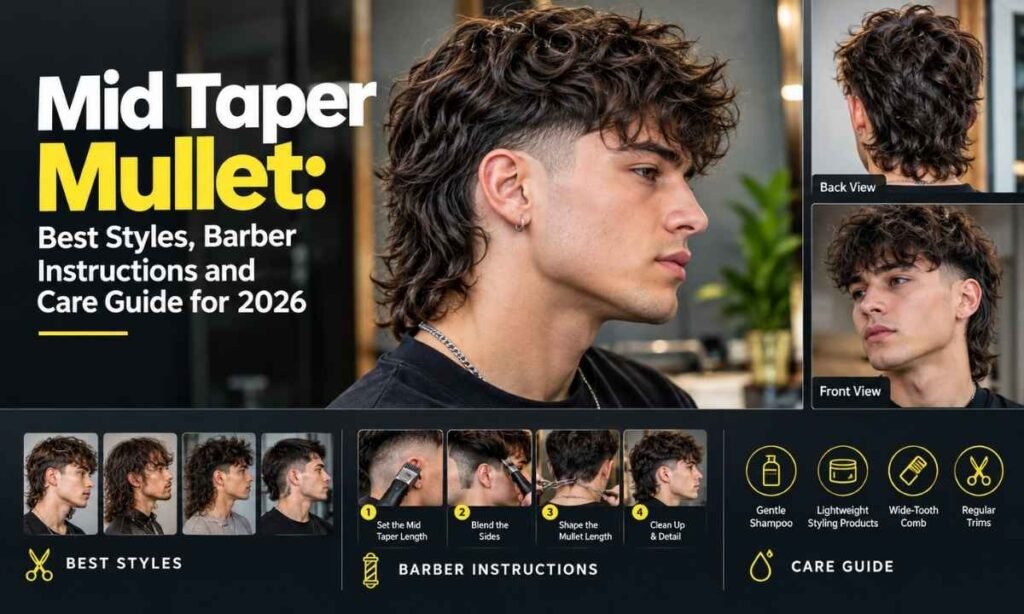
A mid taper mullet keeps the sides neat and gradually shorter, starting around the temple, while the hair at the back stays long. It gives you the shape of a mullet without the rough edges. That balance is a big reason the mid fade mullet has become such a common barbershop request.
This guide explains what the cut is and who it suits, then shows how to describe it so your barber gets it right the first time. You will also find six style variations, styling routines by hair type, trim schedules, and quick answers to common questions.
Quick answer: Ask for a mid taper that starts at the temple. Name a guard number for the shortest part, then say how many inches you want left at the back. Bring photos.
What Is a Mid Taper Mullet?
A mid taper mullet is a haircut with a taper that begins around the temple and shortens gradually toward the ears and neckline, paired with noticeably longer hair at the back. The top is usually left long enough to style. The contrast between neat sides and a longer back defines the look.
What separates it from an ordinary mid taper is the back. In a standard mid taper, the neckline is cleaned up and kept short all the way around. In the mullet version, the back is left to grow, so the taper only frames the sides.
The taper does a lot of work here. A traditional mullet can look heavy and shapeless when the sides are bulky. Tightening them makes the length behind feel deliberate. It is a small structural change, but it moves the haircut from nostalgic to tidy.
Mid Taper vs Mid Fade: Are They the Same?
Not quite, although people swap the names constantly. A taper shortens hair gradually around the ears and neckline without reaching bare skin, while a fade can blend all the way down to skin. In practice, a mid taper mullet and a mid fade mullet describe nearly the same layout with a different bottom length.
The safest approach is to name the height you want, then say how short the bottom should go. Use a guard number, or the word “skin” if you truly want it. Barbers point to one common mix-up: asking for a skin fade when you actually want visible hair left on the sides.
Where the Taper Starts: Low, Mid, High and Burst
Height changes how much skin shows at the sides and how sharp the cut looks from the front. Compare the options below before you sit in the chair.
| Height | Where the blend starts | Look |
|---|---|---|
| Low | Just above the ear | Subtle, office-friendly |
| Mid | Around the temple | Balanced, most requested |
| High | Higher up the side | Bold, high contrast |
| Burst | Curved around the ear | Sharp ear area, longer nape |
A mid height starts about halfway between the ear and the crown and is the most requested. For a mullet, that makes it a practical default. It shows enough contrast to read as a fade from the front without carving away as much side hair as a high version does. That leaves more to blend into the longer back. The Kinsman Team
Is a Mid Taper Mullet Right for You?
Hair Type and Face Shape
The cut works across textures, but the effort differs. Wavy and curly hair supply volume on their own, so the shape appears almost automatically. Straight or fine hair can still work, though it needs more styling to build volume.
Face shape offers hints, not strict rules. Round faces tend to look balanced with added height on top, while angular faces pair well with structured styles. If your face is long, softer layers and some side volume from waves or curls usually work better than extra height.
If your hairline recedes at the temples, tell your barber before the cut starts. A mid taper shows more of that area than a low taper does, and a slightly lower blend may look kinder. This is a judgment call that depends on your hairline, so let the barber see it in person.
Daily Life and Work
Think about how much time you will spend on it. Most versions need only a short styling routine, but the sides need regular upkeep to stay crisp. If you cannot visit every two to three weeks, skip skin and high fades in favor of low, mid, or plain tapers.
The mid taper version also fits many workplaces better than a long, unstructured mullet, since the sides read as tidy. Some employers and schools do have grooming rules, so check yours before committing to a long back. A subtle back length is easier to adjust later.
Best Mid Fade Mullet Styles for 2026 at a Glance
The six styles below share the same mid-height taper but differ in texture, layering, and attitude. This table gives a quick comparison, and each style gets its own section afterward.
| Style | Suits hair | Feel |
|---|---|---|
| Timeless | Straight to wavy | Clean, subtle |
| Modern | Straight to wavy | Textured, polished |
| Curly | Curly to coily | Full, soft |
| Straight | Medium to thick | Sleek, sharp |
| Wolf | Wavy, thick | Wild, layered |
| Shag | Wavy to fine | Airy, feathered |
Timeless Mid Taper Mullet Variations for 2026
The timeless version is the easiest place to start. The sides carry a clean mid taper, the top is long enough to comb or push back, and the back falls to a modest length. Nothing is exaggerated, which is exactly why it ages well.
Back length is the main dial. One guide describes a subtle mullet as keeping the back around 2 to 3 inches. Another suggests leaving 4 to 6 inches behind a number 2 on the sides. Treat both as starting points and adjust to your hair density.
Ask for a natural or softly tapered neckline instead of a hard square edge if you want an easy grow-out. A blunt line looks sharp on day one but shows regrowth quickly. This version also works as a low-risk way to test the shape before going bolder.
Mid Taper Modern Mullet
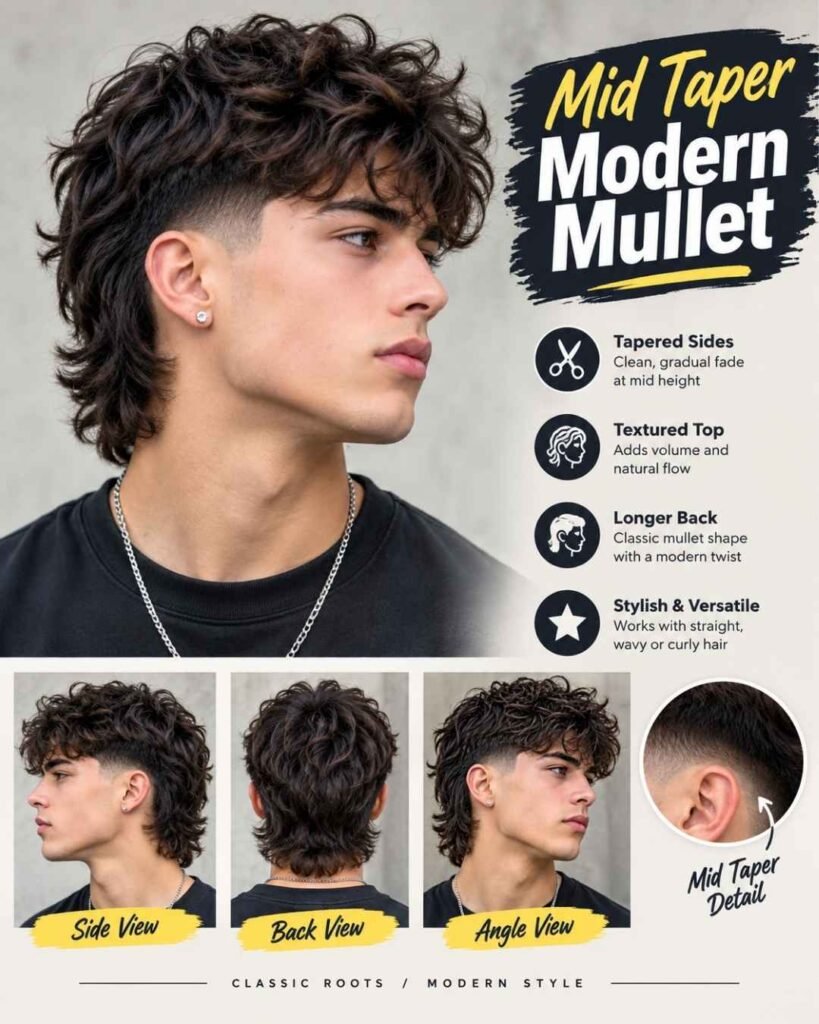
The modern mullet keeps tapered sides but adds texture and movement on top. Barbers often soften the upper layers with point cutting, which gives the hair a lived-in shape instead of a blunt outline. Point-cutting or shear-over-comb work helps avoid a harsh line where short meets long. Tyme
That connection point matters most. If the top drops to the back in a hard step, the cut looks like two separate haircuts. Ask your barber to blend it lightly so the length flows down instead of falling off.
For styling, work a small amount of texture paste or sea salt spray through the hair and shape it with your fingers. A comb usually makes the result too neat. Keeping the top matte lets the taper stay the sharpest detail.
Mid Taper Curly Mullet
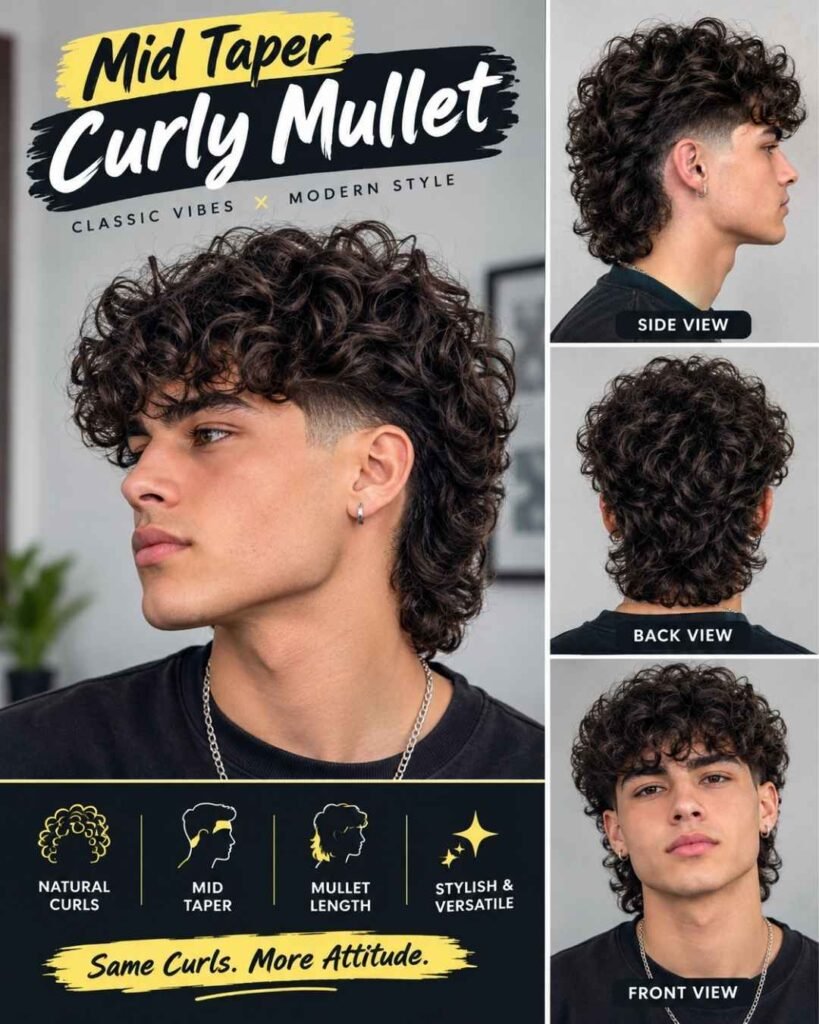
Curls and a mullet suit each other because curls supply volume and movement without much effort. The taper keeps the sides from ballooning outward, which is the usual complaint with curly hair cut short at the sides. The result reads as full on top and controlled at the edges.
Length behaves differently once curls dry. Curls shrink as they dry, so ask your barber to shape the hair without removing too much weight. Tell them how long you want the hair to look when dry, not just how long it is when wet.
Care is mostly about moisture. Washing two to three times a week helps curly hair keep moisture, and a leave-in conditioner or curl cream seals it in, while too much product weighs curls down. The same source suggests trimming the top and sides every 6 to 8 weeks and the back every 8 to 12 weeks. A very tight taper may need shorter gaps.
Mid Taper Straight Mullet
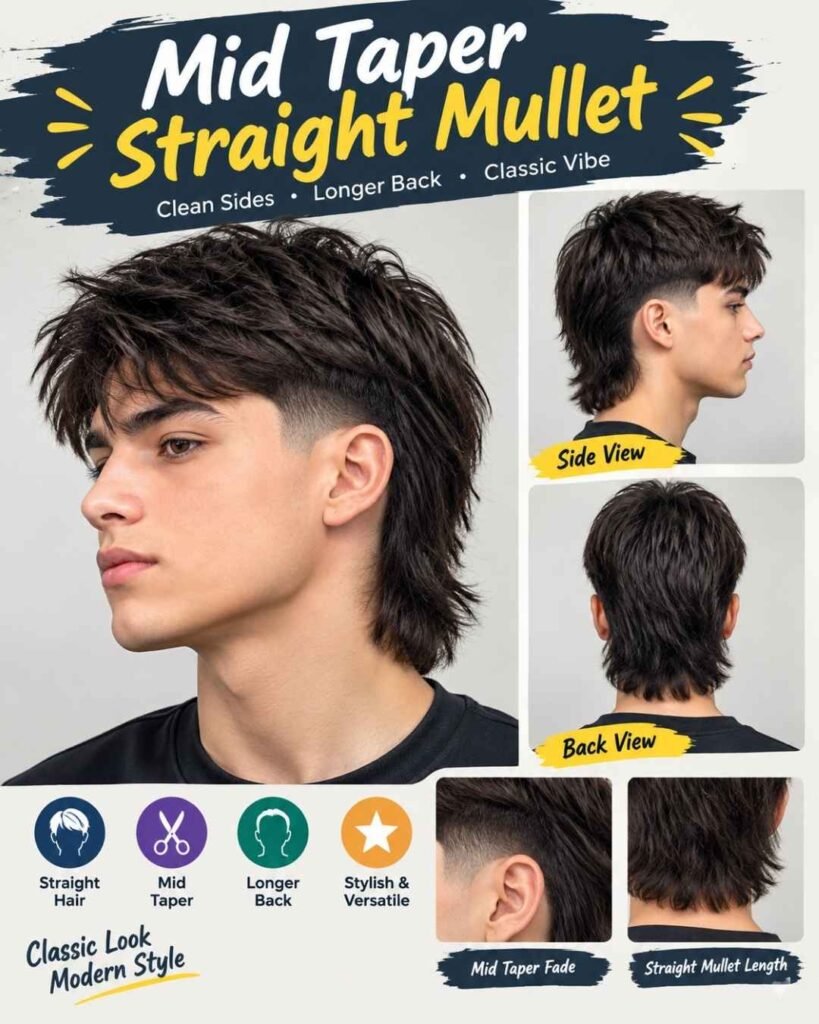
Straight hair shows every line, so this version looks sharp and graphic when cut well. The contrast between tapered sides and a longer back is easy to see. The trade-off is that straight hair tends to lie flat, so volume and texture need deliberate attention.
Ask for a layered top so the hair has lift instead of falling in one sheet. Fine hair deserves a conversation, since heavy layering can make it look sparse. The most common problem is a harsh step where the short top meets the long back. Straight hair exposes that step more than any other texture, so check it in the mirror before you leave.
Styling makes a large difference. Apply sea salt spray to damp hair, blow-dry the crown upward with a round brush, and finish with a matte paste through the mid-lengths. A sea salt texture spray can make straight or thin hair look fuller.
Mid Taper Wolf Mullet
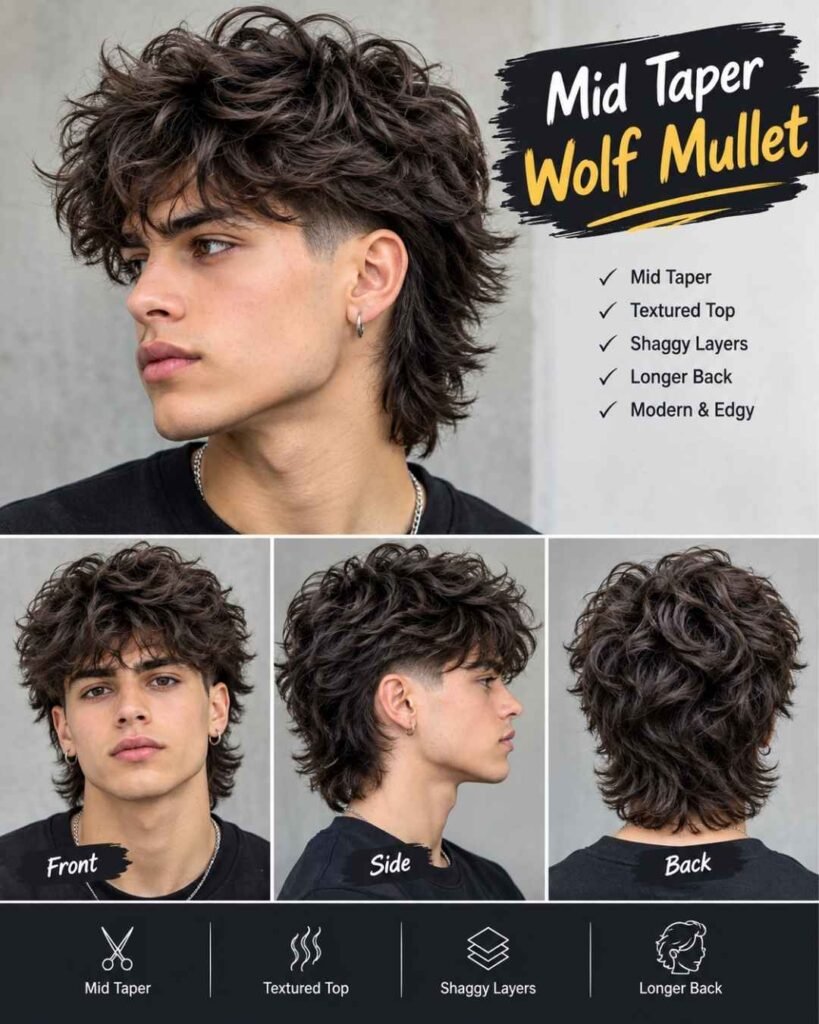
The wolf mullet blends a mullet’s length pattern with the choppy layers of a shag. The sides get a mid taper for structure, while the top and back carry heavy, feathered layers. It is the most dramatic of the six styles, but the taper keeps it from looking shapeless.
A wolf cut blurs the contrast of a classic mullet, using layers to move gradually from crown to back rather than creating a sharp separation. Stylists often describe it as a hybrid of shag and mullet. That makes it softer and less extreme than a traditional mullet.
Definitions vary between stylists, so bring photos. Some wolf cuts include a curtain fringe, while others focus on crown volume. Tell your barber how long the back should be and whether you want a fringe. Also say how visible the taper should be at the sides. Most style guides say wolf cuts suit straight to curly hair, though thicker hair holds the layers with less effort.
Mid Taper Shag Mullet
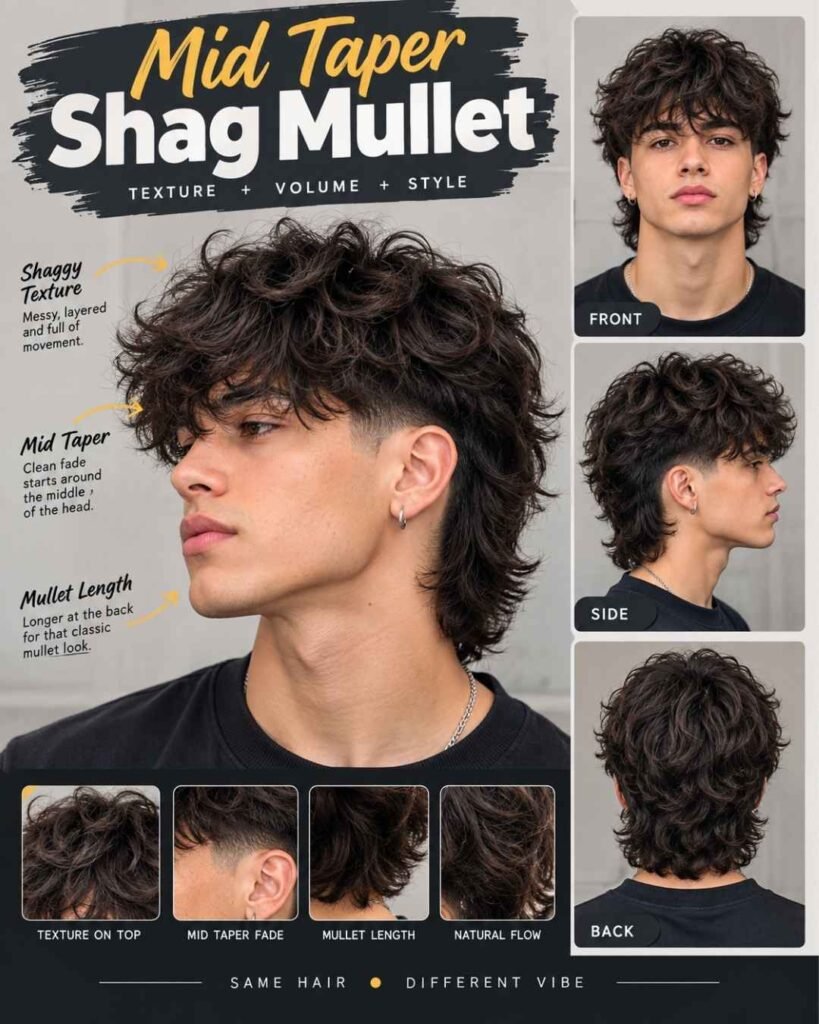
The shag mullet, sometimes called a shullet, combines shag layering with the mullet silhouette. It offers movement at the crown, airy wispy finishes, and a softer, longer back. A mid taper on the sides gives the cut enough structure to look styled instead of accidental.
The difference from the wolf mullet is mostly in the finish. Wolf versions lean heavy and voluminous, while shag versions lean airy and feathered. The line between them is blurry, and stylists interpret both names differently, so pictures work better than labels.
Wavy hair is the natural fit, since it gives the layers something to work with. On straight hair, a texturizing spray and a blow-dry help the layering show. Skip heavy waxes, which can flatten airy ends and leave the cut looking greasy.
How to Ask Your Barber for a Mid Taper Mullet
Clear instructions prevent most bad haircuts. Barbers work from a shared vocabulary, so give them the parts that matter and show a photo. Cover these four points, in this order:
- Taper height: “Mid, starting around the temple.”
- Bottom length: A guard number, or skin only if you want bare skin.
- Back length: In inches, or point to where it should land, such as the collar.
- Top texture: Choppy or smooth, with a fringe or without.
Also say how much time you plan to spend styling. Honesty here saves you from a cut that needs more effort than you will give it.
Guard Number Cheat Sheet
Clipper guard numbers are measured in eighths of an inch, so a higher number leaves more hair. Skin means no guard at all.
| Guard | Length left |
|---|---|
| Skin (0) | Down to the scalp |
| #1 | 1/8 inch |
| #2 | 1/4 inch |
| #3 | 3/8 inch |
| #4 | 1/2 inch |
Each guard number equals that many eighths of an inch. For tight sides, go with a #1 to #3, and for softer sides, a #4 or #5.
A Sample Script You Can Read Out
Adjust the numbers to your taste. Here is how a full request can sound:
“I’d like a mid taper mullet. Start the taper at the temple, take the bottom down to a number 1 and blend up, and keep about five inches at the back. Leave the top long enough to texture, and keep the neckline natural instead of squared off.”
Mistakes That Lead to a Bad Result
- Saying “just a fade” without naming a height.
- Arriving without a reference photo, since your “short” may be their “very short.”
- Skipping the styling-time conversation.
- Booking a tight skin fade with a barber whose fade work you have not seen.
How to Style a Mid Taper Mullet at Home
Styling is simpler than the cut suggests. Treat the hair as zones: the crown gets lift, the sides stay close, and the back gets shape. Build volume at the roots rather than the ends. A blow-dryer with heat control, a medium round brush, and a wide-tooth comb cover most needs.
- Start with damp, towel-dried hair.
- Work a pea-sized amount of product through the mid-lengths.
- Blow-dry the crown up and back with the round brush, and let the back dry mostly on its own.
- Finish with your fingers and a light mist of texture spray.
Sea salt spray works best on damp hair, while matte clays and pastes perform better on dry hair. Match the product to your texture: WelcomeGrow
| Hair type | Try | Why |
|---|---|---|
| Straight or fine | Sea salt spray | Adds grip and body |
| Wavy | Light cream or mousse | Defines without weight |
| Curly | Curl cream, leave-in | Holds moisture |
| Thick | Matte clay | Control without shine |
Hats flatten the crown, but the shape returns. After removing one, flip your head down and finger-comb the crown to restore lift. It is a quick fix worth remembering if you wear a cap most days. My Blog
How Often to Trim a Mid Taper Mullet
The sides and the back age at different speeds. The taper loses its crispness first, since short hair shows regrowth quickly. The longer back changes shape much more slowly, so the sides need visits more often than the length behind them.
| Area | Typical interval | Note |
|---|---|---|
| Skin fade sides | 2 to 3 weeks | Grows out fastest |
| Mid taper sides | 3 to 5 weeks | Depends on the bottom |
| Top and layers | 6 to 8 weeks | Keeps the shape fresh |
| Back length | 8 to 12 weeks | Mostly tidying ends |
These ranges come from barbershop and salon guides that give skin fade upkeep as 2 to 3 weeks, tapered versions as about 3 to 5 weeks, general mullet shaping as 6 to 8 weeks, and the back as 8 to 12 weeks. They are typical guidance, not clinical research, so your own schedule may differ. A commonly cited growth average is about half an inch per month.
Growing Out the Sides and Back
A mid taper mullet is a forgiving cut to grow out. The sides blend into the rest of the length gradually, and the back is already long. A gentler taper grows out more smoothly than a full skin or burst fade.
If you want more length overall, skip the taper for a couple of cycles. Ask the barber to tidy only the neckline and the area around the ears. That keeps things neat while the sides catch up.
Trade-Offs to Weigh Before You Book
No haircut suits everyone. These are the points worth thinking about first:
- The taper needs regular visits to stay crisp.
- Growth between trims can look awkward for a while.
- Straight or fine hair needs product and a blow-dry to hold shape.
- Workplace or school grooming rules may limit how long the back can be.
Frequently Asked Questions
What is a mid taper mullet?
It is a haircut with a taper starting at the temple on the sides and noticeably longer hair at the back.
Is a mid taper mullet the same as a mid fade mullet?
Nearly. Both start at the temple, but a fade usually goes shorter, often to skin, while a taper stays softer.
What guard number should I ask for on the sides?
Ask for a #1 or #2 for tight sides and a #4 for a softer look, which leaves 1/8 to 1/2 inch.
How long should the back be?
Roughly 2 to 3 inches gives a subtle look, while 4 to 6 inches gives a fuller one, depending on your hair.
How often should I trim a mid taper mullet?
Book the sides every 3 to 5 weeks and the back length every 8 to 12 weeks.
Does a mid taper mullet work on straight hair?
Yes, but straight hair needs layering, texture product, and a quick blow-dry to keep its volume.
Can I wear a mid taper mullet to work?
Often yes, since the sides look tidy, but check your grooming rules and consider a shorter back.
What is the difference between a mullet and a wolf cut?
A mullet has a sharper contrast between short front and long back, while a wolf cut uses layers for a softer transition.
Conclusion
The mid taper mullet works because it fixes what people dislike about a traditional mullet. Neat, gradually shorter sides give the longer back a clear purpose. The mid height is the sensible middle ground, with enough contrast to look sharp and enough hair left to grow out gracefully.
Choose the variation that matches your hair: timeless for a subtle start, curly or straight for a look that works with your natural texture, and wolf or shag if you want more layers. Bring photos, name a height, a guard number, and a back length, and you are set.
