

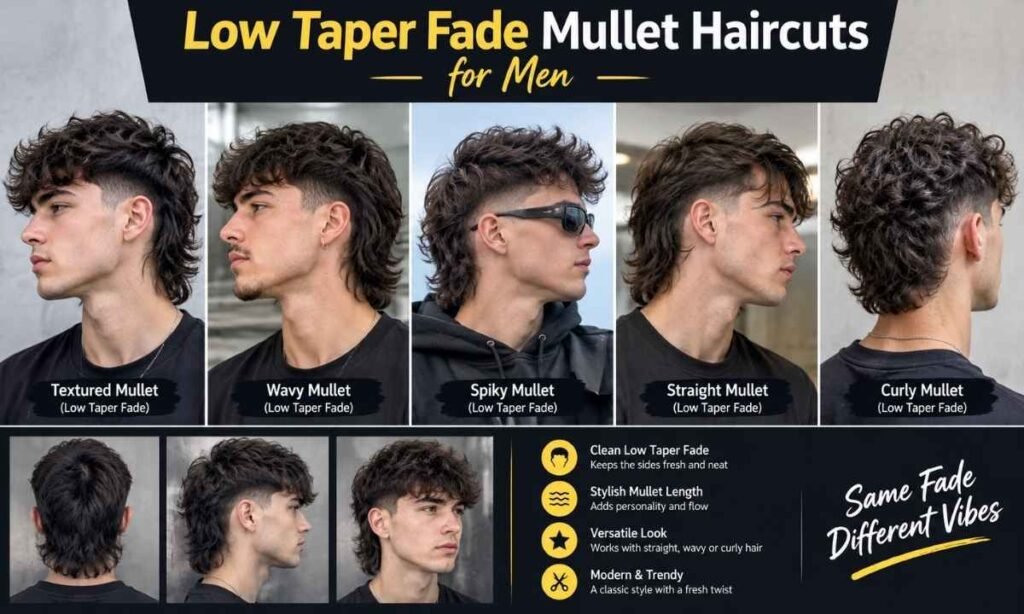
A low taper fade mullet keeps the sides short and blended around the ears and neckline, with noticeably more length at the back. Because the fade starts low, the cut looks tidy from the front and shows its length only from behind. That balance keeps it on barbershop trend lists in 2026.
This guide explains what the cut is and shows 19 versions worth bringing to your barber. It also gives you the exact wording to use in the chair, plus guidance on which faces and hair types suit it and how to keep it sharp.
What Is a Low Taper Fade Mullet?
A low taper fade mullet has short, gradually blended sides that start low near the ear and neckline. The top is long enough to style and the back is left noticeably longer. The contrast comes mostly from length rather than bare skin, so it looks softer than a high fade.
Most versions share these building blocks. Exact numbers vary by barber, so treat them as starting points:
- Sides: Tapered from very short at the bottom to slightly longer near the ear.
- Top: Often around 2 to 4 inches, enough for texture or a fringe.
- Back: A few inches for a subtle look, or 8 inches and up for a bold one.
- Neckline: Cleaned up with a trimmer and shaped to suit your growth pattern.
Taper vs Fade: Why the Words Confuse People
A taper shortens hair gradually around the ears and neckline without reaching skin, while a fade can go all the way down. Many barbers say every fade is a taper, but not every taper is a fade. Definitions differ between shops, so describe the shortest length you want instead of relying on the label.
Low Taper Fade Mullet vs Traditional Mullet
| Feature | Low taper fade mullet | Traditional mullet |
|---|---|---|
| Sides | Tapered short, blended | Short to medium, scissor cut |
| Transition | Gradual | Often abrupt |
| Neckline | Clean and defined | Often left natural |
| Overall feel | Polished, subtle | Bolder, more retro |
| Upkeep | Frequent clean-ups | Trims can be spaced out, but the shape gets shaggy |
These are common tendencies, not rules, because every barber cuts both versions differently. The practical difference is control. The taper gives the sides a defined edge, which is why the cut reads as intentional even when the back is long.
Why Many Barbers Recommend a Low Taper Fade Mullet
Barbers often suggest this version to people trying a mullet for the first time. The reasons are mostly practical:
- It is easy to dial up or down. The lower the taper, the subtler the result, and the back can always be shortened later.
- It grows out softly. A low starting point avoids the hard line a high fade leaves as it fills in.
- It suits many textures. Straight and curly hair both take the shape, though each behaves differently.
- It adapts to your setting. Keep the back short for a strict dress code or let it grow for weekends.
The 19 styles below are grouped by purpose. Each one notes who it suits and gives an ordering or styling tip.
Everyday Low Taper Fade Mullet Styles
1. Classic Low Taper Fade Mullet
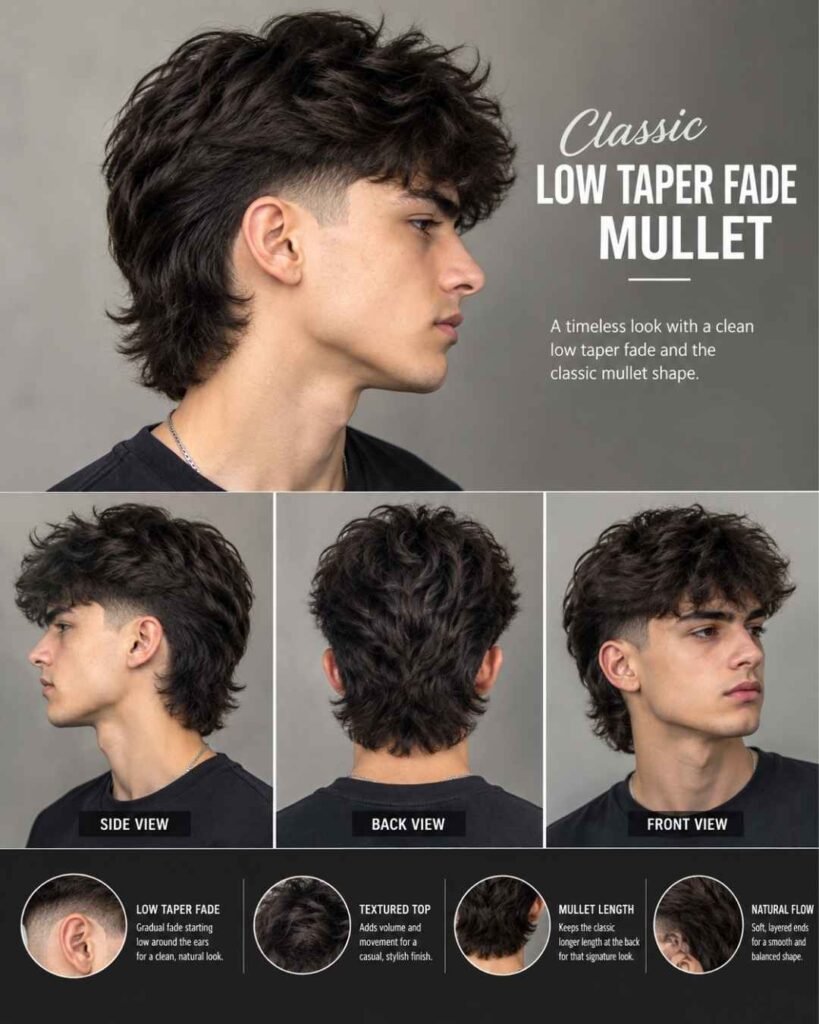
The reference version. The sides taper from short at the neckline into slightly longer hair near the ear. The top stays at a medium, styleable length, and the back drops a few inches past the collar. Ask for a low taper with a medium back. It suits most face shapes and makes a safe first mullet.
2. Textured Low Taper Fade Mullet
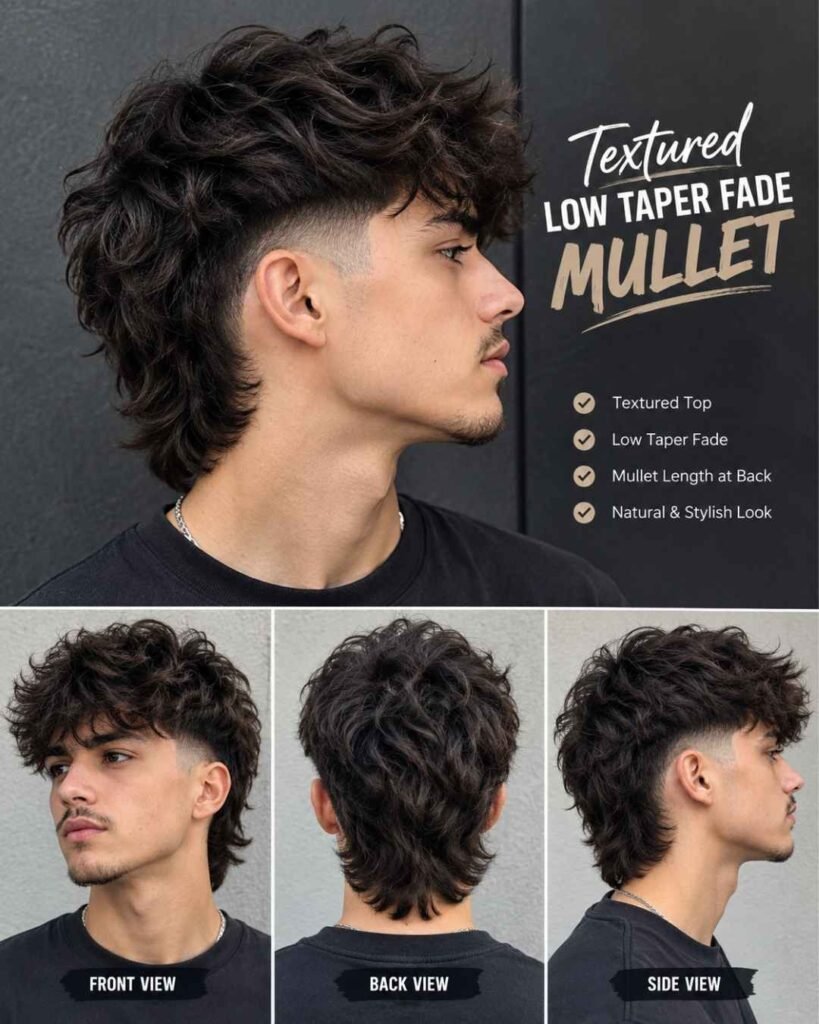
Point cutting or light razoring breaks up the top and back so the hair moves instead of lying flat. It suits straight or slightly wavy hair that needs body. Work a matte clay or texture spray through dry hair and twist the ends for separation.
3. Messy Low Taper Fade Mullet
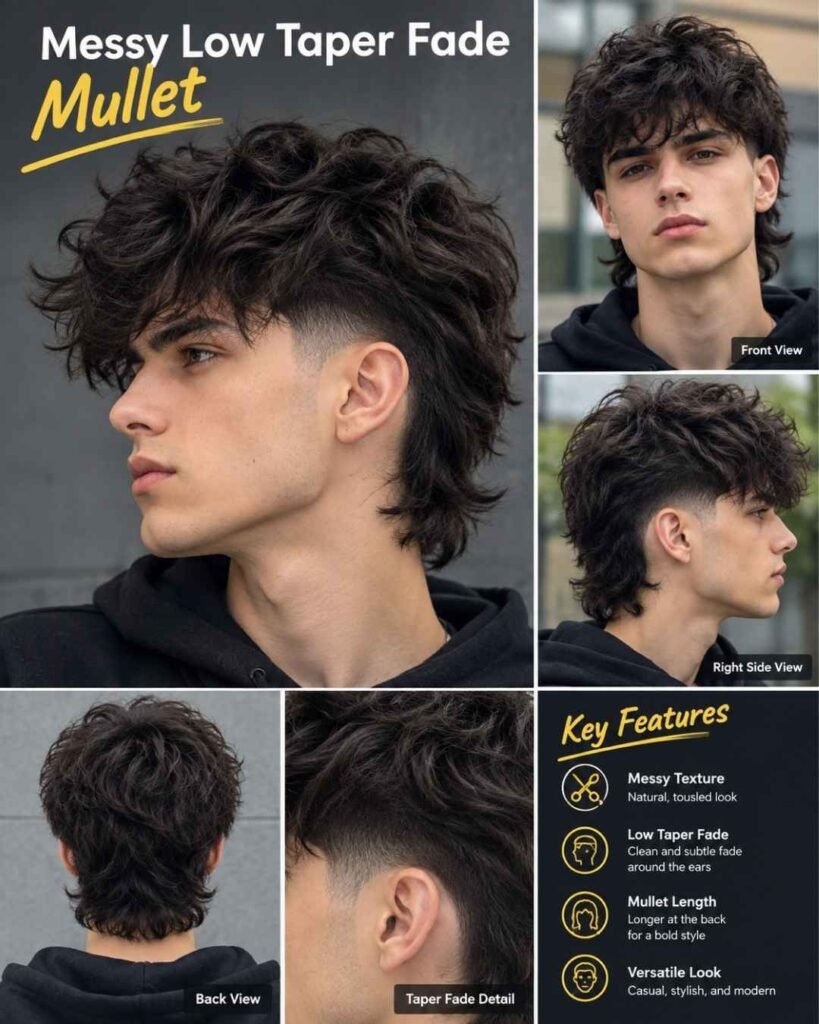
This version is deliberately unfinished on top and at the back, with uneven ends and no strict shape. The low taper keeps the sides clean, so the mess reads as a choice. It works well on wavy hair and on grown-out cuts. Air dry, add a little sea salt spray, and skip the comb.
4. Modern Low Taper Fade Mullet
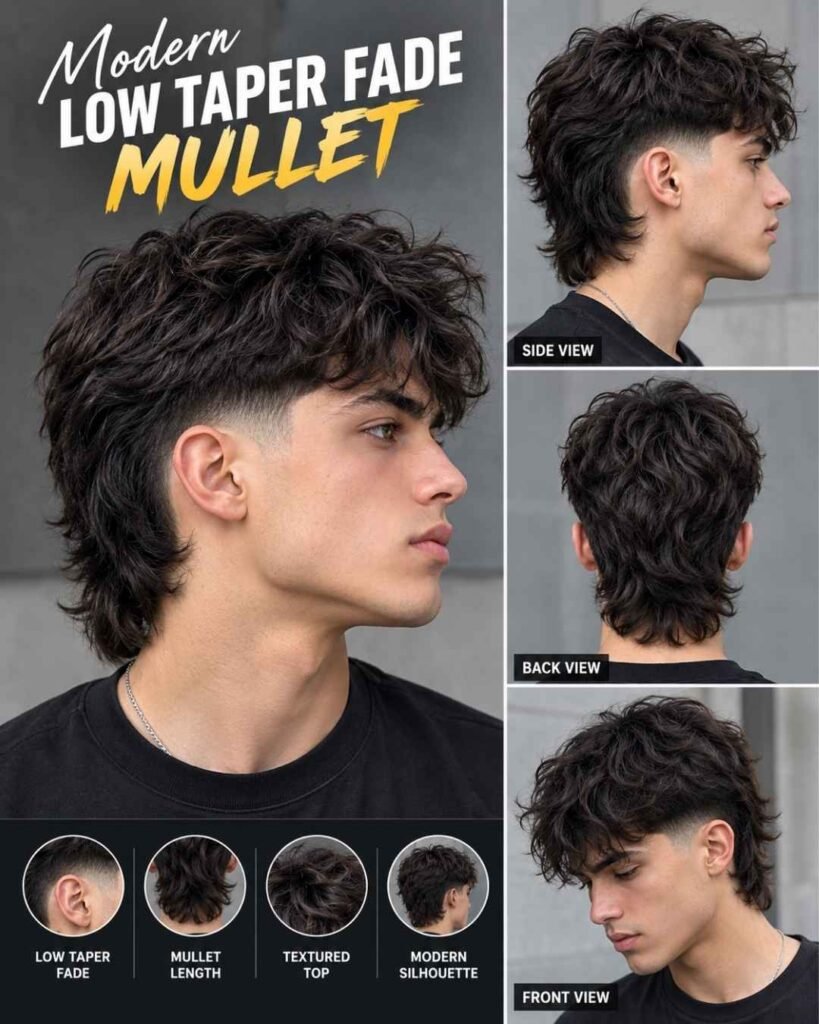
The cleaner, current take. The sides are tight and the back is shorter and more controlled than older mullets. The blend between zones is smooth instead of stepped. Ask for a low blend, a medium back, and a tidy neckline. It suits anyone who wants the trend without the shock.
5. Professional Low Taper Fade Mullet
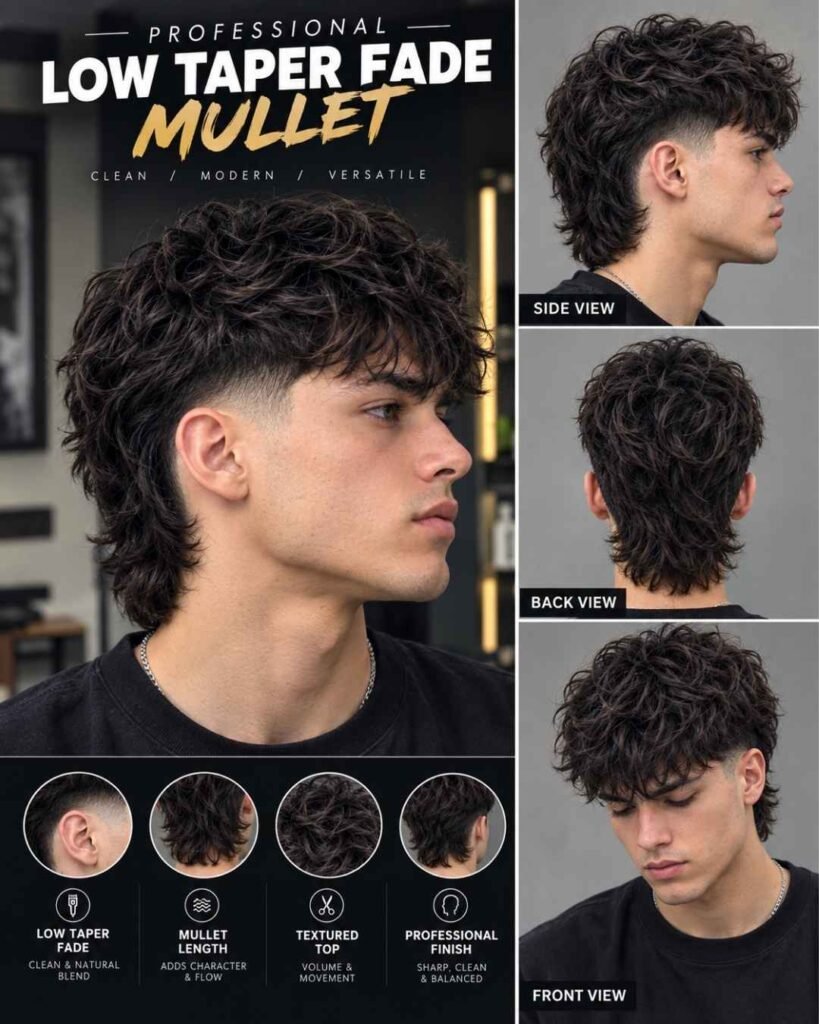
A conservative version for offices and client-facing work. Keep the back near the collar, the top neat, and the neckline crisp. Tell your barber where your dress code draws the line, since workplace rules differ. A light paste or wax keeps everything in place without shine.
Low Taper Fade Mullet Styles by Hair Type
6. Curly Low Taper Fade Mullet
Curls shrink as they dry, so a back that looks long when wet can sit much higher later. Ask your barber to check length on dry hair. If the back puffs outward, ask for light thinning. Curl cream on damp hair defines the pattern.
7. Wavy Low Taper Fade Mullet
Waves give the mullet shape with less effort. The taper controls the sides while the back falls into natural movement. Keep some weight in the length so the waves do not flatten out. Sea salt spray or a light mousse and air drying are often enough.
8. Straight Hair Low Taper Fade Mullet
Straight hair shows every line, so clean blending matters most here. Without layers, the back can hang like a curtain, so ask for soft internal layering. A blow dryer and a small amount of clay lift the crown. Sharp scissor work makes a visible difference.
9. Thick Hair Low Taper Fade Mullet
Dense hair can make the back look bulky and the taper look busy. Ask for light debulking through the back and a slightly cleaner taper to offset the mass. Firm-hold clay handles weight better than light cream. Allow extra drying time after washing.
10. Asian Low Taper Fade Mullet
Many men of East Asian descent have straight, dense hair, though texture varies from person to person. That type suits a clean low taper with a softly layered back. A curtain-style or center-parted fringe is a popular addition. Ask for layers to avoid a heavy, flat shape.
11. Low Taper Fade Mullet with Natural Volume
For hair that grows outward, work with the volume instead of fighting it. The taper frames the shape while the top and back keep their fullness. Use fingers or a pick, avoid heavy gel, and moisturize regularly so the volume looks healthy instead of dry.
Trend-Led and Layered Versions
12. Wolf Cut Low Taper Fade Mullet
This hybrid adds shaggy layers through the top and crown while the taper keeps the sides tidy. A plain mullet is defined by short front and long back, whereas a wolf cut leans on layering. Expect to use texture spray daily so the layers do not collapse.
13. Soft Layered Low Taper Fade Mullet
Blended layers replace the choppy look, so the move from top to back feels smooth. Hair falls gently around the ears. It suits wavy or fine hair that needs shape without heavy texture. Ask for long layers and avoid thinning shears near the ends.
14. Low Taper Fade Mullet with Textured Fringe
A forward-swept or slightly broken fringe gives the front more presence against the longer back. It can also soften a longer forehead. Ask for the fringe to be point cut so it separates naturally, and keep it above the eyebrows so it stays out of your eyes.
15. Athletic Low Taper Fade Mullet
A shorter, practical version for people who train hard or wear helmets and caps. Keep the back near collar length so it stays out of the way and does not trap heat. A tighter taper helps too. This style dries quickly and needs only light product.
Length and Fade Variations
16. Low Taper Fade Mullet with Beard
The taper on your head should flow into the beard so the sideburn-to-cheek line looks continuous. Ask your barber to blend the beard fade into the same low taper. A fuller beard also balances a longer back, so keep the two proportionate.
17. Short Mullet Low Fade
A restrained option with the back only slightly longer than the sides, often around 2 to 3 inches. It gives a hint of mullet without a dramatic tail. First-timers and stricter dress codes are a good match. Ask for a low fade, a textured top, and a back that just covers the neckline.
18. Mid Taper Fade Mullet
The fade starts higher, around the temple, so more of the sides looks short. That creates a sharper, more visible contrast and can help lengthen a rounder face. It needs cleaner touch-ups than the low version. Say “mid taper” clearly so the height is not misunderstood.
19. Mullet Haircut Long Hair Low Taper Fade
For hair already past the shoulders, the low taper cleans up the sides while the length stays. Detangle before styling and use a leave-in conditioner, because long tails tangle easily. Growth takes patience: hair grows about half an inch a month on average, or roughly 6 inches a year.
Which Style Fits Your Hair Type?
| Hair type | Good starting styles | Ask your barber for |
|---|---|---|
| Straight | Classic, Straight, Textured | Soft layers, point cutting |
| Wavy | Wavy, Messy, Soft Layered | Weight kept in the length |
| Curly | Curly, Natural Volume | Length checked dry, light thinning |
| Thick | Thick, Modern | Debulking, cleaner taper |
| Fine | Short Mullet, Textured, Classic | Shorter back, textured top |
How to Ask Your Barber for a Low Taper Fade Mullet
Saying “give me a mullet” leaves too much open. Barbers think in zones, so describe each one:
- Bring photos. Three to five images from different angles work best. Point out what you like and dislike.
- Name the fade height. Say “low taper” and show where it should start, such as the top of the ear.
- Give the shortest length. Clipper guards count in eighths of an inch: a #1 is 1/8″, a #2 is 1/4″, a #3 is 3/8″, and a #4 is 1/2″.
- State the top length. Use inches or finger widths, and say whether you want texture or a fringe.
- Describe the back. Use landmarks like “just past the collar,” or give an inch measurement.
- Cover the finish. Mention neckline shape and how much daily styling time you really have.
A sample script: “I’d like a low taper fade mullet. Start the fade at the top of my ear, a #1 at the bottom blending into a #3. Leave the top around three inches with some texture. Keep the back just past my collar with a natural neckline. I spend about five minutes styling.”
Common mistakes include asking for “just a fade” without a height, cutting the top too short, and forgetting to mention your dress code. If you are new to fades, ask who at the shop specializes in them, since blending is a skill-heavy part of the cut.
Best Face Shapes for a Low Taper Fade Mullet
Face shape guidance is a set of rules of thumb, not strict limits. A good barber will adjust the cut to your features.
| Face shape | Helpful adjustment |
|---|---|
| Oval | Most versions work, so choose by hair type |
| Round | Add height on top, keep the sides tight |
| Square | Softer layers, longer fringe to ease the jaw |
| Diamond | Fuller sides and a longer fringe for narrow temples |
| Rectangular | Avoid excess height, choose wider, softer shapes |
| Heart | Volume near the temples, curtain-style fringe |
Best Hair Types for This Haircut
The cut works on straight, wavy, and curly hair, but it needs enough length to begin. Aim for at least 3 to 4 inches on top and at the back. If you are shorter, expect to wait a couple of months, since growth averages about half an inch monthly.
Fine hair does better with a shorter back and a textured top. Thick hair often needs debulking. Curly hair benefits from a length check on dry hair. If you have thinning at the crown or temples, some barbers can still make the cut work, but that is a judgment call best made in person.
Best Styling Products
| Product | Best for | Tip |
|---|---|---|
| Matte clay | Straight or thick hair | Warm in palms, apply to dry hair |
| Sea salt spray | Wavy or messy styles | Spray on damp hair, then scrunch |
| Curl cream | Curly hair | Use on damp hair for definition |
| Light paste | Fringes, professional looks | A small amount avoids shine |
| Texture spray | Fine or layered hair | Mist at the roots for lift |
Brand choice matters less than matching product to hair type. Ask your barber what they used on your cut, since they know how your hair behaved.
Maintenance Tips
Trim frequency depends on how sharp you want the taper. A common range from barbers is every 3 to 5 weeks, and the sharper the contrast, the sooner you will want a clean-up. With growth around half an inch a month, the sides can visibly fill in within a few weeks.
- Book neckline clean-ups. Some shops offer quick touch-ups between full cuts, though this is not universal.
- Keep the back healthy. Longer hair benefits from conditioner and a trim to remove damaged ends.
- Do not cut the back yourself. The blend between zones is easy to ruin at home.
- Grow it out gently. A low taper fills in softly, so the transition period looks less awkward than with a high fade.
Frequently Asked Questions
What is a low taper fade mullet?
It is a mullet with short, blended sides that begin low near the ear and neckline, and a longer back.
How often should I trim it?
Most barbers suggest every 3 to 5 weeks, sooner if you want the taper very sharp.
How much hair do I need to start?
At least 3 to 4 inches on top and at the back is a practical starting point.
Is a low taper fade mullet office appropriate?
It can be, especially in a short or professional version, but dress codes vary by workplace.
Does it work with curly hair?
Yes. Ask your barber to check length dry, since curls shrink, and use curl cream for definition.
What is the difference between low and mid taper mullets?
A low taper starts near the ear and neckline for a subtle look. A mid taper starts around the temple for more contrast.
Can I get one with thinning hair?
Sometimes. Discuss your crown and temples with a barber in person, since results depend on the pattern.
How is it different from a wolf cut?
A mullet contrasts short sides with a long back, while a wolf cut uses heavy layers throughout.
Conclusion
The low taper fade mullet works because it balances control and character. The low fade keeps the sides clean, while the length at the back adds personality. Pick the version that matches your hair type, describe each zone clearly to your barber, and book regular clean-ups to keep the taper crisp.
