


A French crop low taper fade is a short, textured top with a cropped fringe, paired with sides that shorten gradually around the ears and neckline. To get it, ask for 1 to 3 inches on top, a fringe cut to sit near your brow, and a low taper starting at a #2 guard. It grows out well, styles in minutes, and suits most hair types.
That is the whole idea. The rest of this guide covers who it flatters, 30 specific versions, the exact words to use in the chair, and how to keep it sharp between cuts.
Quick Answer and Key Takeaways
- The cut has two parts: a French crop top with a short forward fringe, and a low taper that only trims the edges.
- It works best on straight, wavy and thick hair, and it can be adapted for curls and coils.
- Plan on a trim every 3 to 4 weeks to keep the taper clean.
- The biggest ordering mistake is saying only “fade.” Say “low taper” and give guard numbers.
| Quick fact | Typical range |
|---|---|
| Top length | About 1 to 3 inches (2.5 to 7.5 cm) |
| Fringe | Sits near the brow line, cut blunt or choppy |
| Taper start | #1 or #2 guard at the neckline and ears |
| Blend up to | #3 or #4 guard on the sides |
| Trim schedule | Every 3 to 4 weeks |
| Daily styling | 3 to 5 minutes |
| Best hair types | Straight, wavy, thick (curly with adjustments) |
What Is a French Crop Low Taper Fade?
It is a hybrid of two ideas. The top borrows from the classic French crop: short, forward-brushed hair with a cropped fringe. The sides borrow from barbering’s taper: a gentle shortening at the edges rather than a dramatic climb up the head.
The result looks tidy without looking severe. That is why barbers recommend it to people who want something sharper than a scissor cut but calmer than a high skin fade.
The French-Crop Top and Fringe
The French crop is defined by its fringe. Hair on top is cut short, then combed or pushed forward so it lands across the forehead. Most versions leave the front about a finger’s width above the brows, though some barbers cut it higher for a more modern, barely-there look.
The fringe can be:
- Blunt, cut straight across for a graphic edge
- Choppy, point-cut so the ends look broken and soft
- Side-swept, angled slightly to one side
Texture does the heavy lifting. A French crop with no texture reads like a bowl cut. With texture, it reads deliberate.
What Makes the Taper “Low”?
A taper shortens hair gradually, but only at the perimeter: around the ears, the sideburns and the nape. The “low” part means the shortening begins near the ear line instead of climbing toward the temples.
The length difference between your sides and your top stays visible, because the taper doesn’t eat into the sides the way a fade does. A fade removes more length and often reaches skin. A taper leaves some hair even at its shortest, unless you ask for a skin finish.
A quick guard reference helps when you talk to a barber:
| Guard | Length left |
|---|---|
| #1 | 1/8 inch (3 mm) |
| #2 | 1/4 inch (6 mm) |
| #3 | 3/8 inch (10 mm) |
| #4 | 1/2 inch (13 mm) |
Why This Cut Is Popular Right Now
Part of it is practicality. The top needs little product, the sides need little thought, and the shape looks intentional even on a lazy morning. Style publications such as Fashionisto and Luxe Digital now run entire lists on French crops and low tapers, which tells you how often barbers get asked for them.
There is also a generational angle. People often call the textured fringe with tapered sides the “Gen Z haircut.” There is no official definition, and the label also gets pinned on curtains and two-block cuts. But the French crop low taper fade fits the description: low effort, textured, a bit undone, and still neat enough for school, work or a night out.
Will a French Crop Low Taper Fade Suit You?
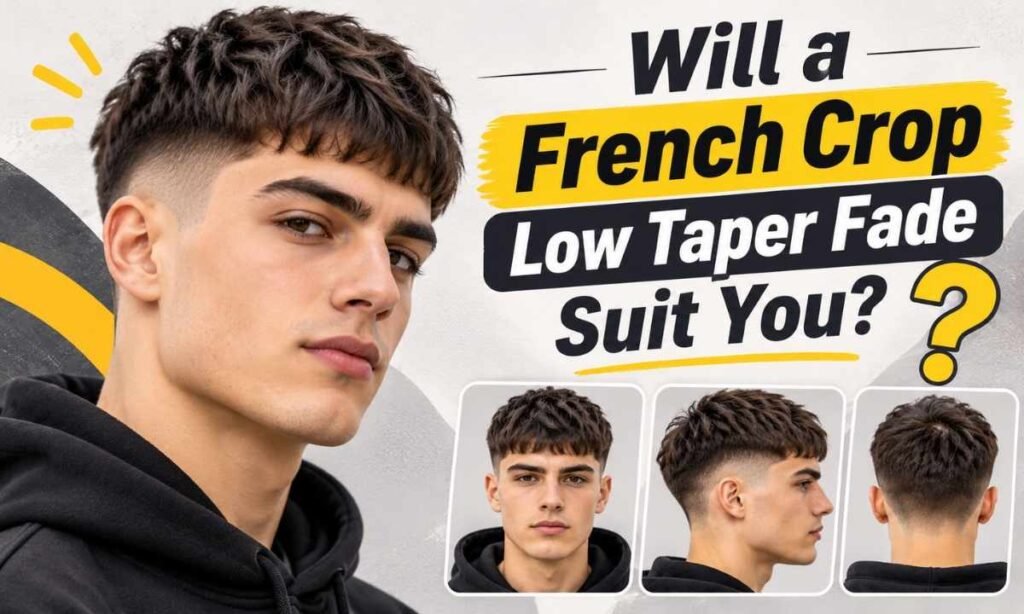
Most people can wear it. The details change depending on your hair, your face and your scalp.
Suitability by Hair Type and Density
Hair type decides how the top behaves. Density decides how much the barber has to remove so the fringe lies flat instead of puffing out.
Straight or Fine Hair
This is the easiest match for a French crop low taper fade straight hair look. Straight hair lies flat, so the fringe stays in place and the blunt edge looks crisp.
Fine hair needs a little help with volume. Ask for a short, slightly longer top (around 2 inches) and use a texturizing powder or sea salt spray. Without it, fine hair can look flat and stringy against the taper.
Wavy or Thick Hair
Wavy and thick hair have natural body, so the crop looks textured with almost no effort. The risk is bulk. Thick hair can push the fringe outward, so a barber will usually thin or point-cut the top to keep the shape controlled.
Waves also tend to curl up at the ends of the fringe. A little weight from a paste or cream keeps them pointing forward.
Curly or Coily Hair
A French crop low taper fade curly hair version works, but the “French” part changes. Instead of a flat fringe, the curls themselves become the texture. The top is kept at a length where curls spring up and forward, and the taper cleans up the sides.
For tight coils, a cropped top with a defined edge-up gives the same structure. Moisture matters more here than hold, so use a curl cream instead of a heavy clay.
Face Shape, Forehead and Hairline Considerations
The fringe changes how your face is framed, so face shape matters.
| Face shape | What works |
|---|---|
| Oval | Almost any version |
| Round | Slightly longer top with some height, side-swept fringe |
| Square | Blunt or choppy fringe, soft texture to ease the jaw |
| Long or oblong | Fringe sitting lower to shorten the forehead |
| Heart | Longer, softer fringe to balance a narrow chin |
A high forehead benefits from a lower fringe. A low hairline needs a shorter, lighter fringe so the hair doesn’t sit right on the brows. If your temples are receding, a choppy or side-swept fringe hides the recession better than a ruler-straight one.
Cowlicks, Crown Thinning and Sensitive Skin
Cowlicks at the front hairline can make a fringe split or stand up. A good barber will cut around the growth direction, leaving the front a touch longer so it falls the way it grows. Fighting a strong front cowlick with a very short fringe rarely ends well.
If you have crown thinning, keep the top at a medium length and add texture. A short, messy crop disguises thin areas better than a slicked-down one.
Sensitive skin deserves a pause. A taper that ends at a #1 or #2 is gentler than a skin finish because a razor isn’t passing over the same patch repeatedly. If you get bumps after haircuts, avoid the skin version.
Pros and Cons of This Haircut
| Pros | Cons |
|---|---|
| Quick to style | Needs trims every 3 to 4 weeks |
| Hides a receding hairline reasonably well | Hard to manage with strong front cowlicks |
| Works on many hair types | Fine hair may need volume products |
| Looks neat but not harsh | A very low taper loses contrast fast as it grows out |
| Easy to describe to a barber | Wrong guard numbers can give you a bowl-like top |
30 Best French Crop Low Taper Fade Styles
These are grouped so you can scan by what you care about most: the fringe, the texture, your hair type or the taper finish. Each one works with a low taper on the sides.
8 Fringe Styles
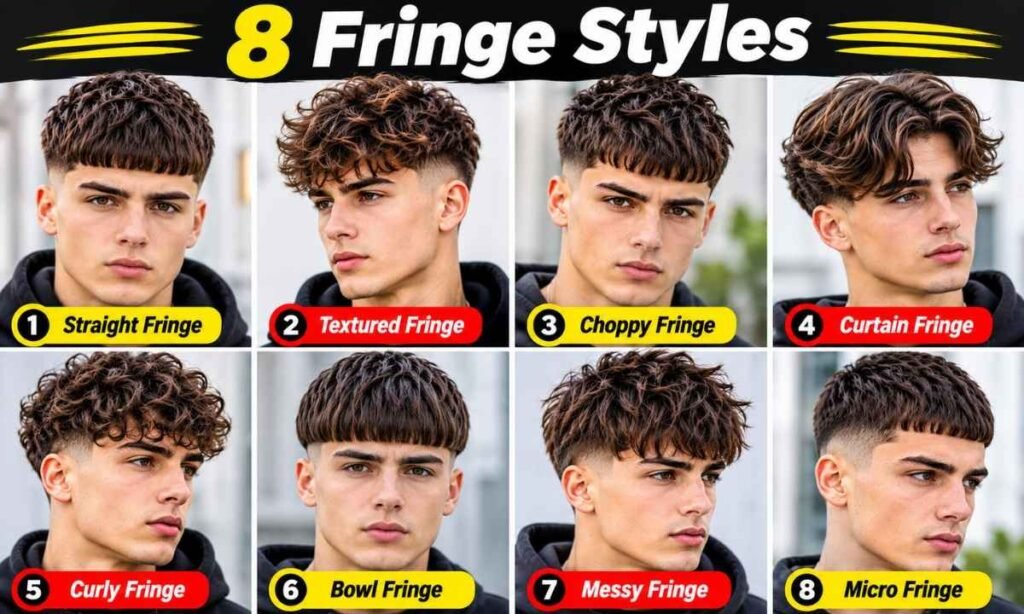
- Blunt straight fringe. A clean line across the forehead with a #2 low taper. Sharp, graphic and best on straight, thick hair.
- Short choppy fringe. Point-cut ends sit about a finger above the brow. Soft, modern and forgiving if your hairline isn’t perfectly even.
- Side-swept fringe. The fringe angles slightly to one side. A good fit for round and square faces.
- Micro fringe. Cut very short and high on the forehead. It looks minimal and suits people with a low hairline.
- Longer forward fringe. The front stays closer to 2 or 3 inches. It brushes the brow and works well for wavy hair.
- Diagonal fringe. Cut at an angle from one temple to the other. It softens the forehead without hiding it.
- Split fringe. A soft parting in the middle that falls to both sides. Easy to wear on straight and wavy hair.
- Feathered fringe. Ends are razor- or point-cut so they separate naturally. Gives movement to fine hair.
8 Textured and Messy Styles
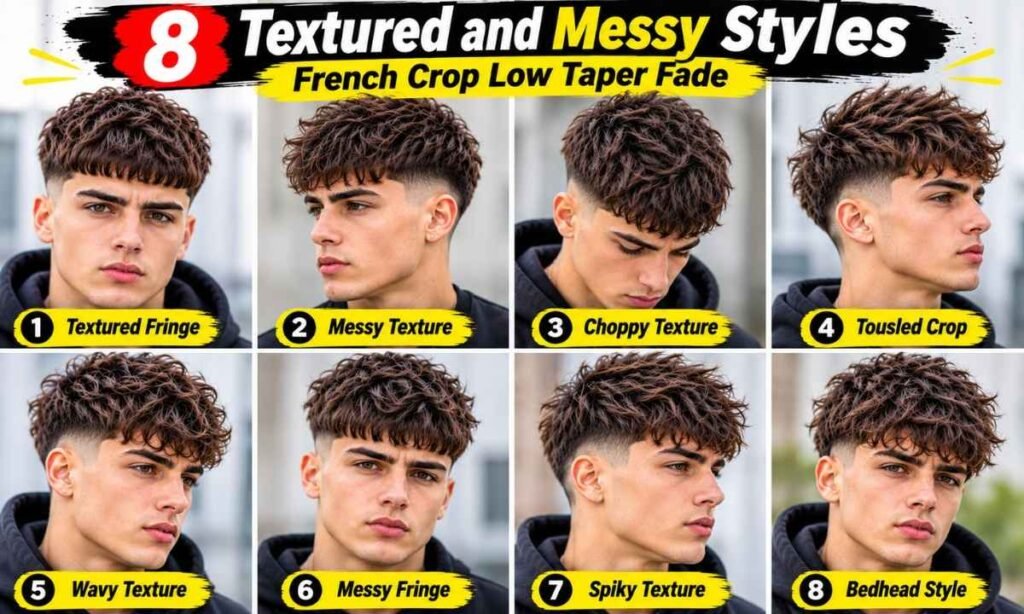
This is the territory of the messy French crop low taper fade and the textured French crop low taper fade. The goal is controlled disorder.
- Messy French crop. Scrunch in a matte paste and leave it. The taper keeps the mess from looking sloppy.
- Sea salt texture. Spray, rough-dry and leave. Good for fine hair that needs grit.
- Choppy layered crop. The barber cuts short layers on top so pieces separate on their own.
- Matte clay crop. Heavy texture with zero shine. It stays put all day.
- Bed-head blow-dry. Blow-dry the fringe forward with your fingers, then break it up with a little powder.
- Spiky textured crop. Short and tousled, pushed up slightly at the front. Younger and edgier.
- Disconnected top. A visible length gap between top and sides, kept soft by the low taper.
- Lived-in grown-out crop. A longer, softer version about 3 inches on top. Casual, and it forgives the missed trim.
8 Styles by Hair Type

- Fine straight crop. Short top, light texturizing powder, taper at #2. Avoid heavy products.
- Thick straight crop. Point-cut to remove weight so the fringe lies flat instead of pushing out.
- Wavy forward crop. Let the waves fall forward naturally and tidy only the edges.
- Wavy side-parted crop. A soft side part with a low taper. Neat enough for an office.
- Curly fringe crop. Curls cut short and brushed forward over the brow, using the curl as the fringe.
- Coily twist-top crop. Defined twists or coils on top with a low taper cleaning the sides.
- Afro French crop. A rounded, cropped afro top with a clear edge-up. Structured and easy to maintain.
- Loose curl tousled crop. Wider curls with a messy, scrunched finish and a soft #3 taper.
6 Styles by Taper Finish or Add-On

- Shadow taper. The sides blend down to a short shadow of hair, never to skin. Understated and low risk.
- Skin taper. The edges blend to bare skin at the very bottom. Sharper contrast, shorter shelf life.
- Hard part. A shaved line to mark the part, paired with a side-swept crop. Adds definition.
- Beard blend. The taper flows into a trimmed beard so there’s no abrupt change at the sideburn.
- Temple edge-up. A crisp line at the temples and forehead. It frames the fringe.
- Tapered neckline. The nape tapers to a soft finish rather than a hard block. It grows out more naturally.
French Crop Low Taper Fade Variations
Since the 30 styles above already cover the common variations, here is the short version of what changes from one to the next.
Fringe and top. Blunt, choppy, side-swept or micro are the main fringe options. A low taper fade textured top simply means the barber adds layering or point-cutting to give the crop movement.
Hair type. Straight hair keeps a clean line. Wavy hair gets a softer, forward-falling top. Curly and coily hair use the curl itself as the texture, with the taper handling the structure.
Taper finish. Natural, shadow and skin finishes differ only at the base of the cut. A natural taper stops at a short guard. A shadow taper blends a little lower. A skin finish goes to bare skin and needs more frequent trims.
French Crop Low Taper Fade Comparisons
Low Taper vs Low Fade, Mid Fade and High Fade
People search for a French crop mid fade or a French crop taper fade and expect the same thing. They aren’t the same.
| Cut | Where it starts | Contrast | Best for |
|---|---|---|---|
| Low taper | Ear line and nape only | Subtle | Office, first-timers, thick sides |
| Low fade | Just above the ear, can reach skin | Moderate | A cleaner, sharper look |
| Mid fade | About temple height | Strong | A defined, modern shape |
| High fade | Above the temples | Strongest | A bold, high-contrast style |
A low taper keeps the most length on the sides and is the softest of the four. If you want visible contrast, choose a fade. If you want polish without drama, choose the taper.
French Crop vs Textured Crop, Caesar Cut and Crew Cut
These get mixed up constantly.
| Cut | Top | Fringe | Texture |
|---|---|---|---|
| French crop | Short, forward-brushed | Cropped, blunt or choppy | Usually textured |
| Textured crop | Short to medium, piecey | Optional, softer | Heavy |
| Caesar cut | Short, even length | Straight, horizontal | Little to none |
| Crew cut | Short, kept up or brushed up | None | Minimal |
A textured crop low taper fade is the closest relative: the same short top and low sides, but the fringe is not required to be blunt. The Caesar cut is more uniform and flat. The crew cut is shorter and stands up rather than forward.
What Should You Ask Your Barber For?
Barbers work from precise instructions. “A French crop with a fade” leaves too much open, so give measurements.
The Barber Consultation Checklist
Cover these points before the clippers come on:
- The name of the cut: French crop with a low taper
- Top length in inches or centimeters
- Fringe style: blunt, choppy or side-swept
- Taper start and finish guards
- Neckline: tapered, rounded or blocked
- Whether you want a hard part or edge-up
- How you plan to style it
A Copyable Barber Script
“I’d like a French crop with a low taper. Top about 2 inches, cut forward with a choppy fringe that sits just above my brows. Sides start at a #2 at the neckline and blend up to a #3 around the ears. Tapered neckline, no skin. Leave it textured, please.”
Swap in your own numbers. If you aren’t sure, tell the barber how much time you want to spend styling and let them suggest lengths.
How to Use Reference Photos Without Getting the Wrong Cut
A photo is helpful but easy to misread. Lighting, hair density and camera angle all change how a haircut appears.
- Bring two or three photos from different angles, including the side and back.
- Point at what you like: the fringe, the taper height or the texture.
- Mention differences between that person’s hair and yours. Curly hair will not behave like the straight hair in the photo.
- Ask the barber if it will work on your hair type before they start.
Common Ordering Mistakes
- Saying “fade” and nothing else. A fade can go from a low taper to a high skin fade. Say “low taper” and add a guard number.
- Skipping guard numbers. “Short on the sides” is ambiguous. Give a starting guard.
- Not specifying the top. “Short” means different things to different people.
- Ignoring the neckline. A blocked neckline looks very different from a tapered one.
- Not mentioning your cowlick. Tell the barber where it is so they can cut around it.
How to Style a French Crop Low Taper Fade
The upside of this cut is that styling takes very little effort.
A Five-Minute Everyday Styling Routine
- Start with towel-dried hair, not soaking wet.
- Apply a light spray or cream if your hair is fine or dry.
- Blow-dry the fringe forward using your fingers, flat or slightly angled.
- Rub a small amount of product between your palms and work it through from the roots.
- Pinch and break up the ends of the fringe, then stop. Over-handling it ruins the texture.
Which Product Type Should You Use?
| Product | Best for | Finish |
|---|---|---|
| Matte clay | Thick or straight hair | Strong hold, no shine |
| Paste | Most hair types | Medium hold, flexible |
| Sea salt spray | Fine or straight hair | Light grit and volume |
| Texture powder | Fine, flat hair | Lift with no weight |
| Pomade | Side-swept or slicked versions | Smooth, some shine |
| Curl cream | Curly and coily hair | Definition and moisture |
Styling Mistakes and Weather Adjustments
Common mistakes:
- Using too much product. The fringe looks greasy and heavy.
- Combing it flat when the cut is meant to look undone.
- Styling soaking-wet hair. It won’t hold the shape.
Weather adjustments:
- Humidity: Use a strong-hold matte product to stop frizz and curl in the fringe.
- Wind: Choose clay or paste instead of light sprays.
- Dry winter air: Add a little cream so the top doesn’t look dull.
- Rain: Skip the sea salt spray, which draws more moisture into the hair.
Maintenance, Grow-Out and Scalp Care
How Often Should It Be Trimmed?
| Cut version | Trim every |
|---|---|
| Natural low taper | 3 to 4 weeks |
| Skin taper | 2 to 3 weeks |
| Top and fringe only | 6 to 8 weeks |
The taper shows regrowth first. The top can last longer, but the contrast between top and sides fades within a month.
Keeping the Cut Presentable Between Visits
- Clean up your neckline and sideburns with a small trimmer.
- Keep the fringe trimmed so it doesn’t fall into your eyes.
- Wash hair regularly so oil doesn’t flatten the texture.
- A little product on day two refreshes the shape.
Avoid cutting the taper yourself unless you have the right tools. A crooked line is much harder to fix than it is to leave alone.
How to Grow It Out Gracefully
The low taper makes growing out easier than a high fade. Here’s the process:
- Weeks 1 to 4. The taper softens naturally. Keep the neckline tidy.
- Weeks 4 to 8. The sides begin to fill out. Ask your barber to trim only the neckline and ears.
- Weeks 8 to 12. The top lengthens into a longer fringe. Use a paste to keep it flowing forward.
- After 3 months. You’re at a short textured cut. Shape it with a trim and let it keep growing.
The awkward stage usually shows up around the two-month mark. A hat, a little product and a neckline cleanup get you through it.
Close-Cut Irritation and When to Reconsider a Skin Finish
Cutting down to skin can cause razor bumps, redness or ingrown hairs, especially on curly or coily hair. If you get irritation, move to a shadow taper or a #1 guard instead. Use a gentle aftershave or a soothing balm after each cut, and keep the skin clean. If irritation persists, speak to a dermatologist.
Should You Get This Haircut?
Yes, if you want a neat, modern cut that doesn’t demand much from you. The French crop low taper fade is flexible. It works on most hair types, flatters many face shapes and styles quickly. The main commitment is the regular trim.
A quick checklist before you book:
- Is your hair at least 1 to 2 inches long on top?
- Can you get to a barber every 3 to 4 weeks?
- Are you comfortable with a fringe on your forehead?
- Do you know whether you have a front cowlick?
- Have you decided between a natural and a skin finish?
If most answers are yes, go for it. If your hair is very fine or you have a strong front cowlick, talk through the details with your barber first.
Frequently Asked Questions
Is a French crop a taper fade?
No. A French crop is the top: a short, forward-brushed fringe. A taper fade is the side finish, and the two are often combined.
Which fade is best for French crops?
A low taper is the safest and most versatile choice. A low or mid fade works if you want more contrast.
What is the Gen Z haircut?
There’s no official definition, but the term usually refers to textured fringes with tapered sides, such as a French crop. Curtains and two-block cuts often get the label too.
Is low taper fade haram?
Scholars differ. Many distinguish qaza’, which means shaving part of the head and leaving other parts, from a gradual blend of slightly different lengths. Some treat a skin fade as disliked. Ask a scholar you trust for guidance.
How long should my hair be on top for a French crop?
About 1 to 3 inches (2.5 to 7.5 cm). Fine hair does better near 2 inches.
Can I get a French crop with short or thinning hair?
Yes. Keep the top slightly longer, add texture and choose a choppy fringe. It hides thin areas better than a slicked-back style.
How long does a French crop low taper fade take to grow out?
About 2 to 3 months to a comfortable, even length. The low taper grows out more softly than a high fade.
