

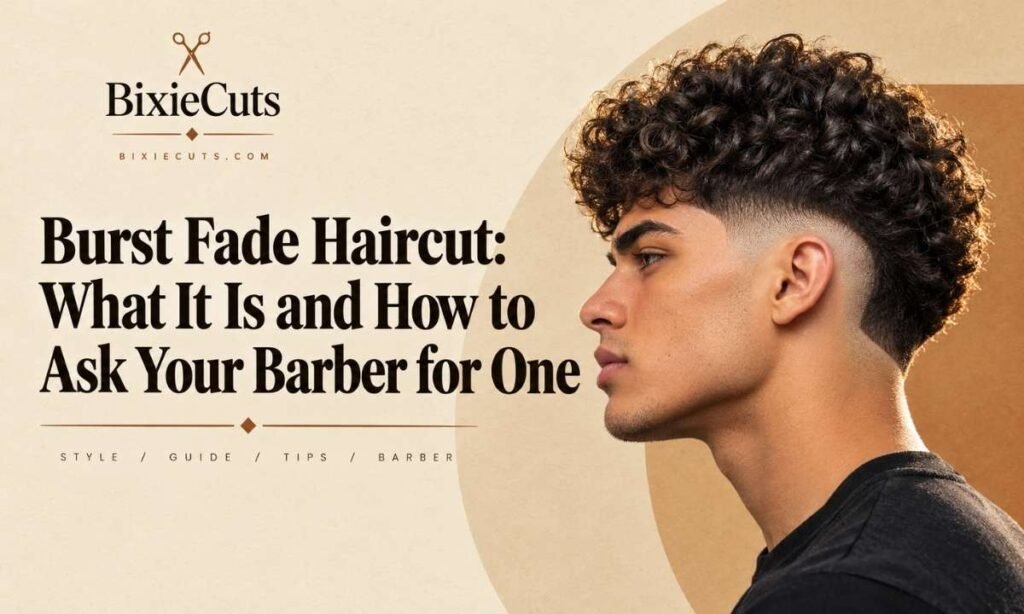
A burst fade haircut is a fade that curves in a half circle around the ear, leaving the hair short behind it and longer on top and at the back. It is a shape for the sides, not a full style, so it works under a mullet, a crop or curls.
Most men bring a photo to the chair and hope for the best. That is where things go wrong, because the same photo can mean a low, mid or high curve, skin or a guard, and a short or long neck. This guide gives you the words to say.
Quick answers
- What it is: a fade shaped as a half circle around the ear, with length kept on top and at the back.
- Height choices: low is subtle, mid is the usual pick, high gives the strongest contrast and needs the most upkeep.
- What to say: “[height] burst fade, [skin or guard number], [top length], leave the neck long.”
- Upkeep: plan on a return visit every 2 to 4 weeks, sooner for high or skin versions.
What is a burst fade haircut?
A burst fade haircut is a fade that spreads out from a short point behind the ear and curves round into the neckline. The hair is shortest right behind the ear and gets longer as the fade moves outwards.
Some barbers and style sites call the same shape a radial fade or a halo taper. The word “burst” describes the way the lines fan out from a point behind the ear.
How does the burst shape work around the ear?
The barber cuts a half circle that starts above the ear, passes behind it and drops towards the neck. Inside that curve the hair is cut close, often to skin. Outside it, the length returns quickly.
That gives a clear contrast between the faded patch and the rest of the head. A standard fade runs level around the head. A burst bends around the ear instead, which is why it reads as a shape rather than a gradient.
What hair stays longer in a burst fade?
The top, the crown and the back of the head keep their length. That is the main difference from a standard fade, which also shortens the back.
Because the neck stays long, the cut pairs naturally with a mullet or a faux hawk. You can still ask for a tidy neckline. The point is that you decide how much length stays, instead of the clippers deciding for you.
Who does a burst fade suit?
A burst fade suits most men, because it only changes the hair around the ears.
What matters more than face shape is the length you have on top, how your hair grows and how often you are willing to see your barber. Some length on top gives the contrast more to work against. If you are unsure how the cut will sit with your face, our guide to triangle face shape hairstyles for men shows how length and sides change your proportions.
Which hair textures work with a burst fade?
Every texture works, but each one behaves differently once the sides are short.
Straight hair shows the shape most cleanly, though it can fall flat on top without product. Wavy hair gives natural movement and hides small blending flaws. Curly and coily hair makes the strongest contrast, because a full top sits against close sides.
Very tight coils shrink when dry, so tell your barber how long you want the top to look, not only how long it is when stretched. Bring a photo of someone with a similar texture if you can.
How do head shape, density and hairline affect the choice?
Head shape, hair density and your hairline decide where the curve can sit and how clean it looks. Four cases come up often:
- A flatter back of the head: length left at the back can add shape where the skull is flat.
- Thin hair: a skin finish shows more scalp, so a low guard behind the ear is usually kinder.
- A cowlick at the crown: short hair there stands up, so leave extra length on top of it.
- Receding temples: ask for the curve to start a little further back, so it does not widen the gap.
If you are not sure which case is yours, ask your barber to look at your hairline and crown before they pick a height.
Low vs mid vs high burst fade: which should you choose?
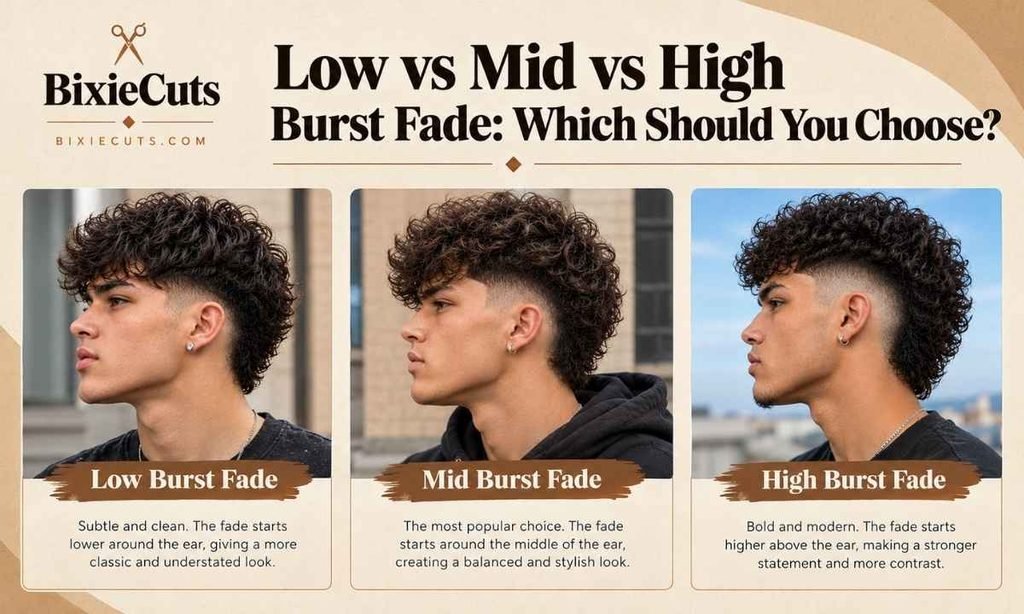
Choose low if you want a subtle cut, mid if you want the standard burst, and high if you want strong contrast and do not mind rebooking often.
| Height | Where the curve sits | Rebooking |
|---|---|---|
| Low | Close to the ear and hairline | Slowest to look grown out |
| Mid | Halfway up the side | About every 3 weeks |
| High | Up towards the crown | Sooner, often 2 weeks |
What is a low burst fade?
A low burst fade keeps the curve close to the ear and the hairline, so most of the side keeps its length. It reads softer than the other two and suits offices, schools and anyone trying a burst for the first time.
A low fade runs level, while a low burst fade curves round the ear. Our low fade haircuts guide shows the straight version if you want to compare them.
What is a mid burst fade?
A mid burst fade puts the curve about halfway up the side of the head. It is the height most people ask for, because the contrast is clear without being extreme.
It also gives your barber room to blend. If you are unsure, say “mid burst” and ask them to show you the line in the mirror before they finish.
What is a high burst fade?
A high burst fade lifts the curve towards the crown, so more of the side goes short. It gives the sharpest contrast, especially when the shortest point is taken to skin.
The price is upkeep. A skin fade shows regrowth quickly, so a high burst needs more visits. Choose it only if you will actually book them.
What guard number goes where? A burst fade zone map
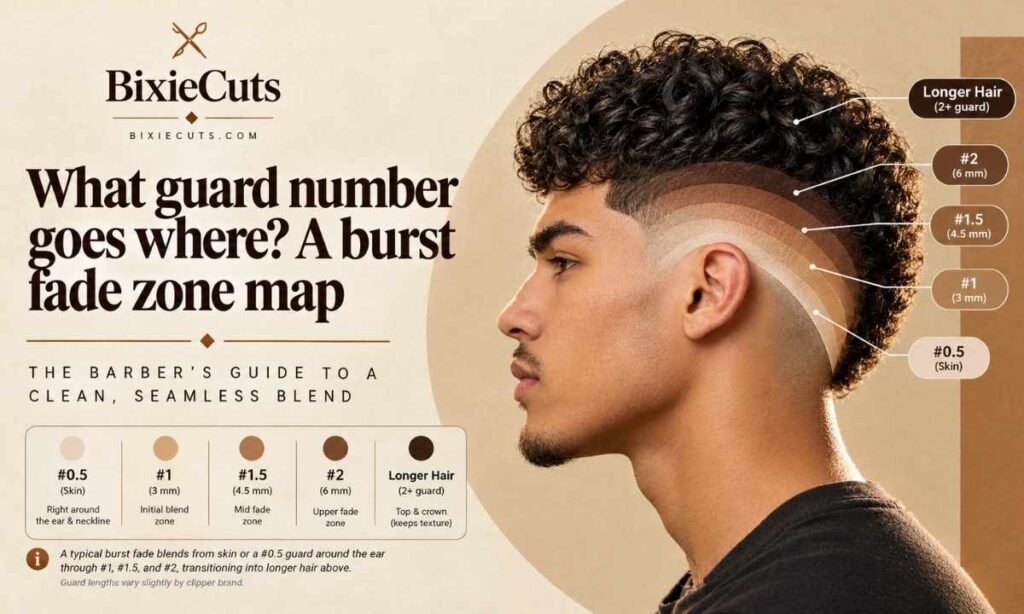
Most burst fades use skin or a low guard behind the ear, then step up through the guards as the curve moves outwards.
| Zone | Closest option | Softer option | Note |
|---|---|---|---|
| Behind the ear | Skin | 0.5 to 1 | Shortest point |
| Around ear and temple | 0.5 to 1 | 1 to 2 | Where the curve starts |
| Upper side | 1.5 to 2 | 2 to 3 | Blends into the top |
| Nape and back | Left long | Left long | Say the neckline shape |
These numbers are typical starting points, and they vary by barber, clipper brand and country.
Guard numbers are a guide, not a recipe. Barbers blend with the clipper lever as well as with guards, so name the closest point you want and let them blend upwards from there.
Best burst fade styles to show your barber
A burst fade only shapes the sides, so the top decides the style. These five combinations are the ones worth saving as reference photos.
1. Burst fade mullet
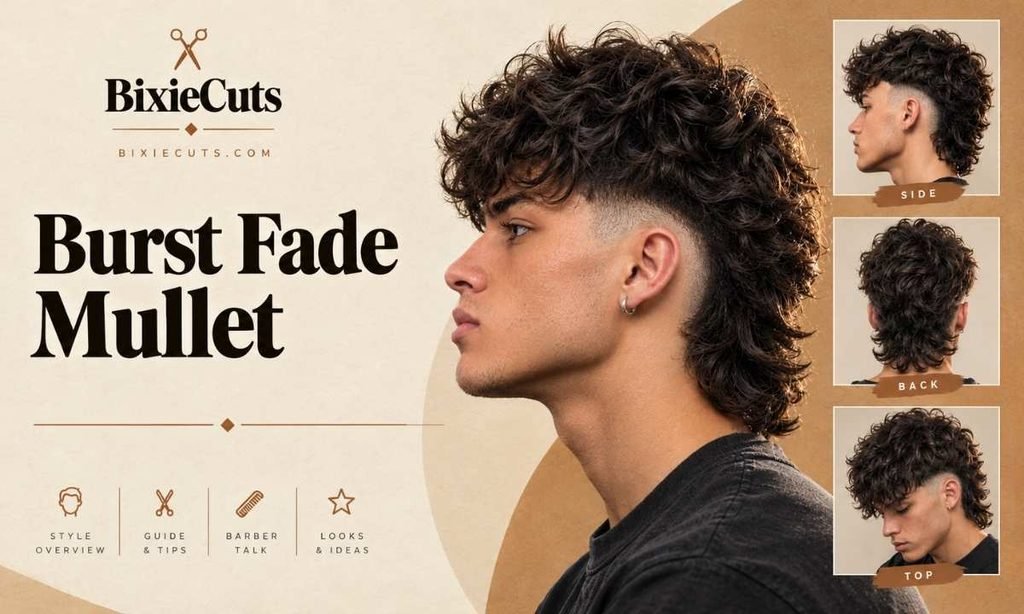
A burst fade mullet keeps the back long while the sides curve short around the ears. It is the most natural pairing, because the burst already leaves the neck alone. Tell your barber how long the back should be in inches, and whether you want it pointed or squared off.
2. Burst fade mohawk or faux hawk

A burst fade mohawk or faux hawk puts the length down the centre and the curve round the ears. The short sides push the eye upwards, so the top looks taller than it is. A faux hawk is softer, because the length blends into the sides instead of standing apart.
3. Curly or coily burst fade

On curls and coils, the burst gives the clearest contrast of any texture. A full top sits above close sides, and the curve frames it. Ask your barber to cut the top dry, so they see how the curls actually fall and shrink.
4. Short or textured-top burst fade

A short burst fade pairs with a French crop or a textured fringe. The top is cut short and choppy, with a fringe that sits forward. It works well on finer hair, but the cut shows every flaw, so it needs regular visits.
5. Straight or wavy burst fade
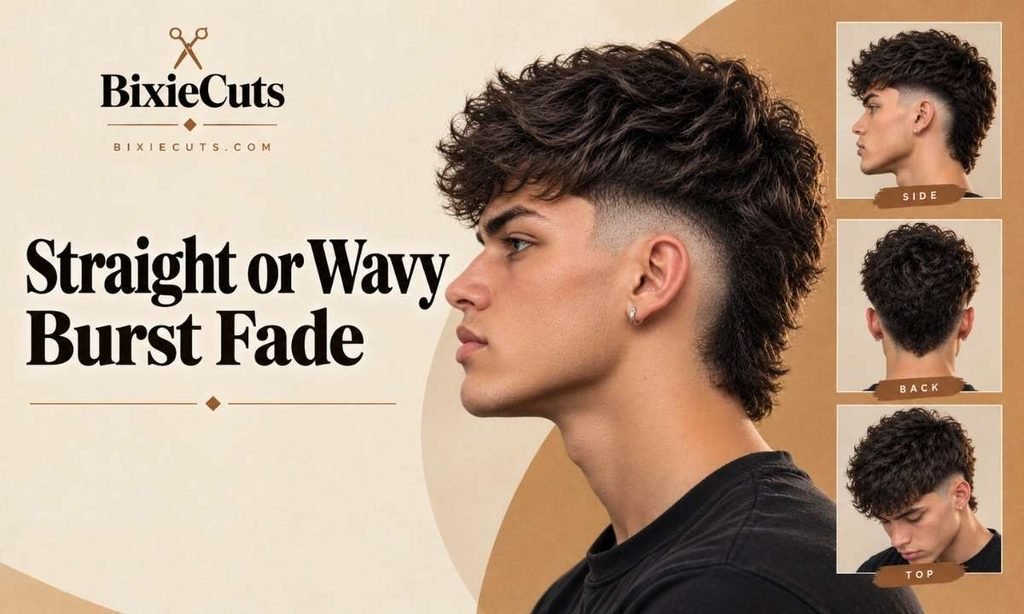
Straight and wavy hair holds the burst line cleanly. A longer top can be swept back or pushed to one side, while a shorter one sits flat with a bit of paste. If your hair is fine, ask for some texture in the top, or it can look limp beside the sharp sides.
Burst fade vs drop fade, taper fade and skin fade
A burst fade is defined by its curve around the ear, while the other three are defined by their height, depth or finish.
| Cut | Where it goes short | The neck | Best for |
|---|---|---|---|
| Burst fade | Behind the ear, in a half circle | Left long | Mullets, curls, textured tops |
| Drop fade | Dips lower behind the ear | Short, follows the dip | Clean, angular looks |
| Taper fade | Sideburns and neckline | Cut short | Quiet, conservative cuts |
| Skin fade | Anywhere, down to bare skin | Varies | Maximum contrast |
Burst fade vs drop fade
The two differ in how they behave behind the ear. A drop fade dips lower there and looks more angular, while a burst curves around the ear and into the neck. If you want a rounded shape, ask for a burst. If you want a sharp, sloping line, ask for a drop.
Burst fade vs taper fade (and can you taper a burst?)
A taper is a gradual blend that stays short at the sideburns and neckline. A burst is a specific curve that leaves the back long. You can combine them: ask for a burst taper if you want the curve with a softer blend. Our burst fade taper haircut guide shows the combination in detail.
Burst fade vs skin fade
A skin fade is a finish, not a shape. It describes how close the shortest point goes: all the way to bare skin. A burst fade can be done to skin or stopped at a guard. So “burst skin fade” is a valid request, and “burst fade” alone leaves the barber guessing about closeness.
How to ask your barber for a burst fade
Ask for a burst fade by naming its height, how close it goes, the top length, the neck length and the finish. Barbers cannot read a photo as precisely as you think, so say these five things out loud.
Use a five-point barber brief
- Height: low, mid or high burst.
- Closeness: skin at the shortest point, or a guard number.
- Top length: give it in inches or by pinching a length on your finger. “Short” means different things to different people.
- Back and neck: leave it long, and say how long. Ask for the neckline shape too: rounded, squared or natural.
- Finish: line up or no line up, and whether you want the barber to show you the curve in the mirror before they finish.
A sample sentence: “Mid burst fade, skin behind the ear, two inches on top, leave the neck long and natural.”
What should your reference photo show?
A good reference photo gives your barber the angles they need. Bring more than one:
- A side view, where the curve is easiest to read.
- A front view, so the height of the burst is clear against the face.
- A back view, which shows the neck length you want.
- A photo of someone with your hair texture, if you can find one.
If the photo is of a different texture, tell the barber so. A cut that looks soft on straight hair can look much stronger on tight curls.
What are the most common miscommunications?
Most disappointments come from the same few gaps in the brief:
- The barber cuts the back short because the neck length was never mentioned.
- “A bit shorter on top” is read as a lot shorter.
- A high burst is cut when you meant mid, because height was never named.
- The line up is added without being asked for.
Each one has the same fix: say the detail out loud before the clippers start, and ask the barber to repeat it back.
Burst fade barber checklist
Screenshot this list and show it to your barber before the clippers come out.
- Burst height: low, mid or high
- Shortest point: skin or a guard number
- Top length in inches
- Back and neck length left long
- Neckline shape: rounded, squared or natural
- Line up or no line up
- Reference photos from side, front and back
- Mirror check before the final trim
How much does a burst fade cost, and should you tip?
A burst fade haircut in the United States typically costs between $25 and $55, with a national average of around $35 to $45 for standard services.
- Standard range: $25 to $45 at most local and independent barbershops. For example, The Wood Shop charges $45 and The Fade Factory charges $25.
- Specialised or upscale shops: $50 to $65 or more in major cities and specialised studios. For example, CROWNS charges $55. Complex cuts with custom hair designs can reach $80 to $100 or more.
Tipping customs differ by country, so here is how the two compare.
| Country | Baseline custom | Usual amount |
|---|---|---|
| United States | Customary and expected | 15% to 20%, often rounded up to the nearest $5 |
| United Kingdom | Optional and voluntary | Round up, or add £2 to £5 |
How do you style a burst fade?
You style a burst fade by styling only the top, because the sides keep their shape on their own. The method changes with your texture and with how long the top is.
Styling by hair texture and top style
| Texture | Prep | Product | Finish |
|---|---|---|---|
| Straight | Damp hair, blow dry up | Texture powder or light clay | Matte, pushed back or to the side |
| Wavy | Sea salt spray, blow dry | Paste or cream | Loose, natural movement |
| Curly | Leave in conditioner, air dry or diffuse | Curl cream or light gel | Defined curls, no crunch |
| Coily | Moisturise, finger coil if wanted | Butter or cream | Soft shape, shine optional |
For a short crop, keep product light. Heavy wax on a short top shows through and weighs fine hair down. For a longer top, a bit more hold helps the length keep its shape through the day.
How long does a burst fade last, and how do you maintain it?
A burst fade looks its best for about two to four weeks, depending on its height and how close it goes.
Touch-up timing: where barbers disagree
Advice on rebooking varies. Some barbers say two weeks is enough for a high or skin burst, while others say three or four is fine for a low one. Both can be right. A skin finish shows regrowth within days, but a softer guard hides it for longer. Book by how the cut looks to you, not by a fixed number.
How does a burst fade grow out?
A burst fade grows out well, because the back and top stay long throughout. Hair grows around half an inch a month, so a burst cut to skin behind the ear has about an inch of regrowth there after two months. That makes it a handy starting point if you want to grow into a mullet.
Once the curve loses its edge, you have two choices. Go back for a touch-up, or let it blur into a taper while the top grows. Both work.
Scalp and skin care for very close or skin bursts
Skin finishes leave the scalp exposed, so a little care helps.
- Moisturise the area after washing, with something light.
- Use sun cover when you are outdoors for long, because a close cut shows no hair cover.
- Avoid scratching newly cut skin, as it can irritate.
- Watch for ingrown hairs, especially on tighter curls, and see a doctor if they become sore.
What if your burst fade goes wrong? Fixes by hair type
Most problems can be fixed with a short, clear sentence at the next visit.
| Problem | Likely cause | What to say | Hair type |
|---|---|---|---|
| Curve too high | Height never named | “Take it down to a low burst, blend up” | Any |
| Back cut too short | Neck length not mentioned | “Let it grow, tidy only the edge” | Any |
| Looks harsh | Skin used instead of a guard | “Soften it with a 0.5 or 1 guard” | Fine or thin |
| Uneven curve | Cowlick or hair growth pattern | “Blend the right side to match the left” | Curly or coily |
| Top looks flat | Too short for the hair texture | “Leave more length and add texture” | Straight or fine |
If you are unhappy, say so at the chair, not after you leave. Hair cannot be added back, so a clear five-point brief is the best fix.
Is a burst fade right for you?
A burst fade is right for you if you want contrast around the ears, are happy to keep length on top, and will book regular visits. If you want a cut that never looks grown out, a softer option may suit you better.
Main benefits
- The curve adds shape without changing your usual top.
- Daily styling covers the top only.
- It works on straight, wavy, curly and coily hair.
- Leaving the back long makes it a handy first step towards a mullet.
Trade-offs, edge cases and dress codes
- A high or skin burst shows regrowth within about two weeks, so it costs more in time and money over a year.
- The cut depends on a clear brief. A barber who is rushed or guessing can easily get the height or neck length wrong.
- Very fine or thin hair can look sparse beside a skin finish. A guard is usually kinder.
- If your hair stays very short all over, the contrast is small.
- Some workplaces and schools have grooming rules. Check yours before booking a high burst.
What are the best alternatives to a burst fade?
If a burst fade is not quite right, these cuts give a similar clean finish with a different shape:
- Taper fade: a gradual blend that stays short at the sideburns and neckline. It is quieter than a burst. Our burst fade taper haircut guide shows the middle ground.
- Drop fade: dips lower behind the ear for a sharper, more angular line.
- Low fade: runs level around the head and is easy to keep. See the low fade haircuts guide.
- Caesar cut: a short, even length with a straight fringe, and almost no styling. Browse Caesar haircuts for men.
- Classic comb over: a tidy side parting with short sides, good for work. See the classic comb over haircut.
Frequently Asked Questions
Is a burst fade the same as a mullet?
No. The burst fade is the shape of the sides, and the mullet is the whole hairstyle with a long back. They are often paired, but a burst also works under crops, mohawks and curls.
Can you taper a burst fade?
Yes. Ask for a burst taper. The curve stays around the ear, but the blend is softer, and the shortest point can stop at a guard instead of going to skin.
How is a low fade different from a low burst fade?
A low fade runs level down the side and across the back. A low burst fade curves round the ear and leaves the neck long. Say both words so your barber gets the shape.
How often do you need a touch-up?
Most people rebook every two to four weeks. High or skin versions show regrowth sooner, while low or guard versions last longer. Rebook when the curve starts to blur.
How long does a burst fade take to grow out?
Hair grows about half an inch a month, so a burst looks clearly grown out after six to eight weeks. The top and back keep their length in the meantime.
How much should you tip for a burst fade?
In the US, tipping is expected at 15% to 20%, often rounded up to the nearest $5. In the UK it is optional, so round up or add £2 to £5.
What do you say to the barber to get a burst fade?
Say: “Mid burst fade, skin behind the ear, two inches on top, leave the neck long.” Swap in your own height, closeness and lengths, and bring photos from the side, front and back.
Is a burst fade suitable for thinning hair or a receding hairline?
Often yes, with care. Ask for a low burst with a guard instead of skin, and have the curve start further back so it does not widen the temples. Ask your barber to check your hairline first.
Conclusion
A burst fade haircut is a simple idea: a curve around the ear, with length kept on top and at the back. The shape is easy to like. The hard part is explaining it, because height, closeness and neck length all change the result.
Use the five-point brief and the checklist, and bring photos from more than one angle. Start low if you are unsure, and move up once you know what you like. Then rebook before the line blurs, not after.
