

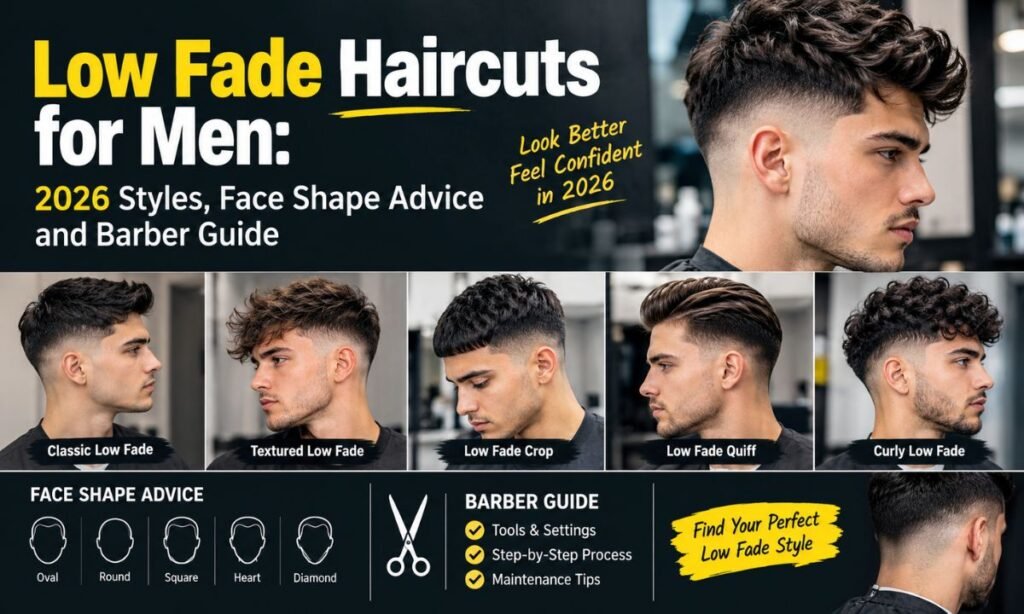
A low fade is a haircut where the sides and back start very short just above the ears and neckline, then blend upward into longer hair. It is the softest kind of fade, which is why men wear it to offices, weddings, classrooms and gyms without a second thought.
This guide explains what a low fade really is, how it differs from a low taper, and which top style suits your hair type and face shape. You will also get exact words to use with your barber, typical US costs, upkeep timing and styling tips.
Quick answer: Ask for a low fade if you want short, clean sides with a visible but gentle blend. Choose a low taper if you want a more conservative cut that leaves more side length and grows out softly.
What Is a Low Fade Haircut?
A low fade shortens the hair gradually around the lower part of the head. The shortest hair sits at the bottom, often at skin level or a very close guard, and the length increases as it rises toward the parietal ridge, the point where the head starts to curve inward.
The word “low” describes where the blend ends, not how short the top is. A low fade can sit under a long pompadour or a tiny crop. The fade is a technique, so the final look depends on the top style you pair with it.
A simple way to picture it is to imagine a line running around your head from the top of your ear. A low fade stays mostly below that line. A mid fade climbs to around temple height, and a high fade starts well above the temples.
Fade Heights Compared
| Fade height | Where the blend ends | How it looks |
|---|---|---|
| Low fade | Just above the ear | Subtle and conservative |
| Mid fade | Around the temple | Balanced and versatile |
| High fade | Well above the temple | Bold and high contrast |
Why the Low Fade Stays Popular
Barber shop trend posts for 2026 describe a shift toward softer, more restrained blends. The idea is that the fade should support the haircut rather than become the haircut. Several shops also report that the low taper fade with a textured top is among their most requested cuts this year.
Treat those claims as a useful signal rather than hard data, since they come from individual shops and not a national survey. What they agree on is practical: a low blend looks polished, suits many jobs and grows out without a harsh line.
Low Fade vs Low Taper vs Skin Fade
These terms overlap, and barbers do not all use them the same way. That is the main reason men leave with a cut they did not expect. Understanding the differences helps you ask clearly.
A fade usually shortens the hair all the way down to skin or very close to it at the base. A taper shortens the hair more gradually and usually only around the sideburns and neckline, leaving the rest of the sides longer. A skin fade, also called a bald fade, is a fade that reaches bare skin at its shortest point.
| Cut | What changes | Best for |
|---|---|---|
| Low taper | Sideburns and neckline only | Conservative, low upkeep |
| Low fade | More of the lower side, often to skin | Sharper look, visible blend |
| Low skin fade | Same height, reaches bare skin | Crisp contrast on a low blend |
| Drop fade | Curves down behind the ear | Rounded heads, curved outline |
One barber academy describes a low skin fade as functionally a low taper that goes all the way to skin at its base. Another barber guide says a low fade removes more hair across the lower side, while a low taper focuses on the sideburn and neckline. Both descriptions point to the same practical rule: the fade is sharper, the taper is softer.
If you are unsure, start with the softer version. A barber can tighten a blend on your next visit, but nobody can add length back.
A Note on the Temple Fade
The temple fade, sometimes called a Brooklyn fade or blowout, concentrates the blend around the temples and sideburns instead of wrapping fully around the head. Reference sources say it became popular in the late 1990s and early 2000s as a variation of the bald fade. It remains common on curly and coily hair because it frames the hairline cleanly.
Clipper Guard Numbers Explained
Knowing guard numbers helps you understand what your barber is doing and lets you ask for a specific finish. On standard US clippers, the number tells you how many eighths of an inch remain after cutting.
| Guard | Hair left | Millimeters |
|---|---|---|
| #0.5 | 1/16 inch | about 1.5 |
| #1 | 1/8 inch | about 3 |
| #1.5 | 3/16 inch | about 5 |
| #2 | 1/4 inch | about 6 |
| #3 | 3/8 inch | about 10 |
| #4 | 1/2 inch | about 13 |
Half sizes such as #0.5 and #1.5 are sold separately in some kits, and barbers use them to smooth fade transitions. With no guard, most clipper blades leave stubble of about half a millimeter, and a taper lever adjusts that slightly. Exact lengths vary a little by brand, so check the marking on your own guard.
Who Should Get a Low Fade?
Almost any man can wear one. The low placement keeps most of the side hair, so the cut changes your outline less than a mid or high fade would. That makes it a sensible first fade if you have never tried one.
Some situations call for extra thought. If your hairline is receding, a very tight fade at the temples can draw attention to the recession. Ask your barber for an honest assessment and a slightly longer guard around the temples.
Workplace rules also matter. Most offices accept a low fade, but a hard skin fade with a shaved line may not suit stricter dress codes. A low taper starting at a #2 guard is usually the safest choice.
Low Fade and Receding Hairlines
Barbers quoted in men’s grooming articles often recommend cuts that work with the hairline instead of hiding it. A textured crop with the front pushed forward softens the hairline, and a fade that graduates naturally does not depend on a perfectly drawn edge.
One New York barber quoted in a thinning-hair guide warns against comb overs, so avoid dragging long strands across thin areas. If your recession is advanced, a short top with a low or mid fade is often the cleanest option.
Best Low Fade Haircuts by Hair Type
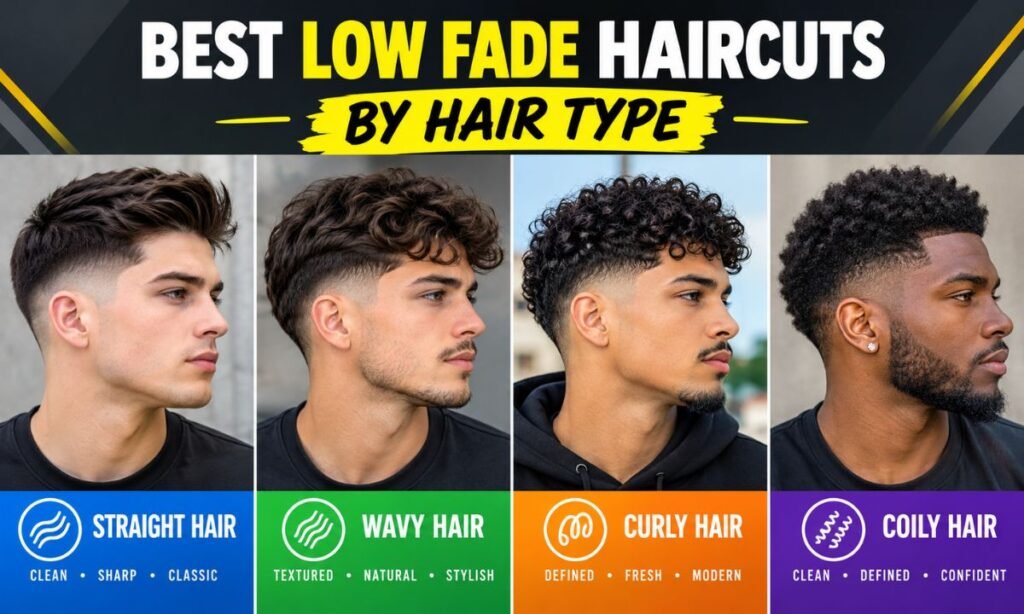
Hair texture decides how the top sits, how long the fade looks fresh and how much styling you need. The fade works on every texture, so choose the top to match your hair.
Thick Hair
Thick hair grows out fast and can look boxy at the sides. A low fade removes bulk around the ears and nape, which are the areas where thick hair puffs out first. Keep the top two to four inches long and ask for texturizing so it does not sit like a helmet.
A textured crop, a side part and a quiff all work. Very short tops on thick hair can stand upright, so tell your barber if you want a softer finish.
Thin Hair
Thin hair looks fuller when the contrast between sides and top is small. Ask for a low fade that stops at a #1 or #2 guard rather than skin, so the sides do not look sparse beside a light top. A soft taper works well here too.
Keep the top short to medium and cut it with light texture. A matte clay or powder adds grip and visual density without weighing hair down.
Curly Hair
Curls and low fades pair well because the fade defines the outline while the curls add shape. Ask your barber to cut the top dry or lightly damp so they can see where each curl falls. Wet curls stretch, and the cut can end up shorter than planned.
Leave two to four inches on top for definition. A light curl cream or defining gel keeps the shape tidy between visits.
Straight Hair
Straight hair shows every line, so blend quality matters more. Sloppy transitions are easy to spot, and the top can fall flat without product. A textured fringe, a side part or a slick back works well with a clean low fade.
If your straight hair is coarse, ask for weight to be removed through the top so it does not stick out at the sides. A blow dryer and a light pomade do most of the work.
Wavy Hair
Wavy hair sits between straight and curly, so it can go in several directions. A low fade with a medium-length top lets the waves add natural movement. Cut it slightly longer than you would for straight hair so the wave stays visible instead of flattening.
Sea salt spray or a light paste boosts the texture. If humidity makes your waves frizzy, a small amount of cream on damp hair helps hold the pattern.
Coily and Afro-Textured Hair
A low fade gives coily hair a sharp edge while the natural texture stands out on top. Twist-outs, short afros, sponge twists and high tops all work. Choose a barber who is comfortable with clipper work on tightly coiled hair, since the technique differs from straight hair.
Ask for a lineup only if you like a crisp hairline, and say how far back you want the edge. Keep the scalp and top moisturized, because dry coils lose definition quickly.
Best Low Fade Haircuts by Face Shape

Face shape advice is a starting point, not a rule. Ear size, jaw, hairline and head shape all change the result. Use these suggestions as a conversation opener and let your barber adjust in the chair.
Round Face
A round face benefits from height on top and tighter sides. A low fade with a quiff, pompadour or textured top adds vertical lines that make the face look longer. Keep the sides close enough that they do not add width near the cheeks.
Avoid heavy, flat fringes across the forehead, since they can emphasize roundness. A slight side sweep gives more structure.
Oval Face
An oval face is balanced and forgiving, so most low fade styles work. This is the shape where personal taste can lead, and you can experiment with length and texture freely.
To keep the balance, avoid piling on too much height or letting the sides grow out wide. A tidy low fade with a natural top usually looks best.
Square Face
A square face has a strong jaw and forehead. A low fade complements that structure, and a textured crop, a short quiff or a classic side part keeps the look sharp. Softer tops, such as a messy fringe, can ease a very angular jaw.
Very short buzzes with a skin fade emphasize the squareness. That may be what you want, but keep some length on top for a softer result.
Diamond Face
A diamond face is widest at the cheekbones, with a narrower forehead and chin. A low fade with a fringe or textured top adds width at the forehead and balances the cheekbones. A side-swept fringe is a good match.
Avoid slicked-back tops that expose a narrow forehead and make the cheekbones dominate. Some front volume helps even out the proportions.
Oblong Face
An oblong face is longer than it is wide, so extra height stretches it further. A low fade with a fringe, a crop or a side part keeps the proportions shorter and wider. Keep the top under three inches for most styles.
Heart-Shaped Face
A heart-shaped face has a wider forehead and a narrower chin. A side-swept fringe softens the forehead, and a medium-length textured top adds balance. A beard can also fill out a narrow chin and even out the outline.
Best Low Fade Haircut Styles for Men in 2026

These styles are grouped roughly from short tops to long tops, then finish with detail variations. Barbers name similar cuts differently, so bring a photo alongside the name.
Simple Top with Clean Sides
A short, even top with a low fade is the easiest version to maintain. It needs almost no product and suits almost any hair type. Ask for a #3 or #4 on top if you want a neat, natural finish.
Classy Caesar Buzz with Low Drop Fade
The Caesar has a short, even fringe combed forward. Adding a low drop fade frames the ears and follows the curve of the skull. It works well on straight or slightly wavy hair.
Caesar, a Mullet and a Low Fade
This is a short Caesar fringe on top with a longer back and a low fade at the sides. It keeps the mullet tidy and modern instead of dramatic. Ask how much length to leave at the nape.
Short Drop Fade
A short top with a fade that curves down behind the ear. The drop shape suits rounded heads and gives the cut a soft, natural outline. It pairs with buzz cuts and crops equally well.
Fine Low Taper Fade
A very gradual blend that shortens mainly at the sideburns and neckline. It is the most conservative option in this guide and stays neat longer than a skin fade. A good choice for formal workplaces.
Simplest Low Key Scissor Cut
A scissor-cut top with only a light low taper at the neckline. It suits men who want minimal contrast and easy grow-out. It works best on hair that already falls neatly.
Straight Textured Fade
Straight hair cut with choppy layers on top and a low fade at the sides. The texture adds movement that flat straight hair lacks. A dab of matte clay separates the ends.
French Crop with Trendy Low Fade
A short, blunt fringe sits across the forehead with tight sides. It suits high foreheads and straight or wavy hair. Ask for a slightly rounded fringe instead of a hard straight line.
Mohawkish French Crop with Cheeky Line Up
A French crop with a little extra height at the center and a crisp lineup at the front. It gives more edge than a standard crop without a full mohawk. Expect to refresh the lineup often.
Low Fade pair with French Crop
The classic version of the French crop: short fringe, low fade and minimal styling. It is a dependable choice for men who want a cut that looks tidy with no effort.
Short Wavy Top with Fine Low Fade
Waves are kept short and shaped into a soft cap while the fade stays subtle. The wave pattern adds texture without extra length. Use a light cream to control frizz.
Casual Wavy Taper
Wavy hair on top with a low taper that keeps the sides natural. It looks relaxed and needs very little product. A great option for men who dislike stiff styling.
Wavy Low Fade
A slightly longer wavy top with a clean low fade underneath. The contrast lets the waves show their shape. Air drying with a touch of sea salt spray works well.
Mid Part Wavy Fade
A centered part lets waves fall on both sides, while the low fade keeps the outline clean. It works best on hair with natural movement, and heavy products flatten the waves.
Low Fade and Medium Wavy Crop
A medium-length wavy top styled into a loose crop, paired with a low fade. It is a versatile everyday cut that looks neat without looking stiff.
Short Curls with Low Fade
Curls are kept an inch or two long and shaped into a tidy cap. The fade keeps the sides clean while the curls stay defined. A light curl cream helps them hold shape.
Controlled Curls with Short Line Up
Short curls paired with a crisp lineup at the forehead and temples. The lineup gives structure to loose curls. Ask for the edge to follow your natural hairline.
Low fade and Curly Top
A longer curly top, often three to four inches, with a low fade at the sides. It gives more volume than short curls and needs regular moisture.
Sneaky Temple Fade with Curls
A temple-focused fade that frames curls without a heavy contrast at the back. It keeps the neckline natural and highlights the curl pattern.
Thin Long Afro Curls with Neat Fade
Longer, looser afro curls on top, with a clean low fade to keep the sides tidy. The fade gives structure to length. Moisture and gentle shaping keep the curls even.
Low Fade and Quiff
The front is lifted and swept up and back while the sides stay short. It adds height, which helps round faces. A blow dryer and firm clay make the lift last.
Low Fade, Sneaky Quiff
A softer quiff with less height, so it reads as a neat side sweep at first glance. It suits offices where a big quiff might stand out too much.
Puffed Quiff with Neat Low Fade
A fuller quiff with obvious volume and a very tidy low fade underneath. It works on thick hair and needs a dryer and strong paste to hold the shape.
High Volume Top with Subtle Low Fade
A tall, textured top balanced by a gentle low blend. The subtle fade keeps the height from looking top-heavy. Use a lightweight powder for volume without stiffness.
Dense Volume with Bright Low Fade
Thick hair with plenty of volume on top and a fade that runs to skin at the base, giving a bright, high-contrast edge below the density. Regular touch-ups keep the contrast sharp.
Fluffed Pompadour with Tapered Lineup
A pompadour lifted with a dryer and finished with a tapered lineup at the sides. It needs strong-hold pomade and a fair amount of morning time.
Neat Short Pompadour with Extreme Low Fade
A shorter pompadour with a very low fade that stays close to the ear. It gives the classic shape without a big morning routine.
Medium Styled Pompadour
A medium-length pompadour with a low fade, styled with pomade and a comb. It suits thick straight or wavy hair and works well with a beard.
Wavy Pompadour with Cheeky Low Fade
Waves are brushed up and back into a soft pompadour. The low fade adds neatness to a naturally textured shape.
Classy Gentleman Side Parted Low Fade
A defined side part with a low fade below it. This is a classic office look that works with pomade or a light gel. Ask for a soft or hard part depending on how formal you want to look.
Cozy Low Fade with Silky Push Back
Medium-length hair pushed back with a light pomade and framed by a low fade. It looks polished without needing heavy hold.
Pushed Back Line Up Low Fade
Hair combed straight back with a sharp lineup along the forehead and temples. It suits thick straight hair and works well with a beard.
Messy Fade with Fringe
A textured fringe styled in a loose, casual way with a low fade at the sides. The fade keeps the shape tidy so the messiness looks deliberate.
Grizzly Casual Top with Tapered Line Up
A rough, textured top with a beard-friendly taper and a light lineup. It suits men who wear a beard and want the hair to feel relaxed.
Temple Fade with Irregular Fringe Cut
A temple-focused fade paired with a fringe cut at varying lengths. The uneven fringe adds a casual, modern feel. Ask your barber to point-cut the ends.
Subtle Temple Fade
A light temple fade with a natural top, ideal for men who want a clean frame without a strong contrast. It is easy to maintain between visits.
Classy Temple Fade
A temple fade with a neat, styled top and a clean neckline. It works for office settings and formal events.
Low Fade with Side Part and Hard Line
A low fade combined with a shaved part line. It adds a sharp detail to a classic cut, and the line needs redoing at every visit.
Almost Hipstered Plain Top with Drop Fade
A simple, plain top with a low drop fade and a natural finish. It pairs well with a full beard and needs very little styling.
Low Faded Band with Shaved Neckline
A low fade that wraps around the head like a band, with a clean shaved neckline. It gives a very tidy outline but needs regular neckline cleanups.
Hardline Side Design and Textured Waves
A textured wavy top paired with a shaved line or design at the sides. It adds personality but grows out quickly. Keep the design small if you plan to wear it to work.
Low fade and Side Line Design
A low fade with a thin razor line or a small design on one side. It works best when kept small and simple.
Spiky Undercut with Low Fade
A short spiky top with a disconnected undercut and a low blend. It reads as a harder look than a fade, so be clear about which you want.
Two-Tone Messy Drop
A messy textured top with lightened tips and a low drop fade. The color contrast draws attention upward. Color adds upkeep, so ask your barber about care.
Cheeky Pony with Low Faded Slit Shave
Longer hair tied back into a ponytail with a low fade and a small shaved slit at the side. It keeps long hair neat while adding a small design touch.
Fringe Or Low Fade Or Both
A textured fringe with a low fade gives the most balanced result. If you are choosing between a fringe or a fade, you rarely need to pick one, since they work well together.
Lined Up Low Fade
A low fade finished with a crisp lineup at the forehead and temples. It sharpens the whole cut but needs a refresh every couple of weeks.
How to Ask Your Barber for a Low Fade
“Just a fade” is the most common reason men leave unhappy. It leaves too many choices open. A short, clear request gives your barber what they need.
Include four details: fade height, bottom length, top length and neckline shape. A good example is: “Low skin fade, tapered neckline, about three inches on top, textured and pushed forward.” That takes ten seconds and prevents most errors.
Bring photos, ideally one from the front and one from the back. Photos remove the vocabulary gap, since “low” can mean different things in different shops. Also say how you style your hair, so the barber can cut the top to match your routine.
If you are unsure, ask for a longer guard on the first pass. Your barber can check the blend and go shorter if you like it.
How Much Does a Low Fade Cost in the US?
Prices vary widely, and published averages disagree. One booking platform reported an average men’s haircut of about $29, though that figure dates from 2022. A 2026 barbershop guide puts the US average around $41, and a cost calculator lists about $43.
For fades specifically, one 2026 pricing guide says a basic low fade often runs $25 to $35, and skin fades cost more. A Sacramento barbershop lists skin fades at roughly $35 to $55, while a Las Vegas shop lists a regular cut at $35 and a skin fade at $40.
| Factor | Effect on price |
|---|---|
| Chain salon | Usually lowest |
| Independent barbershop | Mid range |
| Senior or specialist barber | Higher |
| Lineup or beard trim | Extra charge |
| Large metro area | Usually higher |
Expect to add a tip of 15 to 20 percent. These figures come from shop and platform posts, not government data, so check your own barber’s price list before relying on any average.
How Often Should You Touch Up a Low Fade?
Timing depends on how tight the fade is and how fast your hair grows. Barber guidance ranges from one to four weeks. Tight skin fades look sharpest for one to three weeks, while a soft low fade or taper can hold its shape for three to four weeks.
If you can only go monthly, choose a taper or a low fade that stops at a #1 or #2 guard. It grows out more gracefully than a skin fade.
Many barbers offer a sides-only cleanup or neckline trim at a lower price between full cuts. Ask whether yours does. Longer tops such as pompadours can wait four to six weeks, but the sides usually need attention sooner.
How to Style a Low Fade at Home
Most low fade styles take under five minutes once you know what suits your hair. Towel dry, apply product, and shape with your fingers, a comb or a blow dryer. A dryer adds lift at the roots and makes a bigger difference than most men expect.
Match the product to the result you want:
- Matte clay: texture and medium hold for short to medium tops.
- Pomade: shine and control for side parts, slick backs and pompadours.
- Sea salt spray: grip and roughness for straight or wavy hair.
- Curl cream or gel: definition and reduced frizz for curls.
- Molding paste: flexible hold for crops and fringes.
Start with a pea-sized amount for short hair and add more if needed. Too much product weighs down thin hair and leaves residue on the scalp.
Common Low Fade Mistakes to Avoid
Asking for the wrong height. “Low” means different things to different people. Show a photo and point to where the blend should end.
Going too short on the first try. A skin fade can look harsh if you are used to longer sides. Start with a #1 or #2 finish and go lower next time.
Ignoring your hairline. A receding or uneven hairline needs a fade that follows its shape. Mention it before the barber starts.
Skipping the neckline decision. Blocked, rounded and tapered necklines grow out differently. A tapered neckline usually grows out most naturally.
Using the wrong product. Heavy pomade on thin hair or dry clay on coily hair leads to frustration.
Can You Do a Low Fade at Home?
You can, but expect a learning curve. A home attempt needs a clipper set with guards and half sizes, a detail trimmer and a second mirror for the back. Blending the back of your own head without help is genuinely difficult.
If you try, start with a longer guard than you think you need and step down one guard at a time. Skipping half sizes leaves a visible step where lengths jump. For a first fade or a special occasion, a barber is the safer choice.
Low Fade Trends to Watch in 2026
Shop trend posts describe softer, lower blends replacing harsher, high-contrast skin fades for many clients. Several also mention textured crops, modern mullets with tapers, curly tops and longer, softer tops with low tapers.
These are observations from individual barbershops and style blogs, not measured data, and trends change quickly. A cut that suits your hair texture and schedule will look better than one copied from a photo of someone with different hair.
An internet meme also pushed the phrase “low taper fade” into everyday speech in 2024, after a streamer received the cut. Reference sources confirm the meme, though it says little about what suits your own head.
Frequently Asked Questions
What is a low fade haircut?
It is a haircut where the sides and back taper from very short near the bottom to longer hair above, with the blend ending low around the ears and nape.
Is a low fade the same as a low taper?
Not exactly. A low taper mainly shortens the sideburns and neckline, while a low fade removes more hair across the lower side and often reaches skin.
What guard should I ask for in a low fade?
Many low fades start at skin or a #0.5 to #1 guard and blend into a #2 or #3 before the longer top. Your barber can adjust for your hair.
How often should I touch up a low fade?
Every two to three weeks keeps a tight low fade sharp. A softer low fade or taper can last three to four weeks.
Does a low fade work for thin hair?
Yes. A low fade that stops at a #1 or #2 guard with a short, textured top keeps contrast low and helps thin hair look fuller.
Is a low fade good for curly or coily hair?
Yes. It frames the texture cleanly and keeps the sides tidy. Choose a barber experienced with your hair type for the best blend.
Which face shape suits a low fade?
Almost all of them. Round faces gain from height on top, and square and oval faces can wear most styles.
Is a low fade professional enough for work?
Usually yes. It is one of the most conservative fades, though a skin fade with a hard line may not suit stricter dress codes.
How much does a low fade cost in the US?
Prices vary by city and shop. Many barbershops charge roughly $25 to $55, with higher prices in big metros and for skin fades.
Can I get a low fade with a beard?
Yes. Ask your barber to blend the fade into your sideburns and beard so the transition looks continuous.
What is the difference between a low fade and a skin fade?
A low fade describes where the blend sits, while a skin fade describes how short it goes at the bottom. You can combine both.
Does a low fade help a receding hairline?
It can. A gradual blend with a textured top often looks more natural than hiding the hairline, but ask your barber for an honest read first.
Conclusion
A low fade is a flexible, low-risk way to look neat. It keeps the sides and neckline tidy, leaves room for personality on top and adapts to most hair types and face shapes. The key decisions are fade height, bottom length, top style and how often you can visit a barber.
Pick a top that fits your hair texture, bring a clear photo and describe the fade in specific terms. Plan a touch-up every two to four weeks depending on how tight the blend is. If you are new to fades, start conservatively and adjust from there.

1 thought on “Low Fade Haircuts for Men: 2026 Styles, Face Shape Advice and Barber Guide”