


A low taper fade quiff keeps the sides short and tidy, starting just above the ear and the nape, while the hair on top stays long enough to brush up and back off the forehead. It suits most face shapes, grows out gracefully, and takes about five minutes to style. Below are 25 versions, a length guide, a care routine and the exact words to use with your barber.
Quick answer: Ask for a low taper on the sides and back, clippers at a #1 or #2 at the lowest point and blended up into the longer side hair. Leave 3 to 4 inches (7 to 10 cm) on top. Style it with matte clay or paste, blow-dried up and back.
What Is a Low Taper Fade Quiff?
It is two haircuts working together. The quiff is the top half: hair at the front is kept longer than the rest and styled up and back, so it rises off the forehead. The taper fade is the bottom half: hair on the sides and back gets gradually shorter as it moves down, finishing neatly around the sideburns and the neckline.
The word “low” tells you where the shortening begins. It starts close to the ear and the nape instead of climbing toward the temple. Most of the side hair keeps its length, and only the outer edges are cleaned up. That is why the cut looks polished without looking shaved.
People use “taper” and “fade” loosely, and barbers do not all draw the line in the same place. In general, a taper trims only the edges around the ears and neck. A fade travels further up the head and often ends at bare skin. A low taper fade sits between the two, which is why it feels safe for a first try.
| Cut | Where it starts | Look |
|---|---|---|
| Low taper | Just above ear and nape | Soft, classic |
| Low fade | Slightly higher, can reach skin | Sharper contrast |
| Mid fade | Around the temple | Bold, modern |
| High fade | Upper temple and above | Strong contrast |
Which Low Taper Fade Quiff Haircut for Men Is Right for You
Choose by hair type first, face shape second and daily routine last. The first decides what is physically possible, the second decides what looks balanced, and the third decides whether you will actually keep it up.
1. Match the cut to your hair type
| Hair type | Best version | Key tip |
|---|---|---|
| Straight, fine | Short or voluminous quiff | Use root lift spray |
| Straight, thick | Layered or textured quiff | Ask for thinning |
| Wavy | Messy or textured quiff | Work with the wave |
| Curly | Curly quiff, 3 to 4 in | Define curls, skip brushing |
| Thinning at front | Forward or short quiff | Keep the front shorter |
2. Match the cut to your face shape
- Oval: Nearly anything works. Pick by style, not by fit.
- Round: Go taller on top and keep the sides close. Height makes the face look longer.
- Square: A classic or side-swept quiff keeps the jaw strong without adding bulk.
- Long or oblong: Keep the quiff modest. Too much height stretches the face further.
- Heart: A textured fringe softens the forehead, and a slightly fuller taper balances the chin.
3. Match the cut to your routine
If you have two minutes in the morning, choose a short quiff with a messy finish. If you can spare ten, a long, blow-dried version pays off. Work in a formal setting? A hard part or a clean professional cut is the safer pick. If you play sports, favor shorter lengths that survive a helmet or a hat.
Quiff Length Guide
Length on top changes the whole personality of the haircut. Hair grows roughly half an inch a month, so a style you like today will drift one size larger within two months.
| Style | Top length | Feel |
|---|---|---|
| Short | 1.5 to 2.5 in (4 to 6 cm) | Neat, low effort |
| Medium | 3 to 4 in (7 to 10 cm) | Classic, versatile |
| Long | 4.5 to 6 in (11 to 15 cm) | Dramatic, needs styling |
The sides follow a simple pattern. Barbers describe clipper guards by number, and each one leaves a set amount of hair:
| Guard | Length left |
|---|---|
| #1 | 1/8 in (3 mm) |
| #2 | 1/4 in (6 mm) |
| #3 | 3/8 in (10 mm) |
| #4 | 1/2 in (13 mm) |
For a low taper, the nape and sideburns usually start at a #1 or #2 and blend upward into the natural side length. Many barbers finish with scissor-over-comb for a softer transition, especially on fine hair. If you want a faint visible fade rather than a bare taper, ask for a #0.5 or a #1 at the lowest point.
A practical rule: the shorter the top, the tighter the sides can go. A long quiff needs fuller sides, or the head looks top-heavy.
25 Low Taper Fade Quiff Haircuts
Each style below includes who it suits and a styling note. Use them as a menu rather than a checklist. Most barbers will happily combine two.
Classic Low Taper Fade Quiff

The reference version. Sides stay about an inch long with a clean taper at the sideburns and neck, and the top sits around 3 inches, combed up and back with a soft side shine. It is the easiest one to explain to a barber, which makes it a fair first pick.
Best for: First-timers and office settings. Style it: Water-based pomade on damp hair, blow-dry upward, then comb back.
Modern Quiff with Low Taper Fade

The modern take drops the shine. The sides are slightly shorter, the top is cut with a gentle gradient so the front stands taller than the crown, and the finish is dry and matte. It looks current without trying too hard.
Best for: Men who find the classic version a bit retro. Style it: Matte clay worked through dry hair with fingertips.
Textured Low Taper Fade Quiff
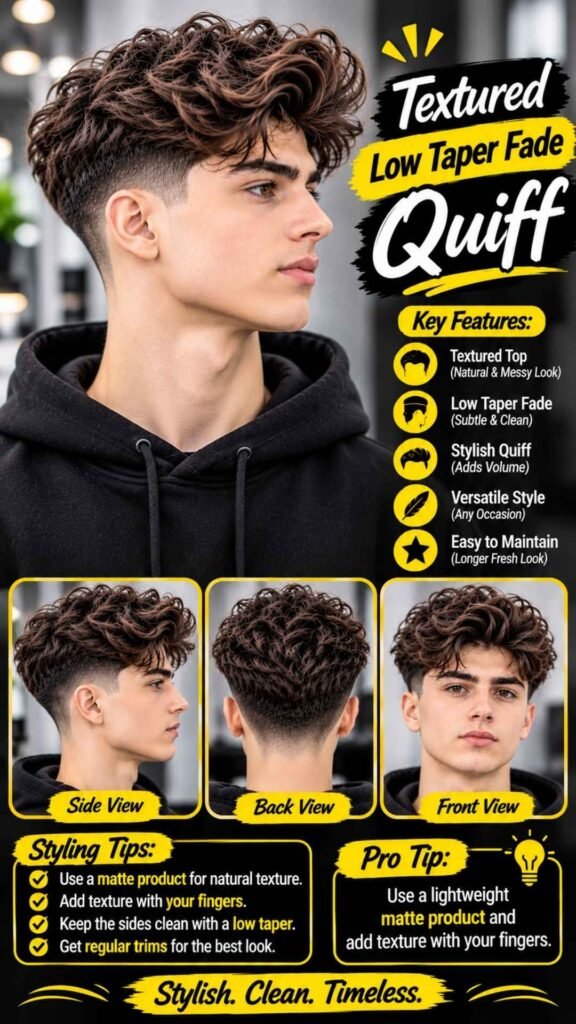
Here the barber uses point cutting or texturizing shears on top, so the ends look broken up instead of blunt. The quiff reads as lived-in and has more grip, which helps it hold height through the day.
Best for: Straight or slightly wavy hair that falls flat. Style it: Sea salt spray, a quick blow-dry, then paste on the ends only.
Messy Quiff with Taper Fade
Controlled chaos. Pieces point in different directions, but the taper underneath keeps the outline tidy, and that contrast is the whole appeal. The mess only works because the edges are clean.
Best for: Thick or wavy hair. Style it: Towel dry, add texture powder at the roots, then rake with your fingers.
Short Low Taper Quiff Haircut
With 1.5 to 2.5 inches on top, this is the low effort option. The quiff is more of a gentle lift than a wave, so you can style it in the time it takes to find your keys.
Best for: Fine hair, busy mornings, and anyone growing out a buzz cut. Style it: A pea-sized dab of light paste, pushed upward from the front.
Long Quiff with Low Taper Fade
Five to six inches on top gives real drama. The low taper matters more here, because it keeps the sides from looking bulky beneath all that length. Expect to use a dryer.
Best for: Straight or wavy hair with good density. Style it: Mousse, blow-dry with a round brush, then finish with a light pomade.
Clean Textured Quiff Low Fade
Crisp edges, a defined outline at the temples, and a top that has texture but no clutter. This one suits people who want to look sharp without looking slick.
Best for: Professionals who like a visible barber touch. Style it: Clay, then a comb to tidy the front only.
Low Taper Fade Quiff for Wavy Hair
Wavy hair already has natural lift, so the quiff nearly builds itself. Ask the barber to cut with the wave pattern, not against it, so the pieces curl in the same direction.
Best for: Type 2 waves. Style it: Curl cream or sea salt spray on damp hair, then air dry or diffuse. Brushing it dry will turn waves to frizz.
Low Taper Fade Quiff with Volume
This version is cut with layers on top so each section props up the one above it. The taper below it exaggerates the height, making the quiff look bigger than it is.
Best for: Fine hair that struggles to stand up. Style it: Root lift spray, blow-dry the roots upward, then a little hairspray.
Low Taper Fade Quiff with Beard
The taper should run straight into the beard, so the sideburn and the beard line look like one continuous shape. Ask your barber to blend the two, not treat them separately. The result looks deliberate.
Best for: Men with short or medium beards. Style it: Beard balm for shape, and keep the neckline about an inch above the Adam’s apple.
Low Taper Fade Quiff for Thick Hair
Thick hair is heavy and can collapse a quiff. Ask the barber to remove weight through the middle with thinning shears, then taper the sides so the cut does not flare outward.
Best for: Dense, coarse hair. Style it: Work the product in two light passes rather than one heavy one, so it spreads without clumping.
Low Taper Fade Quiff Haircut for Straight Hair
Straight hair shows every cutting line, so precision matters. Light layers add the movement that the hair does not supply on its own.
Best for: Straight hair of any thickness. Style it: Round brush with a blow-dryer, aimed up and back, then a flexible-hold paste.
Low Taper Fade Quiff with Hard Part
A hard part is a razor or trimmer line cut into the hair, usually on the side. It gives the quiff a crisp base and makes the whole look more formal.
Best for: Formal settings and men who like a retro edge. Style it: Pomade, then comb from the part across and back. Ask for the line to be refreshed every visit.
Side-Swept Low Taper Fade Quiff
The top lifts at the front and sweeps toward one side. The slight asymmetry adds interest and works well to break up a round face.
Best for: Round and square faces. Style it: Part on your natural side, then blow-dry across and up.
Layered Low Taper Fade Quiff
Layers reduce bulk and let the quiff move. Instead of one block of hair, you get several levels that stack and catch light.
Best for: Thick or wavy hair. Style it: Light cream for definition. Skip heavy gels.
Casual Textured Quiff Taper Fade
The weekend version. The shape is loose and the finish is rough, with nothing glued in place. It looks best a day after washing, when the hair has a little grit.
Best for: Relaxed, everyday wear. Style it: Sea salt spray, then air dry with a quick flick of the fingers.
Professional Low Taper Fade Quiff Haircut for Male
Conservative sides, a medium-length top and a subtle sheen. Nothing about it is loud, yet it still looks intentional. This is the one to wear when you are unsure what a room expects.
Best for: Client-facing jobs and interviews. Style it: A light pomade, then a comb. Keep the finish tidy.
Forward Taper Fade with Quiff
The top is styled forward and lifted only at the very front. It is a smart option when the hairline is receding at the temples, since the longer front hair covers the corners.
Best for: Men with thinning temples. Style it: Dry the hair forward first, then lift the front with clay.
Low Taper Fade Quiff Haircut for Curly Hair
Curls give the quiff natural spring. The low taper keeps the sides from puffing out, and the top is left at 3 to 4 inches so the curls can form their own shape.
Best for: Curly hair, types 3A to 3C. Style it: Curl cream on wet hair, then lift the front with fingers or a pick. Never brush dry.
Low Taper Fade Quiff for Teen Boys
School-friendly and easy to maintain. The top is shorter, the taper is soft, and the product is minimal. Teens tend to skip styling, so the cut should look decent even then.
Best for: Boys aged 12 to 17. Style it: Light paste, finger styled. Check the school’s grooming rules before asking for anything extreme.
Low Taper Fade Pompadour Quiff
The pompadour is the quiff’s taller, smoother cousin. It sweeps straight back with a high front, while the low taper keeps the sides tight. The mix of old and new is the draw.
Best for: Men who want a bold shape. Style it: Blow-dry up and back, then use a shine pomade for hold.
Low Taper Fade Side Part Quiff
A soft side part runs down one side, and the front lifts above it. It reads as polished and slightly vintage, and it suits both oval and long faces.
Best for: Straight or lightly wavy hair. Style it: Comb the part into damp hair, then dry and finish with a flexible pomade.
Low Taper Fade Brushed-Up Quiff
The top is brushed upward instead of back, leaving a faint faux-hawk impression without going extreme. It keeps good height and looks lively.
Best for: Thick, strong hair. Style it: Matte clay, then brush straight up with a bristle brush.
Low Taper Fade Quiff with Textured Fringe
A short fringe falls forward with a quiff lift behind it. The texture on the fringe makes the haircut younger and a little more playful.
Best for: Heart and oval faces. Style it: Paste on the fringe only, with clay at the crown for lift.
Low Taper Fade Faux Hawk Quiff
Hair on top is pulled toward the center, forming a soft ridge down the middle. Because the taper is low, the look stays wearable instead of loud.
Best for: Bold dressers and weekend wear. Style it: Pinch the center into a ridge with paste, then set with hairspray.
How to Maintain a Low Taper Fade Quiff Haircut

A low taper is forgiving, but the edges blur quickly. Book a visit every 3 to 4 weeks to keep the neckline and sideburns clean. Waiting longer is fine for a casual look, though the shape will lose its edge by week five.
Daily styling in five steps
- Start with damp hair, not soaking wet. Towel dry first.
- Apply a light mist of sea salt spray or root lift spray at the front.
- Blow-dry the front upward and back, using your fingers or a round brush.
- Warm a small amount of product between your palms. Rub it in from the back to the front.
- Shape the quiff with fingertips and finish with a light hairspray if needed.
Choose the right product
| Product | Hold | Finish | Best for |
|---|---|---|---|
| Matte clay | Strong | Dry | Thick, messy styles |
| Paste | Medium | Natural | Everyday texture |
| Pomade (water-based) | Medium to strong | Shiny | Classic, formal looks |
| Sea salt spray | Light | Gritty | Fine or wavy hair |
| Mousse | Light | Soft | Volume at roots |
The most common mistake is using too much. Start with a pea-sized amount and add more only if needed. Heavy product weighs a quiff down, and that kills the height you came for.
Washing and care
Wash two to three times a week with a mild shampoo. Daily washing strips natural oils and can leave hair flat or brittle. Use conditioner on the lengths, not the scalp. A cool rinse at the end helps the hair lie smoothly.
Avoid these common mistakes
- Styling soaking wet hair, which pulls the quiff flat.
- Combing sticky product through dry hair, which leaves flakes.
- Skipping trims, which loses the taper line.
- Using a hot dryer on its highest setting, which dries out ends.
- Brushing curly or wavy hair when dry.
How to Ask Your Barber for a Taper Fade with Quiff
Bring a photo, and say the numbers. Photos show the look, and numbers remove guesswork. Together they prevent most haircut regrets.
Here is a script you can use almost word for word:
- “I would like a low taper on the sides and back, starting at a #1 at the sideburns and nape.”
- “Blend it into the longer hair on the sides, with scissor-over-comb if possible.”
- “Leave about 3 inches on top so I can style it up and back.”
- “Please add some texture to the ends so it does not look blunt.”
- “Keep the neckline natural” or “Square off the neckline,” depending on your preference.
Terms worth knowing
| Term | What it means |
|---|---|
| Taper | Gradual shortening at edges |
| Blend | Smooth transition between lengths |
| Point cutting | Snipping into the ends for texture |
| Scissor-over-comb | Cutting with scissors along a comb |
| Neckline | Shape of hair at the nape |
| Shape-up | Cleaning the hairline with a trimmer |
Before you leave the chair
Look at the back with a hand mirror, then check the sideburns on both sides. Ask the barber how they styled your top, and which product they used. If the quiff feels too long, say so now, since adding hair later is impossible while trimming is easy.
One more tip: describe how you plan to wear it, not just how it looks. “I wear it to the office, and I have five minutes” gives a barber more useful information than a photo alone.
Frequently Asked Questions
What is a low taper fade quiff?
It is a haircut with short, gradually tapered sides starting low near the ears and nape, and a longer top styled up and back.
How long should my hair be for a quiff?
Aim for at least 2 inches (5 cm) on top for a short quiff, and 3 to 4 inches (7 to 10 cm) for a classic one.
How often should I get a low taper fade trimmed?
Every 3 to 4 weeks keeps the edges clean, though you can stretch to 5 weeks for a looser look.
Does a low taper fade quiff suit thin hair?
Yes. A short or voluminous quiff with root lift spray gives fine hair body, and the low taper keeps the sides from looking sparse.
Can curly hair wear a low taper fade quiff?
Yes. Leave 3 to 4 inches on top, use curl cream, and lift the front with your fingers instead of brushing.
What is the difference between a quiff and a pompadour?
A pompadour is taller and swept straight back, while a quiff is usually shorter, looser and lifted mostly at the front.
What product is best for a quiff?
Matte clay suits thick or messy styles, and water-based pomade suits a polished look. Use a pea-sized amount.
How do I make my quiff stand up?
Blow-dry the front upward and back at the roots, then set it with clay or a light hairspray.
Conclusion
The low taper fade quiff stays popular because it asks little and gives a lot. The sides stay neat, the top has room to move, and the cut adapts to straight, wavy or curly hair. Pick the version that matches your hair type and routine, show a photo, give your barber the numbers, and book the next trim before you leave the shop. That small habit keeps the shape sharp.
