


A mid taper fade on curly hair keeps your curls on top and tidies the sides and back with a gradual cut that starts around the temple and ear. It gives you a clean outline without asking you to give up length or texture.
That balance is why so many people with curls ask for it. The sides stay neat, the top keeps its shape, and the whole cut grows out without an awkward stage.
This guide covers what the cut actually is, how it differs from low and high tapers, which curl types suit it, six styles worth showing your barber, the exact words to use in the chair, and how to look after it at home.
Mid taper fade curly hair at a glance
- Where it starts: around the temple and the top of the ear
- What stays long: the curls on top, plus any fringe
- Typical upkeep: a clean-up every 2 to 4 weeks
- Best for: wavy, curly, and coily textures that need a tidy frame
- Biggest mistake: cutting curls only when wet and misjudging shrinkage
What is a mid taper fade on curly hair?
A mid taper fade shortens the hair on the sides and back in a smooth gradient. The change begins at roughly mid-height on the head, around the temple and just above the ear, then gets shorter as it moves down toward the neckline and sideburns.
On straight hair, a gradient can look flat. On curls, it works differently. The tight sides give your curls a visible edge, so the top reads as a deliberate shape instead of a mass of volume.
There are two parts to the cut:
- The taper: the gradual shortening of length on the sides and back.
- The top: the section left long enough to show your curl pattern.
The taper can end in a short length, such as a number 1 or 2 clipper guard, or go all the way down to skin at the very bottom. The top is cut separately, usually with scissors or a comb and clippers, so it keeps its natural spring.
Mid taper vs. mid fade: why the names get confused

People use “taper” and “fade” as if they mean the same thing. Barbers do not always agree on the difference, which is why the confusion shows up in every shop.
In most explanations, a taper is the gentler of the two. It shortens the hair gradually and usually leaves some length at the bottom, especially around the sideburns and nape. A fade is more dramatic. It blends hair down to very short stubble or skin, so the contrast between top and sides is sharper.
| Mid taper | Mid fade | |
|---|---|---|
| Contrast | Soft to moderate | Moderate to strong |
| Bottom length | Short, rarely bare | Short or skin |
| Look | Natural, classic | Sharper, more visible |
In practice, “mid taper fade” has become a catch-all term. Some barbers hear it as a gentle taper. Others hear it as a mid fade with a skin finish. Ask for the height (mid), then say how short you want the bottom. That one extra sentence prevents most bad surprises.
Mid taper vs. low and high tapers on curly hair

The main difference between the three is where the shortening begins. The lower it starts, the more hair you keep and the softer the result.
| Taper | Starts around | Contrast | Upkeep |
|---|---|---|---|
| Low | Ear and nape | Subtle | Lower |
| Mid | Temple and ear top | Balanced | Medium |
| High | Near the crown | Bold | Higher |
On curly hair, height matters more than on straight hair because curls add width on the sides. A taper that starts too low can leave the sides puffing out. One that starts too high can make the top look like a separate hat.
Low taper vs. mid taper on curly hair

A low taper stays close to the ear and neckline. It leaves most of the sides intact, which suits people who want a quiet cut for work or school and do not mind a little more width at the sides.
The mid taper takes more off. It controls sideways volume better, which helps loose and medium curls that spread out as they grow. If your sides tend to flare, a low taper may not hold the shape for long.
The trade-off is upkeep. A low taper hides regrowth for longer. A mid taper looks fuzzy sooner.
Mid taper vs. high taper

A high taper starts closer to the crown. It exposes more of the scalp and creates strong contrast with the curls on top. It looks sharp and modern, and it makes the curls appear taller.
The mid taper is the safer choice if you are unsure. It frames the face without cutting so high that the top looks detached. It is also easier to grow out, since you can let the sides catch up without the shape collapsing.
If you like bold contrast and you are fine with frequent visits, a high taper is worth a look. If not, stay at mid height.
Is a mid taper good for your curly hair?
For most curl types, yes. The cut is flexible because the sides and the top are handled as two separate jobs. What changes is how your barber approaches each texture.
Loose curls, tight curls, and coily hair
Texture affects both the cut and the finish, so it helps to know where your hair sits.
| Hair type | What to expect | Barber tip |
|---|---|---|
| Loose curls and waves | Sides spread out fast | Go slightly tighter at the sides |
| Tight curls | Strong shrinkage | Cut with dry hair in view |
| Coily or afro-textured | Crisp fade shows clearly | Pay attention to the hairline |
Loose curls and waves form S-shapes and often fall over the ears as they grow. A mid taper keeps that from turning into a bowl shape. Because these curls can look much longer when stretched, a barber who only sees them wet may cut the top too short.
Tight curls spring up when dry, sometimes by a lot. The fade shows well here because the contrast between short sides and springy curls is easy to see. Ask your barber to check length with the hair dry or at least partly dry.
Coily and afro-textured hair takes a fade very well. The gradient looks clean, and a mid taper pairs naturally with twists, a shaped afro, or a high-top. A crisp neckline and hairline matter more here, since they define the whole look.
Short, medium, or long curls on top
The length you keep on top changes the personality of the cut.
- Short (about 1 to 3 inches): easy to manage, quick to style, and the fade does most of the visual work.
- Medium (about 3 to 5 inches): the sweet spot for most people. You can wear it natural, defined, or pushed back.
- Long (5 inches and up): needs more product and more patience. The taper keeps the sides from adding bulk, so the length looks intentional.
These numbers are rough guides. Curls shrink, and the same measured length can look quite different on tight and loose patterns. Judge by how it looks dry, not by a tape measure.
Best mid taper fade curly hair styles
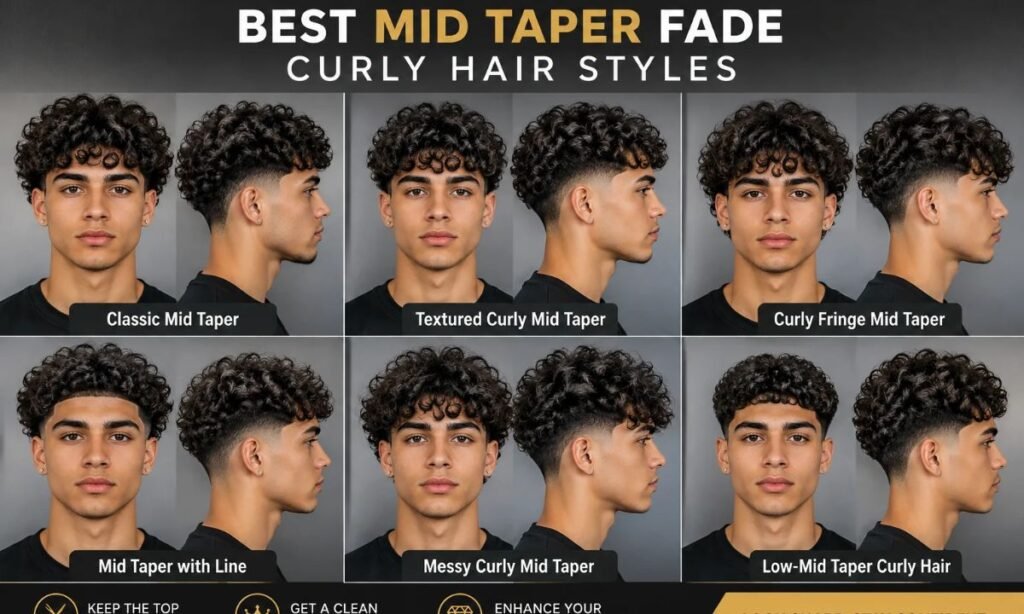
These six styles cover the most common requests. Each one uses the same mid taper on the sides and changes what happens on top.
1. Classic curly mid taper
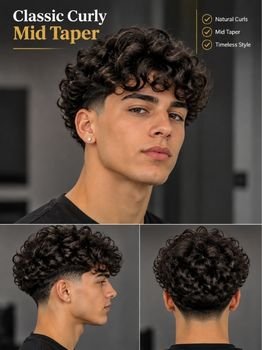
This is the standard version. The sides taper cleanly, and the top stays full with natural curls, trimmed lightly for shape.
It works for most occasions and it is the easiest cut to explain to a new barber. If you have never tried a taper, start here.
2. Mid taper with curly fringe

Here the front stays longer and falls forward over the forehead. The fringe softens the face and gives the cut a relaxed feel.
Curls shrink as they dry, so ask for the fringe a little longer than you want it to end up. A fringe that looks perfect wet can sit too high once the curls spring back.
3. Curly blowout mid taper
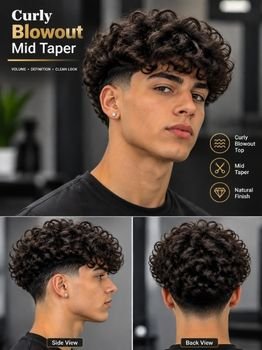
A blowout means the curls are dried with a brush or a blow dryer to stretch them and add height. With a mid taper, the result looks voluminous and tidy at once.
This style suits medium to longer curls. It takes more time in the morning, so it fits people who enjoy styling more than those who want to wake up and go.
4. Short curly mid taper
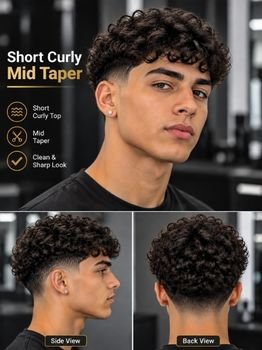
The curls on top are kept short, often one to two inches, with a soft, textured finish. The fade creates structure, and the top needs very little help.
It is a practical choice for people who want curls without a daily routine. A light leave-in and a quick scrunch is usually enough.
5. Mid taper with coily or afro-textured hair

On coily hair, the mid taper frames a shaped top such as a twist-out, finger coils, sponge twists, or a rounded afro. The clean sides make the texture on top stand out.
Because the contrast is so visible, ask your barber to shape the hairline carefully. A good lineup on this cut changes how finished the whole style looks.
6. Mid taper with line-up or beard blend

A line-up sharpens the front hairline, temples, and sometimes the neckline. A beard blend connects the taper to your facial hair so there is no sudden break at the sideburns.
This version looks polished and takes more upkeep, since the line-up loses definition within a couple of weeks.
What should you ask your barber for?

Clear instructions matter more with curls than with almost any other texture. A short conversation up front saves you a lot of regrowth time.
1. Show a reference photo
Bring a picture of a cut you like, ideally on someone with a similar curl pattern. A photo of straight hair with a taper can mislead, because curls behave differently.
Two photos help: one of the look you want and one of what you do not want. The second one tells your barber more than you might expect.
2. Say where the taper should begin
Use the word “mid” and point to the spot. Many people tap the side of the head around the temple or ear. If you are unsure, ask your barber to start slightly low and go higher if you want more contrast.
Going shorter is always possible. Going longer is not.
3. Decide how short the bottom goes
Tell your barber if you want the taper to end at a guard length or at skin. A number 1 or 2 guard leaves a soft, visible texture. A skin finish gives a cleaner, sharper edge.
If you are trying the cut for the first time, a slightly longer finish is safer.
4. Explain how much curl length to keep
Show the length you want with your fingers, and say whether you are measuring wet or dry. Mention that your curls shrink, if they do.
If you want to keep as much volume as possible, say that too. A barber can cut around the curl pattern instead of straight across it.
5. Discuss bulk, fringe, and neckline
Three small details change the final look. Ask how much weight to remove from the top, whether to keep a fringe, and what shape the neckline should have.
A natural neckline looks relaxed and grows out gently. A squared one looks sharper and shows regrowth faster. A rounded one sits in between.
How do you style a mid taper with curly hair?
The cut does a lot on its own, but a simple routine makes it look better. You do not need many products. You need the right order.
Step 1: start with damp, detangled hair
Apply styling products to hair that is wet, not just slightly damp. Detangle with your fingers or a wide-tooth comb while conditioner or water is still in the hair. Skipping this step leads to frizz and broken curl clumps.
Step 2: add moisture and definition
Use a leave-in conditioner first, then a curl cream or gel. Cream gives softness and a looser hold. Gel gives more definition and lasts longer.
Smooth the product through with your palms, then scrunch upward. For thicker hair, section the top and work through it in layers.
Step 3: air-dry or diffuse without flattening the shape
Air-drying gives the most natural result but takes time. A diffuser on low heat dries curls faster while keeping the clumps together.
Avoid touching your hair until it is dry. Handling curls while they dry breaks up the pattern and creates frizz. Once dry, scrunch gently to release any stiffness from the gel.
Step 4: refresh between wash days
Mist your curls with water, add a small amount of cream, and scrunch. Use a pick or your fingers to lift the roots if the top has gone flat.
At night, protect your curls with a satin bonnet or a silk or satin pillowcase. That cuts down on friction and helps the style last another day.
How do you maintain a curly mid taper?
A taper is only as good as its edges. Maintenance has two parts: keeping the sides sharp and keeping the curls healthy.
How often should you get the taper cleaned up?
Most people need a clean-up every 2 to 4 weeks. The sides grow out first, and curls make the fade look fuzzy quickly.
If you wear a skin finish or a line-up, expect to go closer to 2 weeks. A softer taper can stretch toward 4 weeks or a little longer. Trim the top less often, roughly every couple of months, unless you want to keep a specific shape.
How should you care for the curly top?
Treat the top the way you would treat any curly hair.
- Use a gentle, moisturizing shampoo and avoid washing too often.
- Deep condition regularly, especially in dry weather.
- Skip heavy products that weigh curls down.
- Be careful with heat, and use a diffuser on low when you can.
Good habits matter more than expensive products. Healthy curls hold shape better, so the cut looks fresher between visits.
Common mid taper mistakes to avoid
Most bad results come from a few repeat errors. Knowing them ahead of time saves you from a haircut you regret.
- Cutting the top only when wet. Curls shrink as they dry, so the length you see in the mirror is not the length you keep.
- Skipping the reference photo. “Mid taper” means different things to different barbers.
- Going too high on the first try. You can always go higher at the next visit.
- Ignoring the neckline. A rough nape ruins an otherwise clean cut.
- Brushing dry curls. It breaks the clumps and creates frizz that no product fixes.
- Waiting too long between clean-ups. The fade needs regular touch-ups to keep the gradient visible.
- Using heavy products on short curls. They flatten the top and make the fade look greasy.
Alternatives if a mid taper is not the look you want
If the mid taper feels too structured or too plain, a few other cuts suit curls well.
| Cut | Best for | Trade-off |
|---|---|---|
| Low taper | Subtle, work-friendly look | Less side control |
| High taper | Strong contrast | More upkeep |
| Drop fade | Curved shape around the ear | Needs a skilled barber |
| Scissor cut | Natural, soft look | Less defined edges |
| Undercut | Dramatic shape | Hard to grow out |
A low taper is the easy step down. It keeps more hair on the sides and grows out slowly.
A drop fade curves behind the ear, which suits rounder head shapes and adds a modern touch.
A scissor-only cut skips clippers entirely. It looks softer and more natural, but the edges are less crisp.
If you are still undecided, take a photo of your current cut and your two favourite options to your barber. They can tell you what will work with your growth pattern.
Products for curls and waves on a fade
You do not need a long shelf of products. A short routine covers most needs. Add affiliate or product links next to each category if you plan to monetise the page.
| Product type | What it does | Best for |
|---|---|---|
| Gentle shampoo | Cleans without drying | All curl types |
| Conditioner or mask | Adds moisture | Dry or coily hair |
| Leave-in conditioner | Softens and detangles | Wash day and refreshes |
| Curl cream | Light definition | Loose curls and waves |
| Gel | Strong hold and shape | Tight curls |
| Sea salt or texture spray | Adds grip and volume | Short curly tops |
| Satin bonnet or pillowcase | Reduces friction | Overnight care |
Start with a leave-in and either a cream or a gel. Add the rest as you learn what your hair needs.
Frequently asked questions
What is a mid taper fade on curly hair?
It is a cut where the sides and back shorten gradually from around the temple and ear, while the curls on top stay long.
Is a mid taper the same as a mid fade?
Not exactly. A taper is usually gentler and leaves some length, while a fade often blends closer to skin.
Does a mid taper work on tight curls and coily hair?
Yes. The contrast between the short sides and the springy top shows clearly on tight and coily textures.
How long should my curls be on top?
Most people keep between 2 and 5 inches. Remember that curls look shorter when dry.
How often should I get a mid taper touched up?
Every 2 to 4 weeks keeps the sides neat. Skin finishes and line-ups need visits closer to 2 weeks.
Is a mid taper high maintenance?
It sits in the middle. The top is easy to style, but the sides need regular clean-ups.
Should I ask for a low, mid, or high taper?
Choose mid if you want balanced contrast. Choose low for a quieter look and high for a bolder one.
What should I say to my barber?
Name the height (mid), the bottom length (guard number or skin), the curl length on top, and bring a photo.
How long does a mid taper take to grow out?
The sides usually look soft within a month and blend back in over a couple of months.
Conclusion
A mid taper fade gives curly hair a clean frame without taking away the curls. It starts around the temple and ear, keeps the top full, and sits between the subtle low taper and the bolder high taper.
The cut works across loose, tight, and coily textures, as long as your barber understands shrinkage and cuts with your curl pattern in mind. Bring a photo, name the height and the bottom length, and say how much you want to keep on top.
