


A taper low burst fade is a haircut where the short sides curve in a half circle around each ear, start low on the head, and blend gradually into the sideburns and neckline. The nape keeps more length than in a standard fade.
It sits between a plain taper and a dramatic skin fade. You get a defined shape behind the ear without the stark contrast of a high cut, so it looks sharp at an office desk and still relaxed on a weekend.
This guide covers how the cut is built, how it differs from a taper and a low fade, who it flatters, and what to say in the chair. You will also find upkeep timelines, styling steps, and common mistakes.
What a taper low burst fade is
The name stacks three ideas. “Low” tells you where the cut starts, just above the ear and along the temple and nape line. “Taper” describes how length changes, in small gradual steps. “Burst” describes the shape, a curved arc wrapped around the ear.
Quick answer: A taper low burst fade is a short-sided cut with a curved, half-circle fade around the ear, a low starting point, and a soft taper into the sideburns and neckline. The back stays longer than in a classic fade.
Barbers also call the burst shape a radial fade or a halo taper. Those names describe the same idea. Instead of the fade climbing straight up the side of the head, it radiates outward from the ear like ripples in water.
Here is what defines the cut:
- Placement: The fade begins low, close to the ear, so the upper sides keep their weight.
- Blend: Length drops in small steps, so no hard line separates short hair from long hair.
- Shape: The arc follows the curve of the ear and ends near the sideburn and behind the ear.
- Nape: The hair at the back stays longer and tapers softly instead of being cut square.
- Top: Any length works, from a tight crop to curls that fall over the forehead.
A barber builds the arc first. They mark the curve with a short guard or bare clipper, then work outward in small steps, often moving from a #1 near the ear to a #3 or #4 where the arc meets longer hair.
Height changes the whole feel of the cut. Low versions sit near the ear and look subtle, while higher ones climb the side of the head and read bolder. The taper low burst fade deliberately stays at the quiet end of that range.
| Burst height | Where the arc reaches | Look |
|---|---|---|
| Low | Just above the ear | Subtle and tidy |
| Mid | Around the temple | Noticeable but balanced |
| High | Upper side of the head | Bold, high contrast |
Because the arc is the whole point of the cut, it needs a barber who blends carefully. A rushed burst leaves visible steps. A clean one looks like a soft shadow around the ear, even from several feet away.
Taper vs low fade vs burst fade

Barbershops use these three terms almost interchangeably, and that is where most haircut disappointments start. They actually describe different things. A taper describes how length changes, while a low fade describes height and closeness. A burst describes shape.
Taper
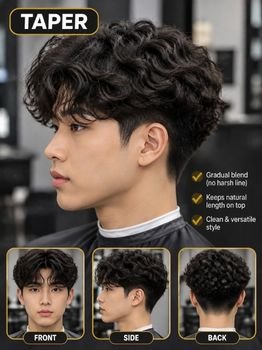
A taper shortens the hair gradually along the sideburns and the back of the neck. Classic versions stop short of bare skin and keep the natural hairline in place. It is the most conservative of the three.
Because the length change is small, a taper grows out gracefully. Many barbers treat it as the safest starting point for someone who has only worn scissor cuts so far. It is also the base under most business haircuts.
Low fade
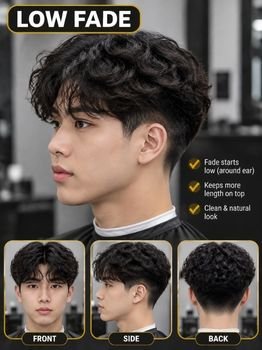
A low fade starts just above the ear and shortens toward the skin or a very short guard at the bottom. It covers more area than a taper at the edges and shows more contrast, though that contrast stays low on the head.
The fade line follows the ear and then dips toward the nape in a straight or slightly curved path. It looks neat and leaves most of the side length above the ear untouched, which keeps the overall shape traditional.
Burst fade
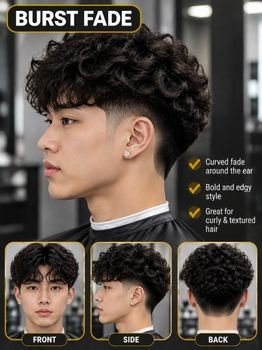
A burst fade is defined by its shape. The fade arcs around the ear in a half circle and carries on into the neckline, with longer hair left behind it. Barbers can set it low or high, which changes how dramatic it looks.
The burst also changes the back of the head. A regular fade wraps the nape in a straight band, while a burst usually leaves length at the back. That is why it pairs so naturally with mullets and long textured backs.
| Feature | Taper | Low fade | Burst fade |
|---|---|---|---|
| Starts | Sideburns and nape | Just above the ear | Around the ear |
| Shortest point | Short guard | Skin or near skin | Skin or short guard |
| Shape | Follows hairline | Straight or gentle curve | Half-circle arc |
| Nape | Tapered | Faded | Usually left longer |
| Contrast | Low | Low to medium | Varies by height |
A taper low burst fade combines the soft blend of a taper with the curved arc of a burst, kept low like a low fade. If your barber asks which part matters most to you, the answer is usually the arc.
Your barber’s vocabulary may differ from the internet’s. Some shops call this a low burst taper, others say burst taper fade. Describe the shape and height, and you will get the same result under any name.
Who a taper low burst fade suits
Most people can wear this cut, because a barber can raise or lower the arc and soften the contrast. The real questions are how much upkeep you want and whether your hair growth around the ear and nape behaves.
Face shapes
Face shape is a loose guide, not a rule. Hair density and growth direction matter just as much, as does how often you visit the barber. Still, the height and softness of the arc can balance your proportions.
| Face shape | Why it works | Ask for |
|---|---|---|
| Oval | Balanced proportions suit most versions | Low arc, any top length |
| Round | Height on top slims the sides | Low burst, volume at the crown |
| Square | A soft arc eases sharp jaw angles | Low taper, avoid skin-tight sides |
| Long | Fuller sides prevent extra length | Low burst, modest height on top |
| Heart | Weight stays near the cheeks | Low arc, textured fringe |
| Diamond | Softens wide cheekbones | Low taper, fuller top |
If you are unsure which category you fall into, hold your hair back and look straight at a mirror. Notice whether your cheekbones or your jaw is the widest point. Your barber will confirm it in seconds.
Hair types
Hair type affects how the blend looks and how long it lasts. The arc shows clearly on every texture, but each one asks for slightly different handling from your barber, so mention yours early.
| Hair type | How the cut behaves | Tip |
|---|---|---|
| Straight | Shows every step in the blend | Ask for a smooth, gradual transition |
| Wavy | Body on top hides small flaws | Let the top air-dry for natural shape |
| Curly | Curls spring up once cut short | Tell the barber your curl pattern |
| Coily | Holds the arc crisply and takes a sharp line-up | Keep the scalp moisturized |
| Thin or receding | A low arc keeps the temples soft | Skip very high-contrast bursts |
Lifestyle counts too. Short sides stay cool under a helmet or in summer heat, but regrowth shows sooner. If frequent appointments annoy you, ask for a longer guard at the bottom of the arc, which grows out more slowly.
Check the back of your head with two mirrors before you book. A cowlick or a strong whorl at the crown or the nape changes how the longer back hair lies. A good barber works with it, but only if you mention it.
Best styles to ask for
The burst is a shape for the sides, so it works under almost any top. These eight combinations come up most often in barbershops, and each one has a line you can use in the chair.
1. Textured Crop
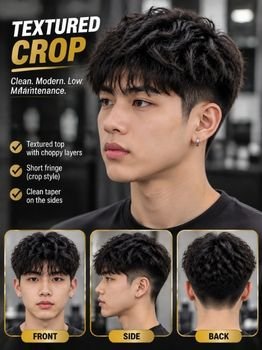
A short, choppy top cut forward with a low burst on the sides. It needs about a minute of styling. Ask for: “Low taper burst, an inch and a half of texture on top, cut forward.”
2. Curly Top
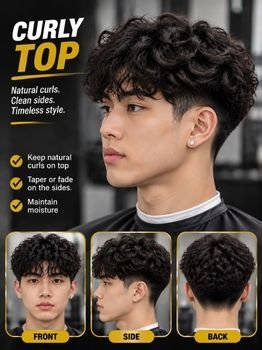
Loose curls or twists kept full while the sides stay close. The contrast makes the curls look bigger. Ask for: “Keep my curls long, with a low burst and a soft taper at the neck.”
3. Taper Burst Mullet
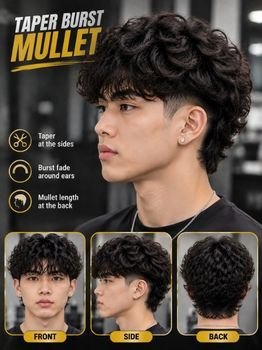
Short sides, with length left at the back that sits over the collar. The low arc keeps it wearable. Ask for: “Low burst, leave the nape long, and blend the back into the top.”
4. Slick Back
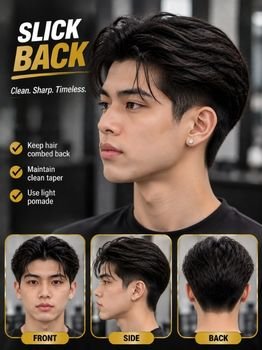
Three or four inches combed back with the arc keeping the edges tidy. It reads polished. Ask for: “Low taper burst with enough length on top to comb straight back.”
5. Quiff or Pompadour
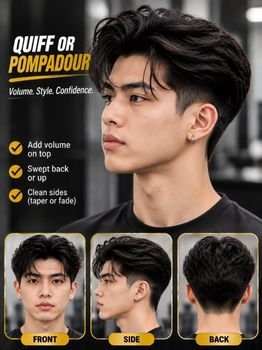
Height at the front with sides that stay tight. The low arc stops the shape looking top-heavy. Ask for: “Low burst taper, longer on top, with volume at the front.”
6. Side Part
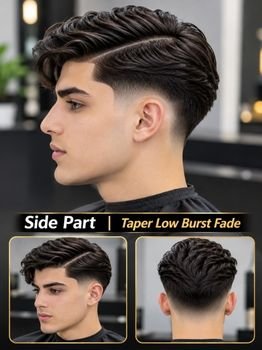
A classic comb-over with a soft part and clean edges. It is the most office-friendly pairing. Ask for: “Low taper burst with a natural side part.”
7. Faux Hawk
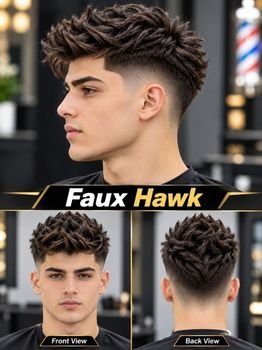
A raised center strip with short, faded sides. The burst frames the strip well. Ask for: “Low burst on both sides, with a textured strip left in the middle.”
8. Buzz Cut with Burst Edges
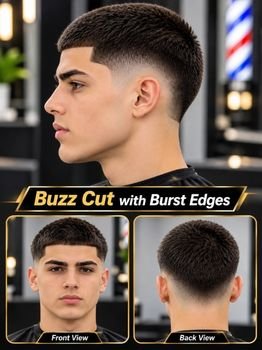
A uniform short top with the arc softening the ears. It is the lowest-maintenance version. Ask for: “A number 2 on top, with a low burst around the ears.”
Pick the top first, then match the arc to it. A long top can carry a slightly higher arc, while a short crop looks best with the arc kept low. Dyed or twisted lengths also show off the contrast of clean sides.
If you wear a beard, tell your barber before the first clipper touches your head. The sideburn can then blend straight into the beard, so the taper runs as one continuous shade instead of two separate cuts.
How to ask your barber for it
Clear instructions matter more than the cut’s name. A barber who hears “burst fade” may picture a mid or even a high version, so you need to give height, closeness, and shape in plain terms.
A script that works
Read this out or paste it into your notes before you sit down. Adjust the top length to your own hair.
“I’d like a low taper with a burst fade around both ears. Start the fade low, just above the ear, and take it to skin at the bottom with a soft blend. Leave the back longer and taper the nape lightly. Keep about two inches on top, textured.”
Guard numbers help you check what the barber plans to use. These sizes match common clipper guards, though brands vary slightly.
| Guard | Length | Typical use here |
|---|---|---|
| No guard | About 0 to 1 mm | Bottom of the arc |
| #1 | 1/8 in (3 mm) | Next step out from the ear |
| #2 | 1/4 in (6 mm) | Middle of the blend |
| #3 | 3/8 in (10 mm) | Top of the arc |
| #4 | 1/2 in (13 mm) | Where the arc meets longer hair |
You do not need to memorize these. Asking “which guards are you starting with?” tells the barber you care about the blend. It also gives you exact numbers to request again at your next visit.
What to show
A photo does more than any description. Bring a few, and make sure at least one shows the cut from behind, since the nape is where barbers differ most.
- A reference photo of the side view, so the arc height is clear.
- A back view, so the barber can see how the nape is finished.
- A picture of your current hair, so they can judge your texture and growth.
- One example of what you do not want, which is often the most useful of all.
Photos of people with a different hair texture are still useful for the shape, but tell your barber you know the result will look different on your head. They can then adjust the blend rather than copy it blindly.
Speak up early in the appointment, not at the end. After the first pass around the ear, ask to see the arc in the mirror. Adjustments are easy while the hair is long, and impossible once it is gone.
Keeping a taper low burst fade sharp
The arc is the first thing to go. Hair grows roughly half an inch a month on average, and the shortest zone around the ear shows regrowth first. Plan your visits around that zone, not around the top.
Touch-up timeline
| Time since cut | What you will see | What to do |
|---|---|---|
| Days 1 to 7 | Crisp arc, cleanest look | Style the top only |
| Week 2 | Slight fuzz at the skin line | Optional neckline cleanup |
| Weeks 3 to 4 | The arc softens, blend widens | Book a fresh fade |
| Weeks 5 to 6 | Shape is mostly gone | Full reset or a new style |
Track your own growth rate. Take a photo of the arc on the day of the cut and another at two weeks. The comparison shows when your blend starts to fade and sets your personal schedule.
Skin-tight versions usually need a visit every two to three weeks. A softer taper with a longer guard at the bottom can stretch to four or five. Ask your barber what your growth rate allows.
Many shops offer a cheaper quick cleanup between full cuts that covers only the neckline and sideburns. If yours does, it is worth using, because it extends the life of the arc without a full appointment.
Neckline and sideburn cleanup
At home, treat the neckline with restraint. A burst looks best when the nape stays natural and softly tapered. Squaring it off with a trimmer cuts through the arc and makes the whole cut look unfinished.
If you must tidy it yourself, keep these rules in mind:
- Use a trimmer with no guard, and work from the middle of the neck outward.
- Remove only stray hairs below the existing line. Never push the line higher.
- Keep both sideburns level by checking them against each other in a mirror.
- Stop once the edge looks clean. Going back for a second pass is how lines creep up.
Sideburns deserve the same care. Keep them tapered, not blunt, and ending at the same point on both sides. A sideburn that sits even a few millimeters off makes the whole arc look crooked.
Mistakes that ruin the cut
Most bad bursts come from a handful of avoidable errors, and few of them are the barber’s fault alone. Here are the ones that appear most often.
- Asking for a “fade” with no height. Without the word “low,” you may get a mid or high cut that exposes far more scalp than you wanted.
- Skipping the reference photo. Words like “burst” mean different shapes to different barbers, and a picture settles it instantly.
- Letting the arc start too high. A high arc on a low-taper request looks harsh and takes weeks to grow into a normal shape.
- Leaving the top too heavy. A big top over a tight arc feels unbalanced. Trim the top when you refresh the sides.
- Squaring the neckline. A boxy neckline fights the curve of the burst and makes the nape look stiff.
- Trimming the arc at home with a razor. One slip creates a bald patch that takes a month to hide.
- Waiting too long between cuts. The blend turns fuzzy first, and a soft taper becomes a plain overgrown cut after about six weeks.
- Washing out the barber’s work with heavy product. Waxy products clump hair in the faded area and hide the blend.
Fixing a bad burst is possible. A skilled barber can usually blend a too-high arc by shortening the surrounding hair, but you lose length on top. A clear request at the start saves both time and hair.
Styling it at home
The arc holds its shape without help, so daily styling is mostly about the top. You will not need much time or product, but a clear routine keeps the cut looking deliberate rather than accidental.
- Wash your hair with a shampoo that suits your scalp, and use conditioner on longer tops.
- Towel dry until the hair is damp, not dripping, since too much water dilutes products.
- Warm a pea-sized amount of product between your palms, then work it through the top only.
- Blow-dry or air-dry, following the direction you want the hair to fall.
- Check the arc in a mirror and wipe any residue away from the faded area.
Product choice depends on length and the finish you want.
| Top length | Product | Finish |
|---|---|---|
| Under 1 inch | Matte paste or light clay | Flat and natural |
| 1 to 2 inches | Texture paste | Choppy and light |
| 2 to 4 inches | Clay or pomade | Structured or slick |
| Curls | Curl cream, then gel | Defined and soft |
Cowlicks and flyaways need a different approach. Apply product to damp hair and dry the stubborn section first, pushing it against its natural direction. Then dry the rest the normal way, so the cowlick settles into the overall shape.
Sleep habits matter for longer tops. A satin pillowcase or a loose scarf reduces friction, so curls and waves keep their shape overnight and need less restyling in the morning. That saves a few minutes every day.
Skin shows more with a fade, so look after it. A light moisturizer stops flaking behind the ears, and sunscreen protects the ears and nape, which are exposed when the sides sit this short.
Taper low burst fade vs blowout taper
These two get mixed up because both are tapers, but they describe different parts of the head. The burst is a shape on the sides. A blowout is a styling choice on top, with volume brushed up and out.
| Feature | Taper low burst fade | Blowout taper |
|---|---|---|
| Defining feature | Arc around the ear | Volume on top |
| Top length | Any length | Usually medium to long |
| Best hair types | All textures | Thick, wavy, or curly |
| Daily styling | Minimal | Blow-dry and pick out |
| Typical upkeep | Every 2 to 4 weeks | Every 3 to 4 weeks |
You do not have to choose one. Many people ask for a blowout on top with a low burst taper on the sides, which gives volume above and a precise shape below. It works best on curly, wavy, or thick hair.
If your hair is fine and straight, a blowout may look flat by lunchtime. In that case, ask for a textured crop or a short quiff with the same low burst, which holds shape with less effort.
Is it okay for school, work, or formal settings?
Yes, in most cases. The low starting point and the soft taper keep the contrast gentle, so the cut reads as neat rather than bold. What changes the impression is the top and how clean the lines are.
| Setting | Fit | Adjustment |
|---|---|---|
| School | Usually fine | Check the dress code first |
| Office | Very good | Choose a side part or slick back |
| Interview | Good | Keep the top combed and tidy |
| Wedding or formal event | Good | Book two or three days ahead |
Workplace culture varies. In conservative offices, keep the burst low and the taper soft, and avoid sharp razor lines around the ear. Creative workplaces tolerate more contrast, so a mid arc and a textured top fit easily.
Dress codes vary, and some schools restrict shaved lines or sharp designs. A low burst with a simple top almost always passes, but a short email to the school settles any doubt before you book.
For formal events, a freshly cut skin line can look slightly red. Booking two or three days ahead lets the skin settle. Keep the top neat, since a tidy top does more for a formal look than the sides do.
Frequently asked questions
What is a taper low burst fade?
It is a haircut with a curved, half-circle fade around the ear, a low starting point, and a soft taper into the sideburns and neckline.
Is a burst fade the same as a taper fade?
No. A taper describes a gradual change in length, while a burst describes a curved shape around the ear. A taper low burst fade combines both.
How often should I get a touch-up?
Every two to four weeks. Skin-tight versions need visits closer to two weeks, while softer tapers can last four or five.
Does a taper low burst fade work on curly hair?
Yes. The contrast makes curls look fuller, and the arc stays defined on curly and coily textures when the barber blends carefully.
Can I get it with long hair on top?
Yes. The burst only shapes the sides, so it pairs with long tops, mullets, and curls without changes to the fade.
Is it good for thinning hair or a receding hairline?
It can be. A low arc keeps the temples soft, but avoid very high-contrast versions that make the hairline look harsher.
What guard numbers do barbers use for it?
Usually a bare clipper or foil shaver at the bottom, then a #1 to #3 as the arc blends out, finishing around #4 where the longer hair begins.
Is it professional enough for a job interview?
Yes. With a neat top and clean edges, the low arc looks tidy and modern in nearly any workplace.
How much does a taper low burst fade cost?
Prices vary by city and barber, so ask before booking. A fade with detailed blending may cost more than a basic cut.
Conclusion
A taper low burst fade gives you a curved, low-contrast shape around the ear with a gentle taper and a nape that keeps some length. It works under almost any top, and it takes little effort once the cut is right.
The result depends on clear communication. Say “low,” describe the arc, bring photos, and agree on guard numbers. Then plan a visit every two to four weeks, and keep the neckline natural between appointments.
